Haas Leo
Hopefuls
–
PORTRAIT
- Navigate to the location
A draftsman and witness to the horror
–
·
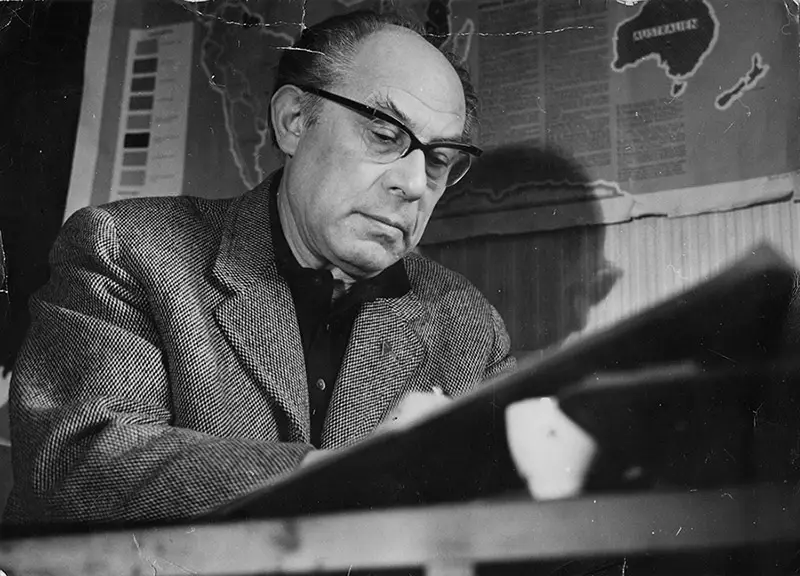
Leo Haas He was a graduate of the Art Academies in Karlsruhe and Berlin. Between 1924 and 1938 he worked as a painter and graphic artist in Vienna and Opava. In 1939 he was arrested for his activities in the Communist Party, deported to the Nisko camp, and then sent to forced labor in Ostrava (Ostrava). In September 1942 he was deported to the Theresienstadt ghetto and assigned to the technical department. There he produced propaganda material for the Germans, while at the same time he secretly photographed life in the ghetto with the help of other artists. In June 1944 the artists were accused of smuggling their works out of the ghetto. Haas was then imprisoned and tortured in the „Little Fortress“. In October 1944, he was deported to Auschwitz and a month later to the Sachsenhausen camp. Here he had to forge Allied banknotes. In February 1945, he was first transported to Mauthausen camp and then to the Ebensee camp, where he experienced liberation. Haas and his wife later adopted the three-year-old son Tommy (Tomáš) of their painter friend Bedřich Fritta, who had been murdered in Auschwitz. After the war, Haas returned to Theresienstadt once again and found almost 400 of his works that he had hidden there.
© Yad Vashem
Wolf H. Wagner: Escaped from Hell. Stations of a Life. A Biography of the Painter and Graphic Artist Leo Haas.
Berlin 1987.
- Sketcher – Witness – Contemporaries. Leo Haas. Documentary film. Book and direction: Jörg d’Bomba. DDR 1970.
- The English-language YouTube video „SS-Dog,“ named after a drawing by Leo Haas and published by Yad Vashem, offers an insight into the daily life in the Theresienstadt ghetto. The drawing shows the deportations of thousands of people, mostly elderly and infirm, to Auschwitz in preparation for the Red Cross visit.
Leo Haas Reported „…On the morning of July 17, 1944, we had to report to the Gestapo office and were immediately taken to the basement. After a long wait, we were ushered into the room of Commandant Rahm. Besides him, the SS officer Moes was present, as well as Günther and Eichmann. We immediately knew that something terrible was about to happen. Eichmann, who opened the interrogation, acted as if he were deeply affected by the slanderous accusations that he had allowed to flourish regarding his „noble ideas“ concerning the Jews.
As evidence, they showed us two to three drawings by each of us four. Günther showed me a sheet on which Jews were looking for potato peelings and asked me, „How did you come up with making such a distorted drawing of reality? Do you really believe that there is hunger in the ghetto? The Red Cross people were by no means of that opinion.“
„There was darkness in the basement when we heard the screeching of the brakes in the evening and immediately afterwards the characteristic roar of the SS who stormed into the basement and pushed us into the covered cargo trucks with fists and kicks. There we found our wives, weeping but happy at our sight. Fritta’s wife was there with the three-year-old son Tomáš (…). My wife Erna, the art dealer Strass and the architect Troller. They brought us to the Little Fortress in Theresienstadt.“
„(...) In the Little Fortress, Fritta and I remained, our two wives and little Fritta. The Gestapo filed charges against us. The charge was „hate propaganda“ and its dissemination abroad. We were sent to Auschwitz.“
„Fritta died there after a week due to blood poisoning. I came to the Sachsenhausen concentration camp until my release in May 1945 (before that I was in Mauthausen and Ebensee). My wife also survived, after spending almost a year in a solitary cell, along with Fritta’s son Tomáš. Hansi, Fritta’s wife, died here as a result of the harsh conditions and we adopted Tomáš.
© Ghetto-Theresienstadt – Lexicon – Leo Haas
Ardi Goldman Kunst-
und Kulturstiftung gGmbH
Uniongelände
Hanauer Landstraße 188, 60314 Frankfurt am Main