Goldmans
PoEthik
Ardi Goldman - Vision and companions
The Art and Resistance Park on the island Union-Gelände is a very personal project for me. For me, it is a place of questions: questions about the world, about history, and about ourselves. It is about human nature, civil courage, and the courage to be ambivalent. Religion gives us rules for how peaceful coexistence can and should work. However, poetry guides me less than doctrine – perhaps something like a poetic ethics can be developed from this. A „PoEthic“.
I love stories. And I love telling them. Union-Gelände There are many of them here – some loud and direct, others more subtle and quiet. The paths we take here are not only physical but also mental. I remember an installation at Expo 02 in Switzerland: a story told from different perspectives, depending on which door one entered the room. This experience has shaped me, because it’s the same here: the perspective determines the view. And each path holds its own story.
Art is part of my way of thinking, my attitude, my everyday life. It breathes, it lives, it contradicts. And it challenges, sometimes radically. The Union area is a vibrant place, a place in constant change. Here, art is not preserved but shown, even with the risk of transgression. That is exactly what makes it valuable. I invite you to stroll through the grounds. Let yourself be guided by the works, challenged, and intrigued. Follow familiar paths or leave them. But be warned: it could change your way of thinking.
The levels of meaning Union-Gelände in art are diverse. What is important to me is that the textualization of art remains vague: it is not about clarity, but rather about complexity. It is about second and third levels of meaning, about what lies between the lines. Of course, personal relationships also play a role; often the artists are companions, people with whom I have conducted intensive conversations that I have discovered or that they have discovered about me. So, each work is not just art in the classical sense, but part of a narrative. Part of my story.
Stefan Strumbel
There Stefan Strumbel is a deep friendship and a special story that connects me to him. I have been collecting his works for a long time. For his Madonna, one of my favorite works on the premises, I had a pedestal made with the inscription La Famiglia, written in the typography of the film The Godfather. I wanted to know how this intervention works. So I went to a few girls near the Maserati workshop and asked them how they found it. They said: „Great, the family!“ The mechanics laughed. They immediately recognized the allusion – Mafia. For many Italians, the Madonna is a saint, the church a central place, on Sundays the whole family goes, the Mafia too. That is the irritation. The paradox. Strumbel himself was not happy about my intervention; for him, art must stand on its own. I see it differently. I didn’t explain the work; I just gave it a „hook“: something that people will be drawn to.
Fabian Thiele & Florian HeINKE
Fabian Thiele
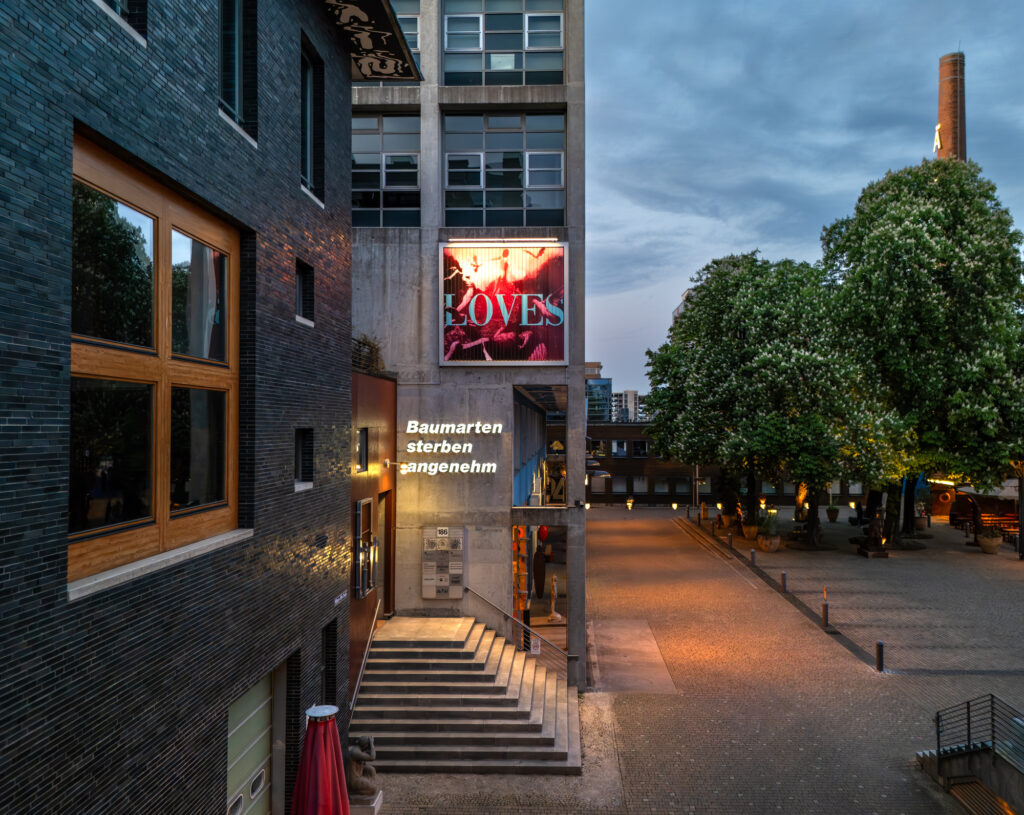
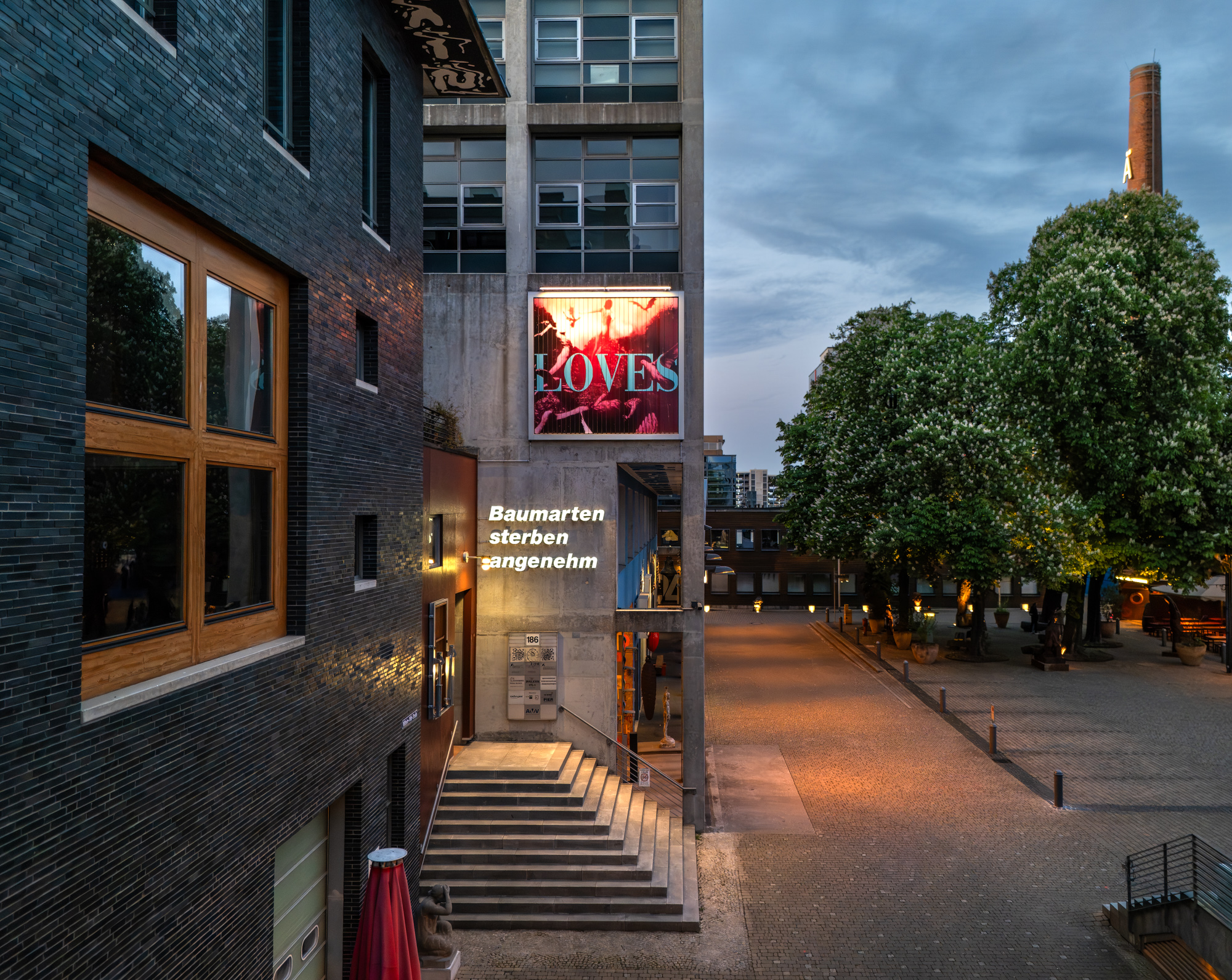
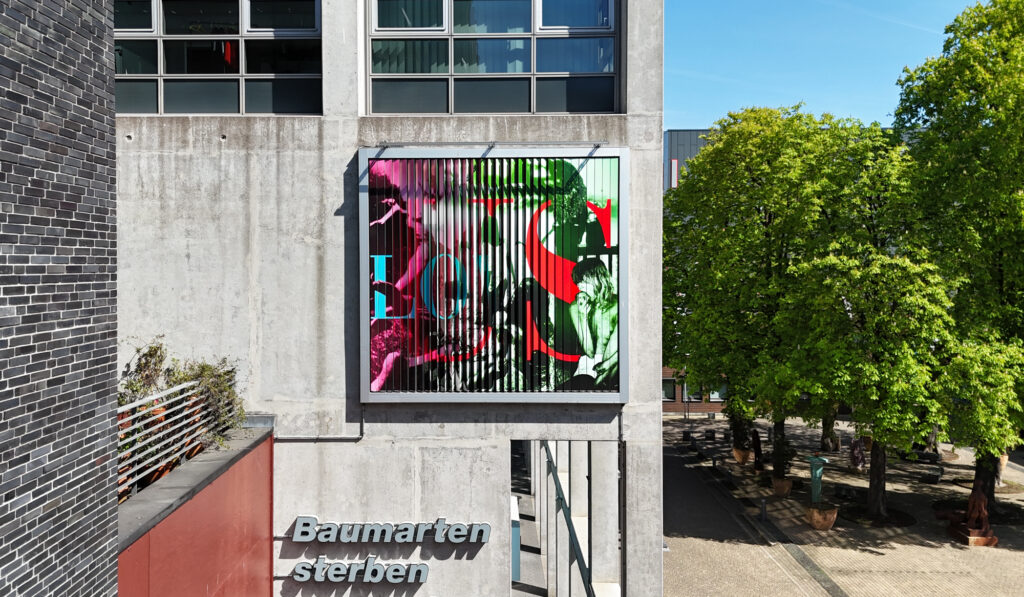
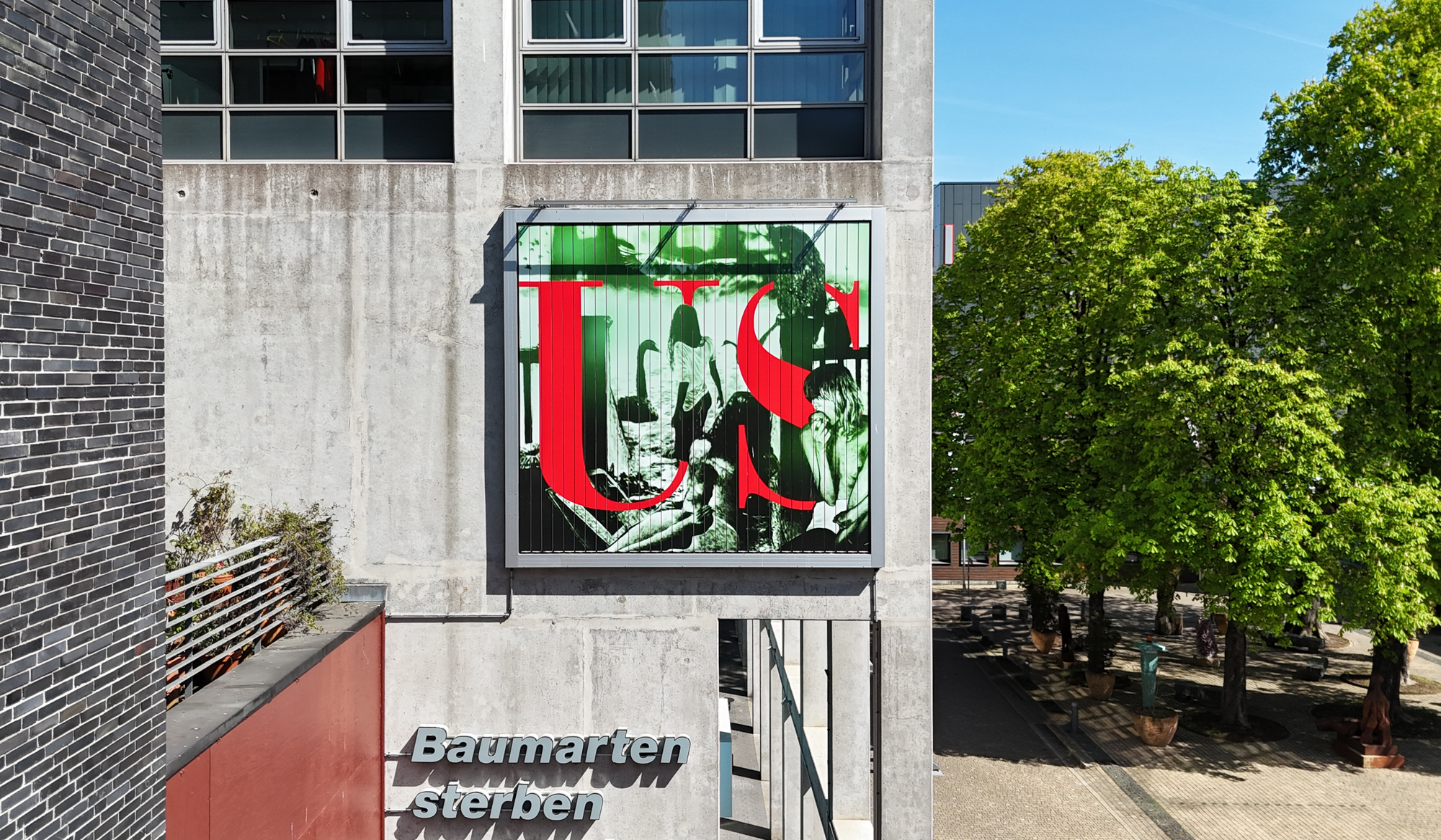
Another work that came to me through a random coincidence is the Baumarten sterben angenehm„light box“ advertisement by Fabian Thiele. The original billboard came from one of my tenants in Hanauer Landstraße 220 – a business consulting firm that wanted to separate itself from its old advertising on the roof. Since I love puns, I asked Fabian to design something new from the existing letters. „Baumarten sterben angenehm“ was the strongest suggestion and the fewest letters had to be exchanged. The effect is enormous – many visitors stop, read, and wonder: Is this meant seriously? Or cynically? The irritation works. Fabian Thiele sammelt Lichtbriefmarken, vor allem klassische Neonanzeigen. For him, they are more than just advertising; they are the heart of urban poetry. In the past, they stood for modernity and progress; today, they are relics. Thiele preserves this aesthetic – not out of nostalgia, but out of conviction. That is what has united us: the fascination with things that tell a story but disappear.
Florian HeINKE
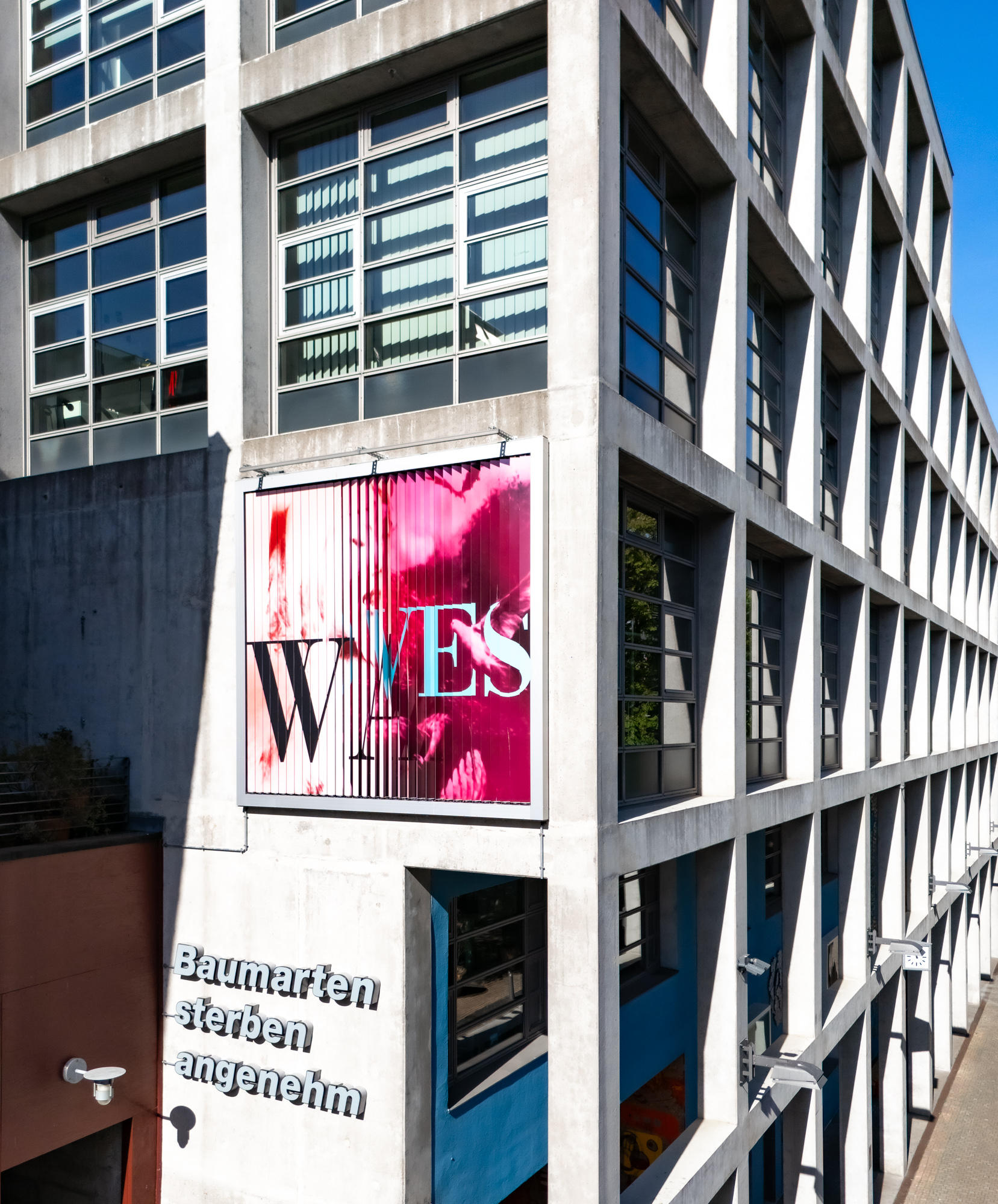
Quite different and yet resonating with this is Florian Heinke. I discovered his works at the Städel – striking, raw, uncompromising. They immediately captured me. His painting reminds me of film posters from old French films, Alain Delon and Romy Schneider. Romy – a single tragedy. Some people just attract misfortune. The Kennedys for example. Superintelligent, privileged and then murdered so early. One wonders: why does God give someone so much and then let them die so early? That is a waste. Heinkes works scream out this despair. I wanted to work with him. As part of a promotional campaign for my shop in Stephansstraße – MA – we developed twelve motifs. The theme was a visual language for a world in turmoil. The strongest motif was: WAR LOVES US. A provocation. A charge. A call to resistance. And in the neighborhood of Thieles work, the work unfolds a double resonance – between humor and abyss, between wordplay and universal sorrow.
Robert Montgomery
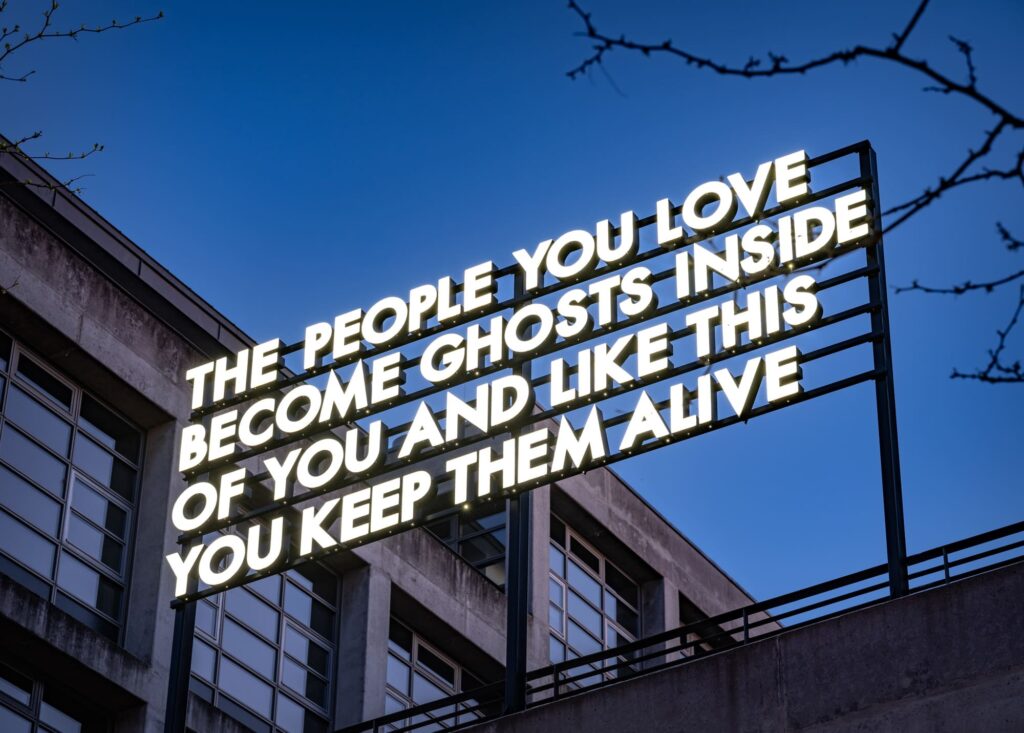
Text-based art, like the one by Türen Robert Montgomery, can open doors. To the outside, but also to the inside. I saw Montgomery’s work for the first time in a catalog in the studio of Lizzy Coleman. They immediately touched me.
Through a friend from London, the contact was made. He wanted me to call him directly – we had a very good conversation. Shortly thereafter, a huge box arrived for me, labeled „For the King Ardi“. However, it wasn’t a finished work; it was an artist’s proof – cables were everywhere. I had it framed in Plexiglas to show it at my club Fortuna Somewhere, and then invited him to Frankfurt. He liked the presentation; I had his okay.
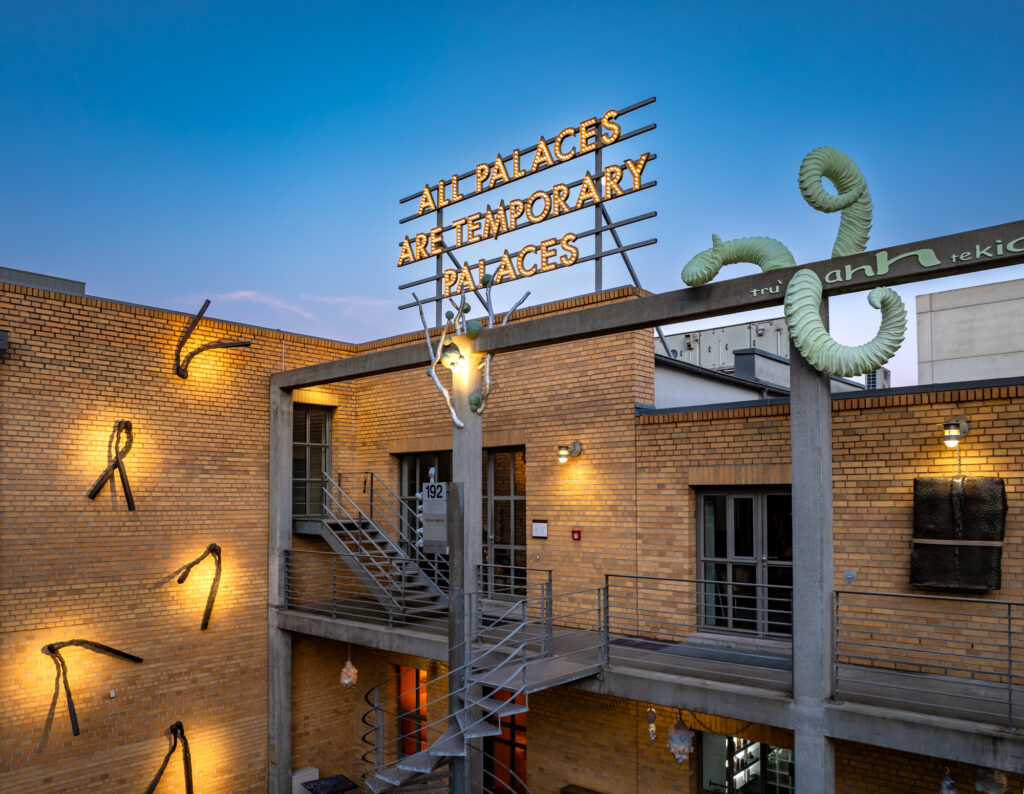
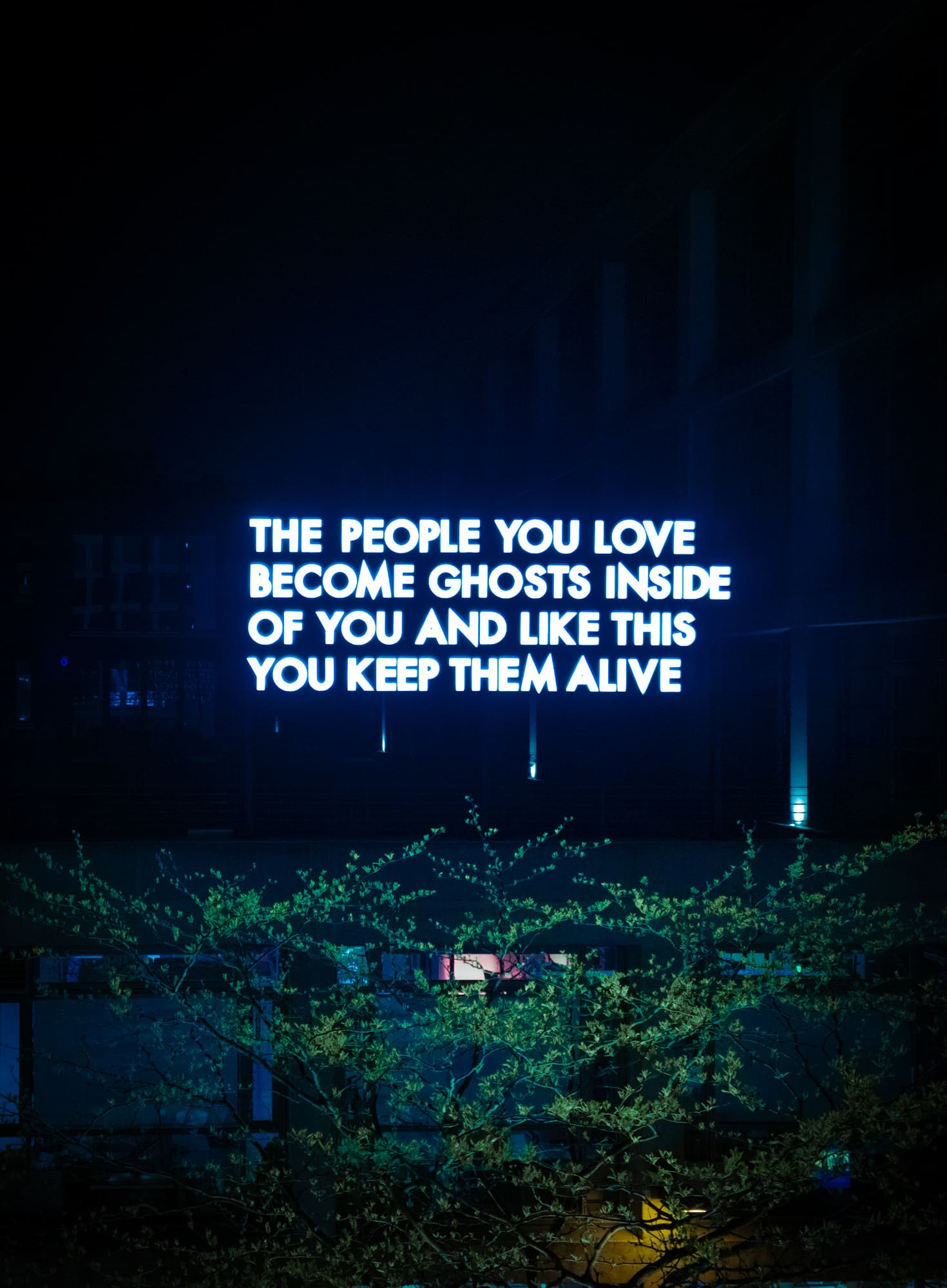
What particularly struck me was his work, which was rejected for the Holocaust Memorial in London because it was „not British enough“. I felt it belonged here on my grounds. Unfortunately, all five editions have already been sold. I nevertheless convinced him – with my vision of the art and resistance park. Today, two of his works stand on the site: „The people you love become ghosts inside of you and this is how you keep them alive“ and „All palaces are temporary palaces“. Both bring a poetic depth to the industrial harshness of the place.

The Mügge brothers
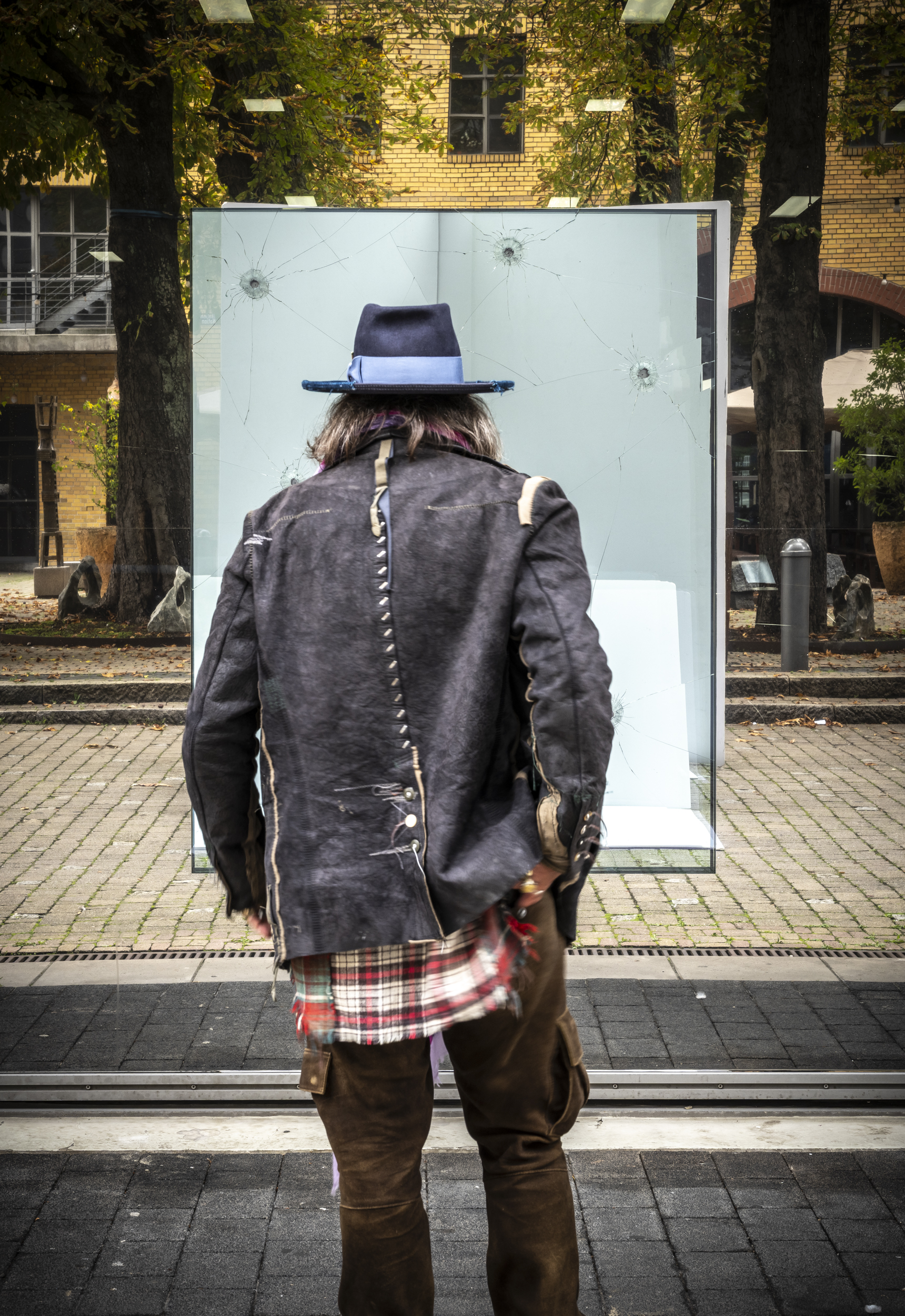
Random encounters enrich my travels and my life in unpredictable ways: the Mügge brothers are such a random find. I was in Munich, wanted to meet friends, and came across an installation in a glass box, a project of the Evangelical Church that was soon to be dismantled. The work kept me occupied. I went back, looked at it more closely, and knew: I want something of the two Union-Gelände. Their work is free, playful, and sometimes ephemeral – like made for the entrance to the underground garage. There, it is exposed to wind and weather.
But that's just the way it is: their art lives by the process, not by preservation.
I am a material person. I like to wander around. Everything I find becomes part of me. In the past I found much more; the 25hours hotels have benefited from that. But today it is becoming more difficult: the good brocanteurs are dying out. And eventually there simply won’t be any more of them. You have to recognize them when they appear and preserve them.
Eva Schwab & Frederik Erichsen
Eva Schwab
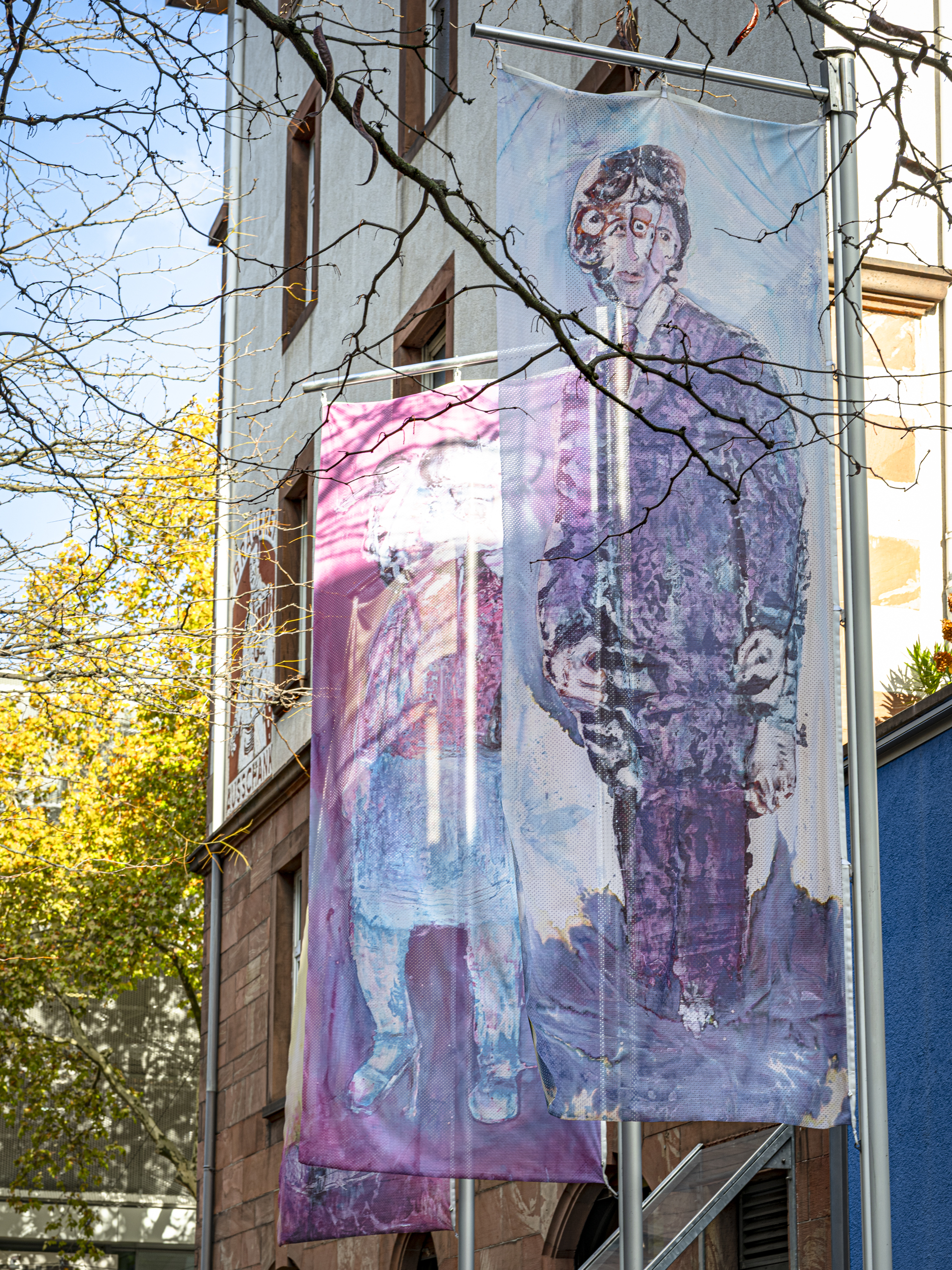
It was the same with Eva Schwabs Flag Works. Their work is called „Transit“, and the title is perfect. Transition. Movement. Uncertainty. Their flags consist of painted canvases, poetic carriers of emotion. I had been following their work for a long time. There is a lot of obsession, poetry, but also pain that isn’t immediately visible. Usually I find: Art doesn’t belong on flags because flags convey clear messages. But Schwab breaks this logic.
Their „flags“ are visual carriers, open and vulnerable. I wanted to know how this works, how visitors react to them. After all, this is my playing field; failure is allowed here; furthermore, everything remains in motion; the flags can temporarily disappear and be replaced by text messages; for the viewers, there is always something new to discover!
Frederik Erichsen
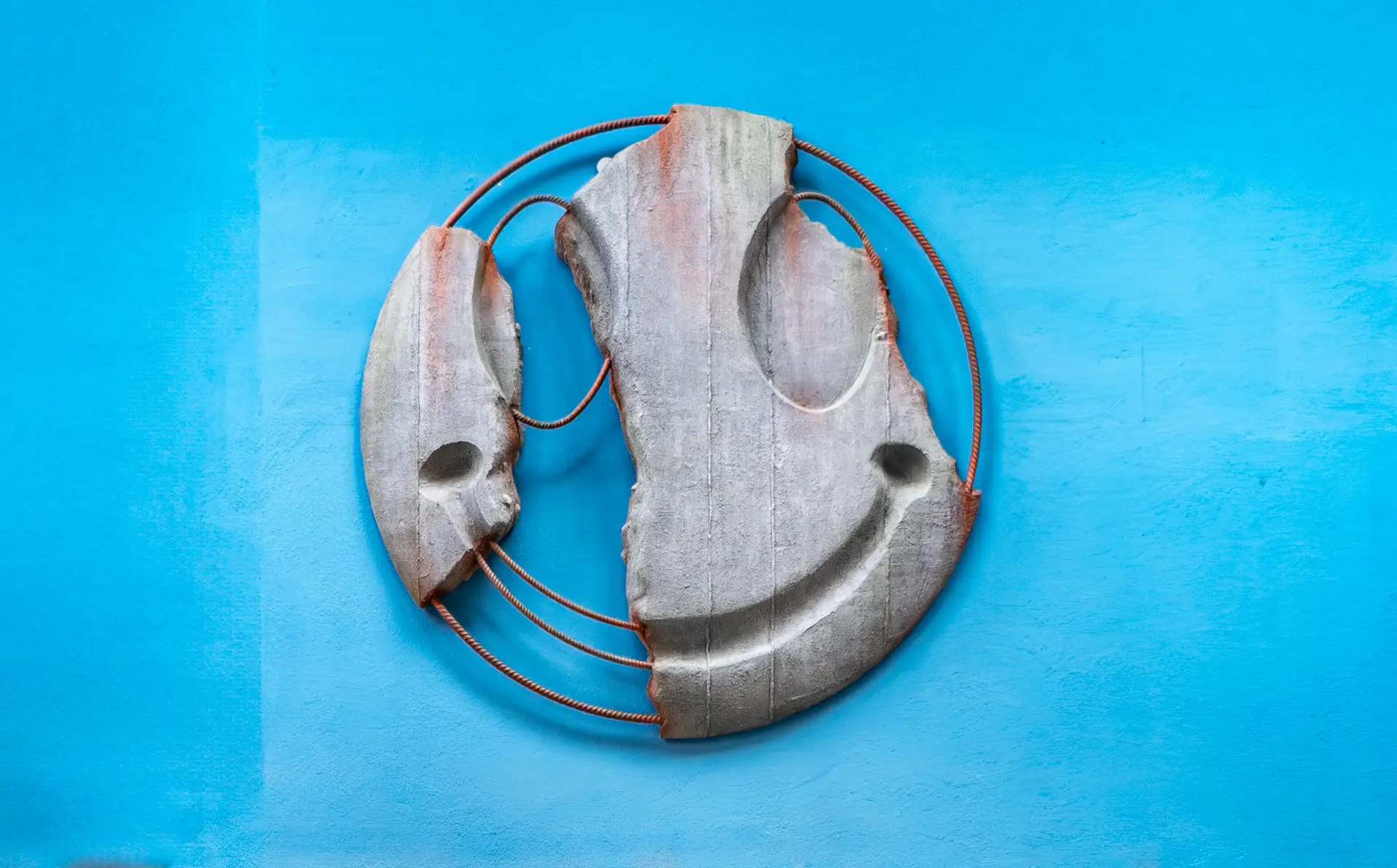
Frederik Erichsen originally designed a monumental object for the club; I didn’t want that. Instead, I chose the smiley that now hangs on the grounds. The smiley was invented by Harvey Ball to cheer up the employees whose mood was low in the basement.
The face with the smile was quickly drawn – a circle, two dots, an arc. The idea was simple, the effect enormous. For me, the smiley is also a reference to Forrest Gump. The scene in which he runs over a loaded truck, his face gets washed off, and the smiley is on the T-shirt he returns, is all I need to show and say „Forrest Gump“ and everyone immediately remembers that moment.
Hagen Bonifer & Rocco und seine Brüder
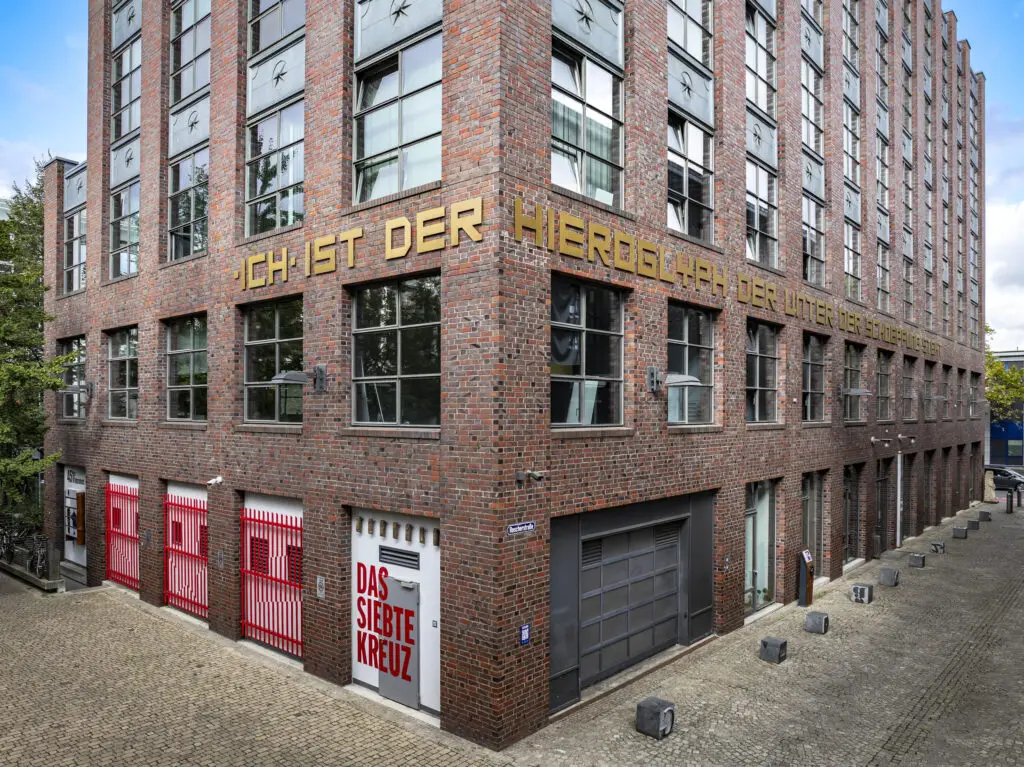
Of course, I cannot mention all the collaborators, artists, and comrades here – that would go beyond the scope. But Hagen Bonifer, whom I met a long time ago and with whom I have already realized three other projects; most recently he decorated the entire facade of my office building on Carl-Benz-Straße with the chants of the „Creatures of the Wind Bride“ in the form of three poems in red, yellow and blue capital letters – and Rocco and his brothers, These are particularly important to me. In both positions, I identify in different ways: With Bonifer, I am fascinated by the work with the written word, which forms the starting point of his artistic process. Word and image complement each other and function as poetic signs. With Rocco and his brothers, however, it is their attitude, their radicalism, that particularly appeals to me.
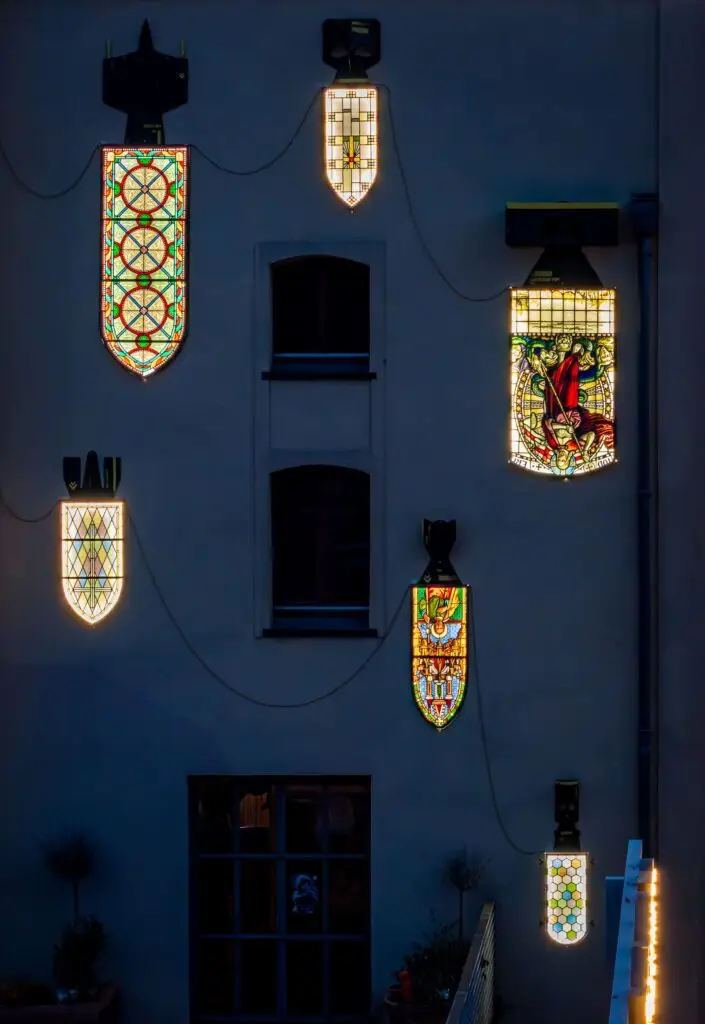
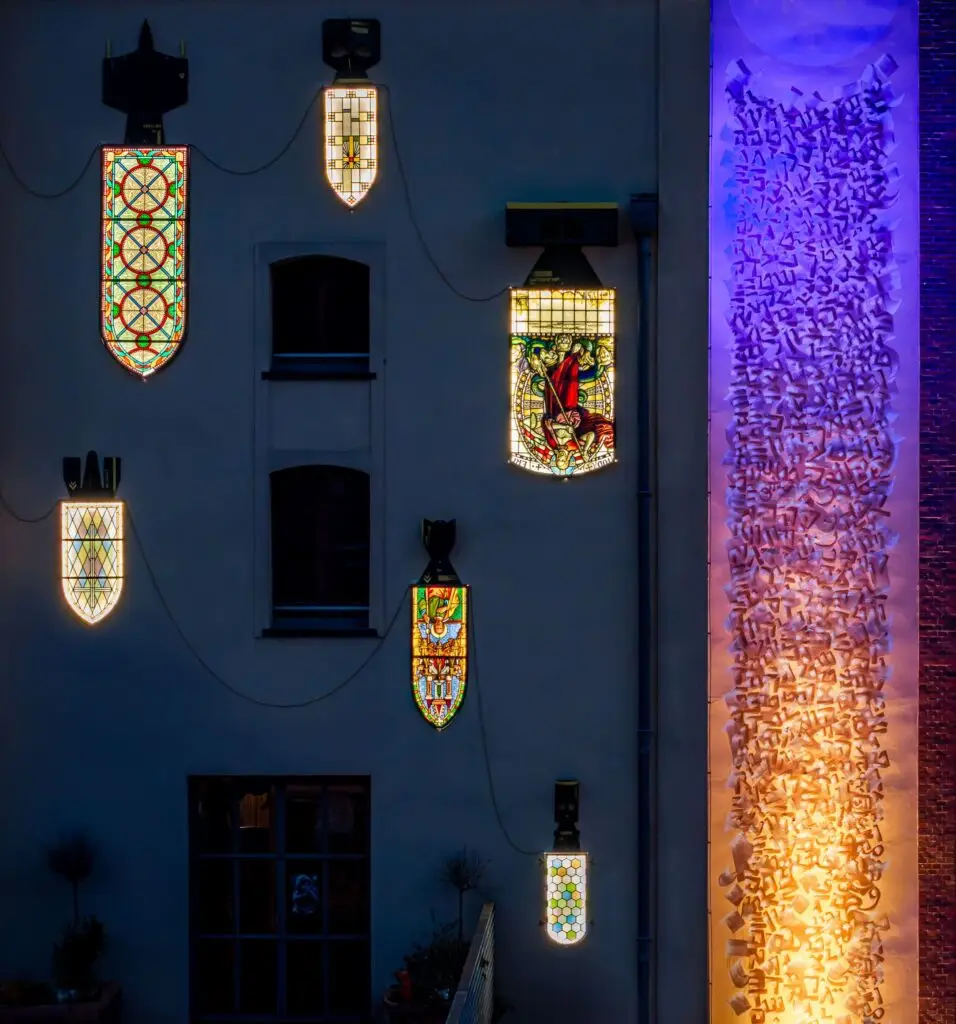
For Union-Gelände this they have created a Installation „11:6“ radical rethinking space. The work plays with the aesthetics of church windows: colorful, filled with light, charged with spiritual meaning. But here they were mounted upside down. The view no longer extends to the sky, but instead plunges towards the earth. The windows seem like falling bombs, supported by attached steering systems. The beauty deceives and reveals a terrifying reversal. From Union-Gelände the sacred becomes the militant. From light becomes destruction. And that is exactly what it is: a space of contrasts, friction, and defiance. And perhaps, with some luck, also a space of awakening.
The missiles or
„Tell me where the flowers are…“
The song „Where Have All The Flowers Gone?“ by Pete Seeger from 1955 became world famous through Marlene Dietrich, who sang it in several languages – including German, English and French, and even on a USO front tour in front of soldiers.
Her interpretation made the ballad a universal appeal for peace, carried by immense tenderness. In her version, which was deeply emotional and compassionate, Dietrich succeeded in establishing the song as a hymn of peace and remembrance over the decades. But other important artists also interpreted the song in their own way. Joan Baez used it as a hymn of the anti-war movement, Dalida gave it a French elegance and melancholy, Nana Mouskouri became a global voice for peace, and Peter, Paul & Mary shaped it with their typical protest folk style. The lines of the song combine world history, memory, and pain and develop a poetic word structure in Goldman’s hands.
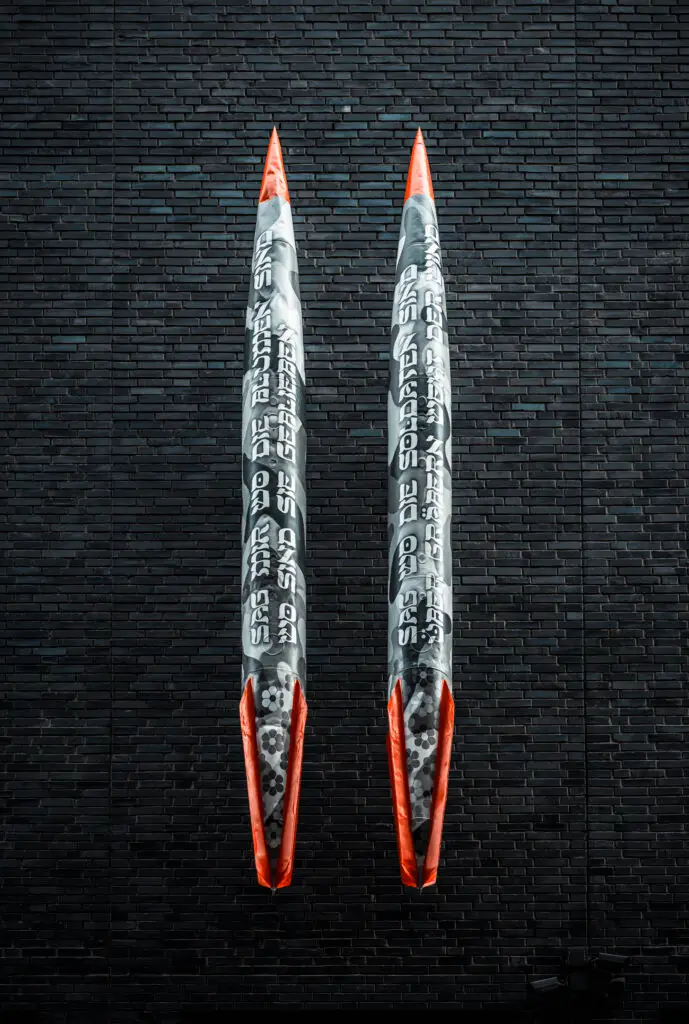
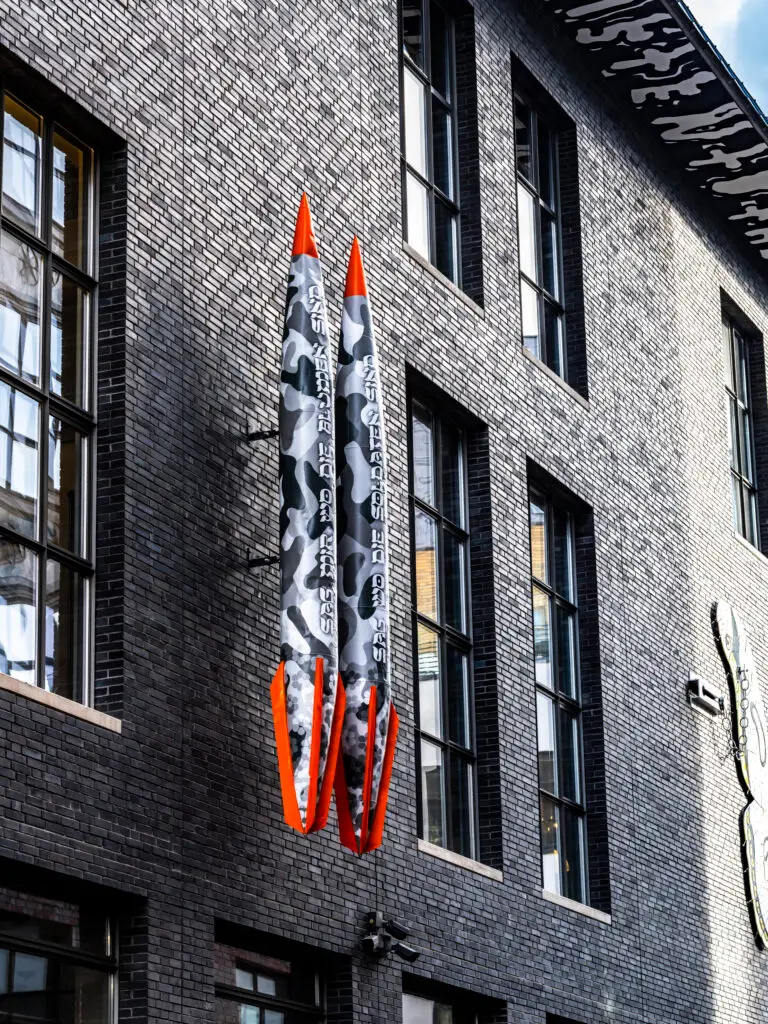
In his installation, the artist uses a strong visual metaphor by placing two vertically mounted rockets on the facade of a black brick building. On their surfaces, central lines of the anti-war anthem „Sag mir, wo die Blumen sind, wo sind sie geblieben?“ and „Sag mir, wo die Soldaten sind, über Gräbern weht der Wind?“ are each emblazoned. These lines are deliberately projected onto objects that stand for destructive power and violence.
The rockets themselves, rigid and silent, form a confrontation between the poetic fragility of the song lyrics and the harsh, destructive reality of war. The work reflects the perpetual cycle of life, loss, and return, as expressed in the ballad, and links these themes with real military violence.
The rockets stand as silent witnesses to a violence that, like a never-ending cycle, leaves its traces in many parts of the world. However, the words etched on their surfaces give them an additional dimension: they become warning signs that point to humanity’s inability to break free from the cycle of war. A tension arises between the buildings, the sky, and the urban space, which inevitably prompts the viewer to reflect on the meaning of the work. The everyday place where this installation can be found stands in stark contrast to the universal message it conveys.
The combination of rockets and a plea for peace makes the viewer pause and think about the inevitability of human suffering. Marlene Dietrich, who became famous in the 1930 film adaptation of Heinrich Mann’s Der blaue Engel as the „brave Lola“, found her second home in the USA. Despite lucrative offers from the German film industry, she remained in Hollywood. In 1939, she became an American citizen and supported the US troops during the Second World War. In 1962, she made the German version of Pete Seeger’s anti-war song famous. The origin of the song is actually a Don Cossak song, which shows that the message is universal and does not fit into national boundaries. „Sag mir, wo die Blumen sind“ is a cyclical narrative that illustrates the consequences of war in recurring questions and answers. It begins with the question of where the flowers have remained, and the answer is that girls picked them. This question about the girls leads to further questions until finally the topic of war and graves is reached. The text version by Pete Seeger and Max Colpet shows an unstoppable chain of events that arise from loss and suffering.
The work brings the anti-war song into the public sphere and directs the gaze upwards – to where both threat and hope can be found. The missiles are frozen testimonies of a violence that leaves its traces worldwide. But the text on them transforms them into warning signs that address the cycle of nature, humans, war, and death described in the ballad. Thus, the work becomes a silent but penetrating question to every viewer: When will we ever understand?
Ardi Goldman Kunst-
und Kulturstiftung gGmbH
Uniongelände
Hanauer Landstraße 188, 60314 Frankfurt am Main