Strumbel Zapfen, 2023
The Art Walk
Zapfen, 2023

Homeland should not be a claim to ownership – but an offer for encounter.
EDUCATION
Grants, awards, recognition
2017 Art in Construction, Sparkasse Offenburg
- Navigate to the location
A Closer Look at the Work
A pivotal point in Strumbel’s oeuvre is the construction of „home,“ a term that imbues emotions, memories, and political interests alike. For the artist, this is not about moralizing or nostalgic retrospectives, but rather about the question of how cultural identity is constructed, narrated, and also instrumentalized.
Traditional symbols from the Black Forest, such as the cuckoo clock, serve as a starting point for an aesthetic transformation in which cultural symbols lose their original meaning and are recontextualized.
In this way he makes visible how much „home“ is an associative and projection space; open to appropriation, exclusion, and the formation of myths. In doing so, he carefully explores the self, the German identity, and the identities of the viewers, provoking irritation, provoking, and sometimes ironically defying expectations, while trying to surprise himself and the viewers.
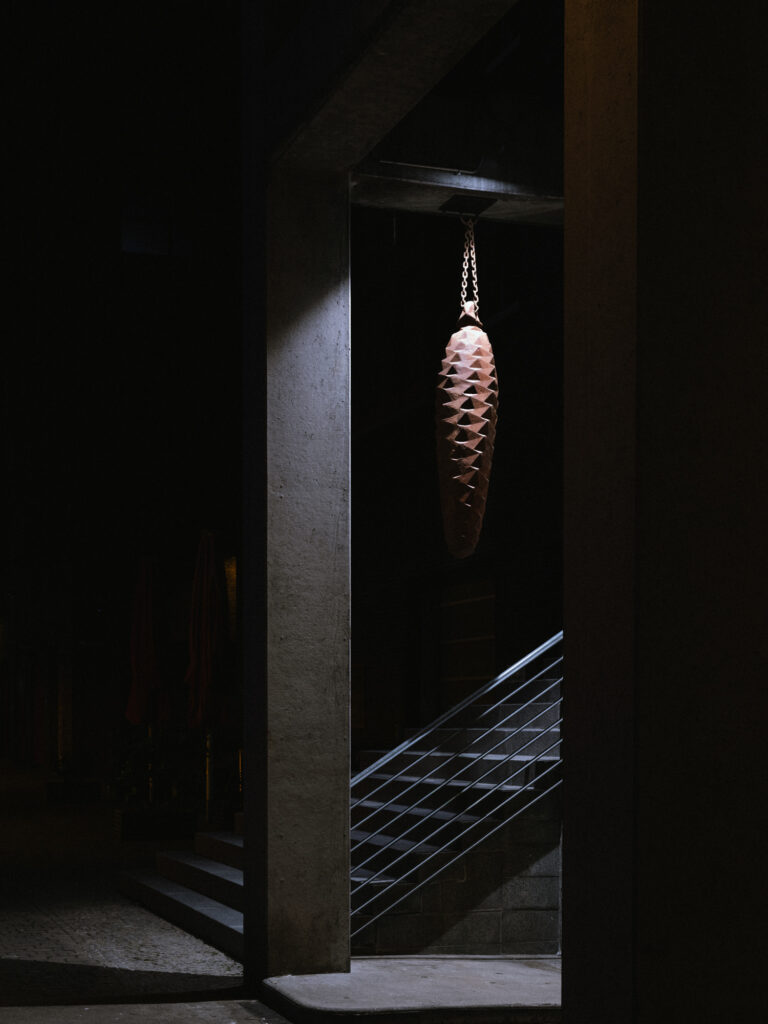
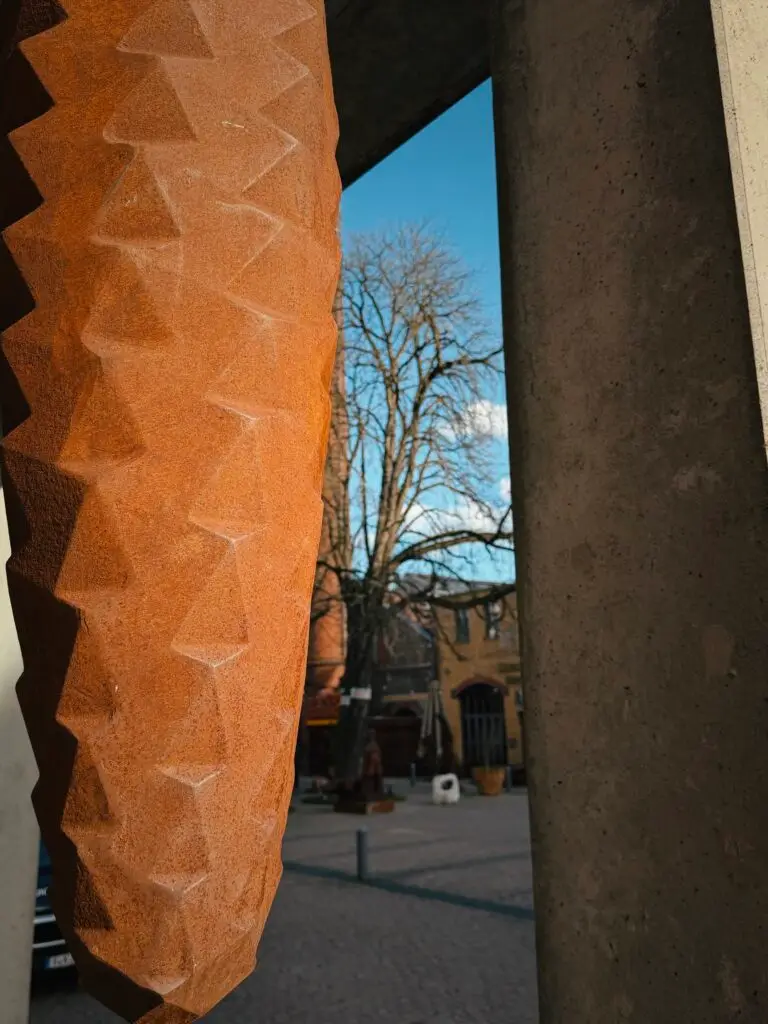
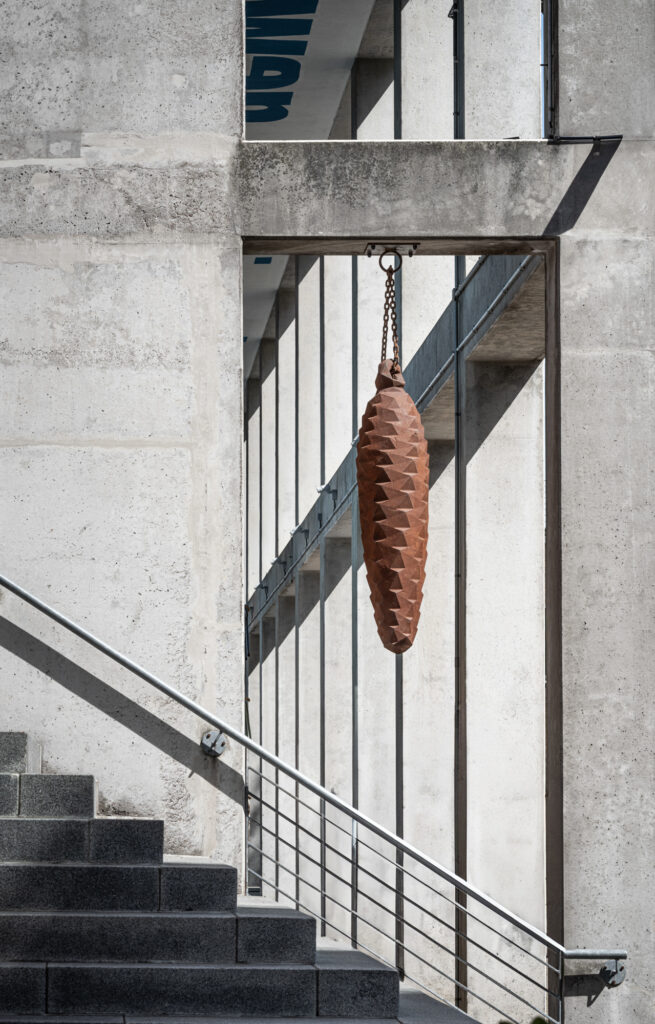
The work too Spikes, The oversized oak acorn made of stainless steel, installed in the Union area at the end of the arcades, refers to familiar elements such as forest and nature, or to what is associated with rural homes. However, Strumbel deliberately subverts this interpretation: the raw material, the industrially manufactured surface, and the deliberate over-size transformation of the entwined tree blossom into a mysterious object. The acorn thus becomes a „mind bomb“ and a spatial experience par excellence.
The title of the work refers to a well-known quote by Albert Einstein: „Imagination is more important than knowledge, because knowledge is limited.“ In this sense, the object serves as a symbol of the human ability to imagine and to move intellectually. Depending on how one views the spire, it can be anything: a quiet pole, a natural sign, a symbol of petty bourgeois thinking, for time (like the chronometer of the Black Forest clock), or a ticking time bomb. What it means depends on one’s own imagination. A possible cultural interpretation can be found in the form of the cuckoo clock, as the epitome of the Black Forest clock. Time measurement as a fundamental parameter regulates human coexistence and controls it. As a progression of the present – described as coming from the past into the future – the reference „the clock is ticking“ reminds us that an undertaking should be carried out in a timely manner to achieve a set goal, or else time will be lost. What follows remains open.
Strumbel does not provide unequivocal answers; instead, he focuses on open interpretations and individual interpretations. The rusty surface reinforces the idea of change and temporality – nothing remains as it was.
The Spikes As a visual stimulus, it creates a space between itself, a threshold between everyday life and reflection. Those who linger here encounter not only a work of art but also an invitation to reflect on origin, memory, belonging, and transience.
About the Artist
The artist Stefan Strumbel (*1979 in Offenburg) discovered his passion for public space and the graffiti scene in the early 1990s. With the beginning of his career as a freelance artist in 2001, „Heimat“ became the leitmotif. He overlays cultural and cultural objects such as cuckoo clocks, wooden masks, and crucifixes with elements of street and pop art and places them in a new, sometimes provocative context. With his transformed objects, Strumbel succeeds in presenting an illusory world that reflects the real injustices of society. Aluminum objects and bronze sculptures mark a new direction in his creative process. Strumbel participated in numerous art-in-architecture projects. For example, he designed the interior of the Catholic church in 2011. Maria, help of the Christians New in Goldscheuer. In addition to numerous solo and group exhibitions, such as „Heimat“ at the Kunstverein Hamburg in 2012 and „Holy Heimat“ at the Baden-Württemberg State Museum in Karlsruhe in 2020, in 2020 he created „Forest Bathing / Biophilia“ at Ruttkowski;68 in Paris and in 2022 „Wonderwalls“ at the NRW Forum in Düsseldorf. For the opera Stuttgart, the artist designed the stage set for the new staging of „La Bohème“ and for the Badische Staatstheater Karlsruhe for the production „Die neuen Todsünden“. His collectors include, for example, Karl Lagerfeld and Hubert Burda.
Photos: © Stefan Gröpper Photography, Marie Ruck
Ardi Goldman Kunst-
und Kulturstiftung gGmbH
Uniongelände
Hanauer Landstraße 188, 60314 Frankfurt am Main