Mügge Sitting. Standing. Shielding. Shouting, 2024
The Art Walk
Sitting. Standing. Shielding. Shouting, 2024
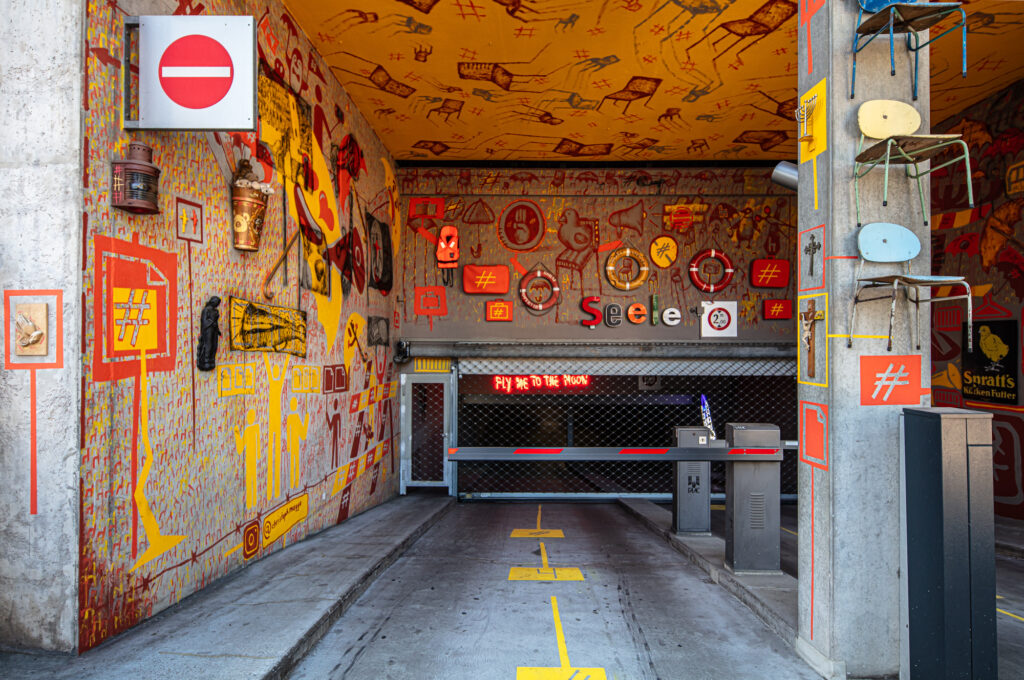
We also usually introduce some materials that we had never used before, such as the windows. Working on spot can be a challenge because we have to leave our comfort zone, but at the same time, it is such a joy to incorporate carefully selected material from a local context and present it in a completely new way.
Sebastian Mügge lives and works in Kristianstad, SWE.
*1981 in Bonn, DE
EDUCATION
Diploma in Painting and Sculpture, Art Academy of Düsseldorf, Düsseldorf
Sebastian Mügge:
BA Umeå Academy of Fine Arts, Stockholm
MFA, Umeå Academy of Fine Arts, Stockholm
Grants, awards, recognition
2024 Artist Residency, Van Gogh AiR, Zundert
2025 Graphic Scholarship, ÖKKV, Örnsköldsvik
Sebastian Mügge:
2023 Lengertz Art Prize, Malmö
2024 IASPIS / Swedish Art Promotion Committee – Scholarship for international cultural exchange, Stockholm
- Navigate to the location
A Closer Look at the Work
Christoph and – Sebastian Mügge Sitting. Standing. Shielding. Shouting.
The installation „Sitting. Standing. Shielding.”. Shouting.“ by Christoph and Sebastian Mügge deals with the subject of resistance in a multifaceted and at the same time playful way.
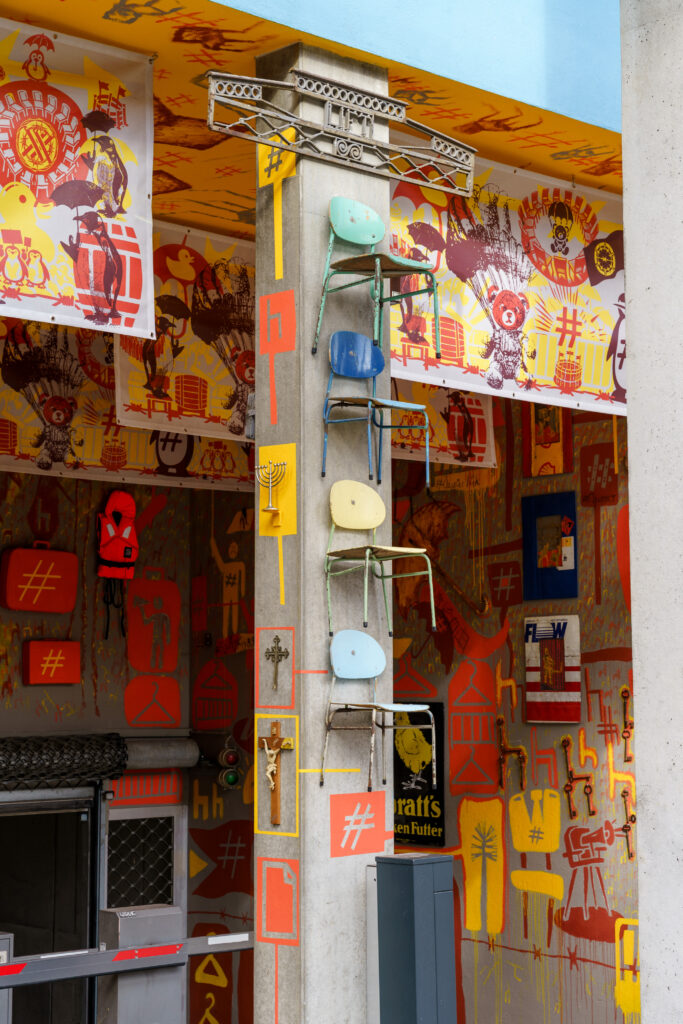
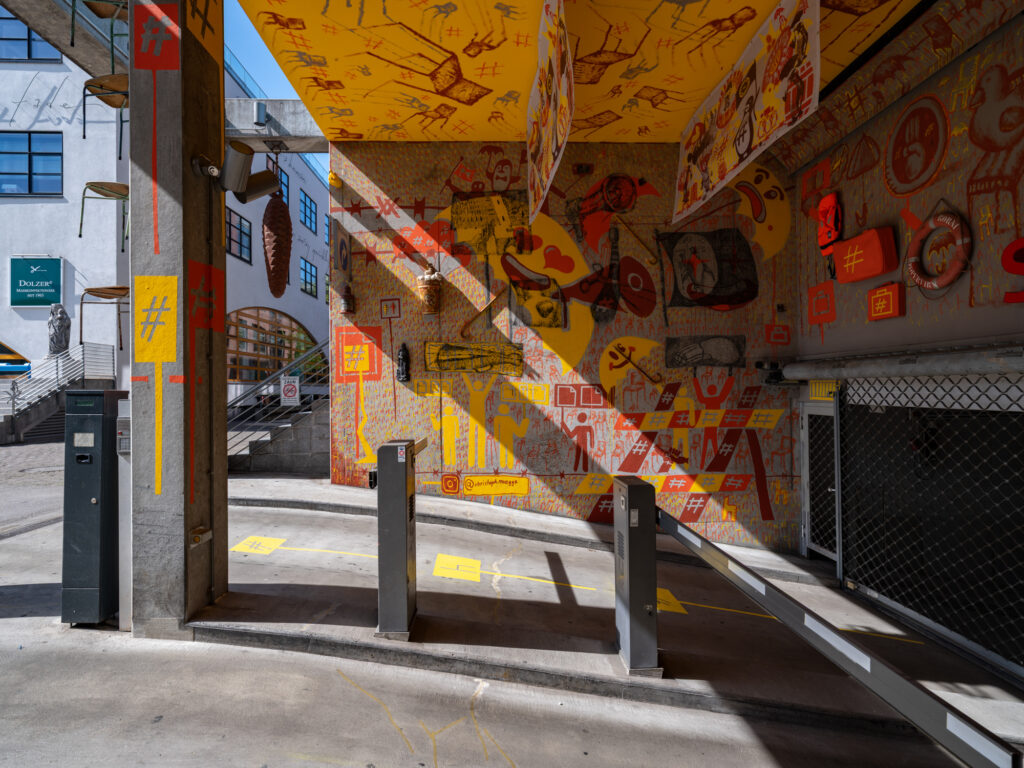
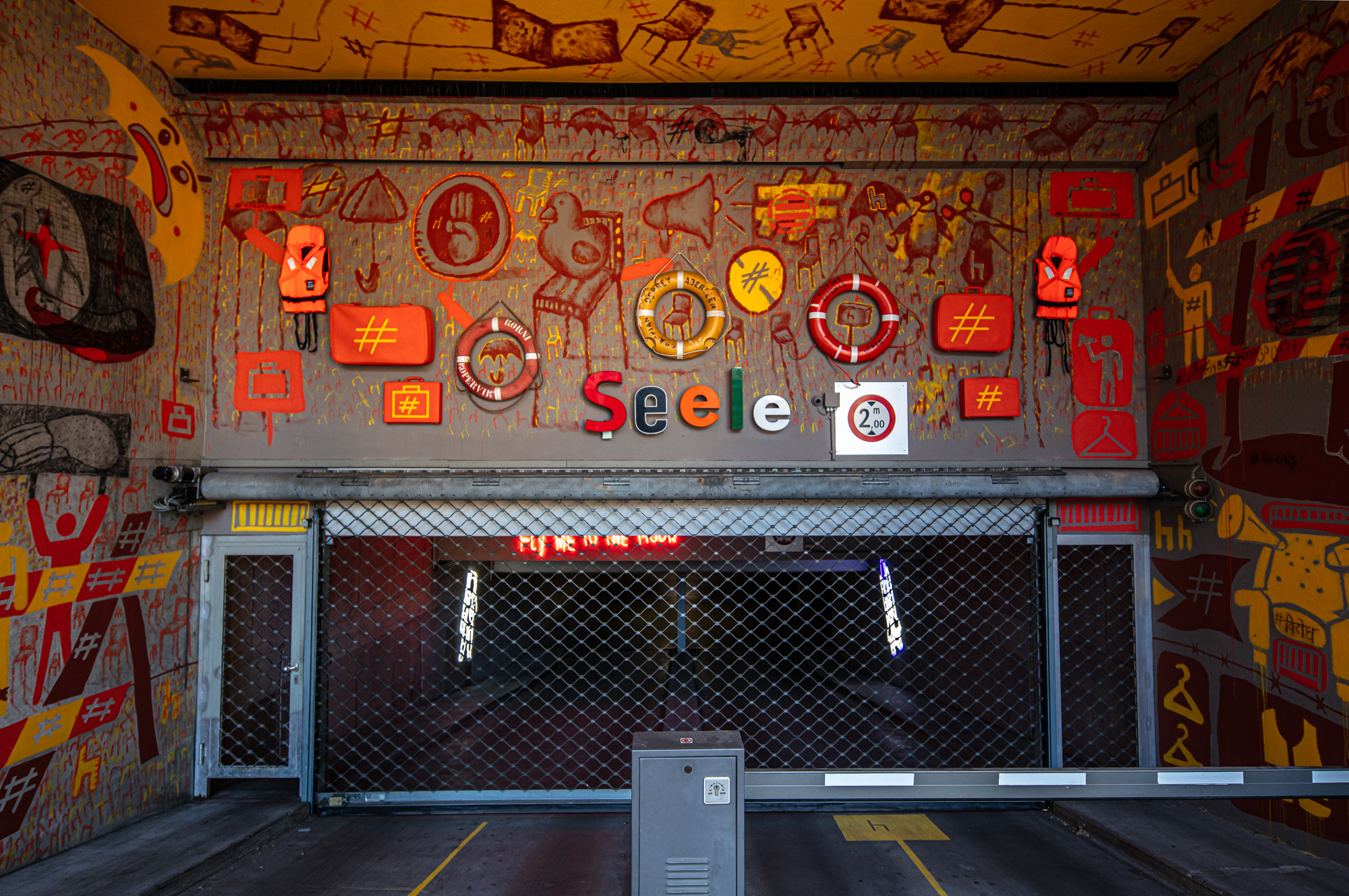
In the entrance of the Union-Gelände underground garage, the artists transform existing barriers into a visual tapestry of murals, drawings, custom-designed banners, and arranged objects. They combine found objects, symbols, and visual references into a sweeping collage that negotiates both political protest forms and societal narratives about power, rebellion, and hope. The work thrives on the interplay of innocuous everyday objects with their loaded meanings in concrete political contexts.
The umbrellas, first seen in the Hong Kong protests in 2019, when millions of people initially took to the streets to oppose a proposed extradition law and later for democracy and against the growing influence of China, have long come to represent more than just protection from water cannons – they have become a symbol of resistance and an expression of the desire for democratic self-determination. Penguins, at first glance cute and unpolitical, in Turkey became a symbol of civil disobedience when during critical protests a television station broadcast a penguin documentary instead of a live broadcast, an absurd act of state-directed censorship. In Chile too, in 2006, protesters took up the penguin motif, wearing it as a costume to demonstrate peacefully for social and economic justice. These moments converge in the installation into a narrative in which irony and seriousness intertwine.
An empty chair points to the absence, the loss of individuals through political repression, their absence in social processes, or their violent disappearance. The rubber duck, which appeared in several protest contexts as an ironic symbol, points to the absurdity of political decisions – and at the same time makes clear that humor can be a subversive tool of resistance. In Belarus, teddy bears were used as carriers of political messages and showed that even seemingly harmless objects can be powerful symbols of protest. A suitcase refers to flight, the moment of packing under coercion or threat. In the installation, it stands for not submitting to a repressive reality; a silent, determined act of self-empowerment.
Lifejackets and life rings are also part of the work. They not only symbolize protection but also community and support in difficult times. In the language of resistance, they stand for networks that carry knowledge that does not perish and hope that asserts itself against oppression. This hope is also reflected in the three fingers that have become a gesture against military coups in Myanmar and Thailand. A visual protest that has long since found a firm place in the global visual language of resistance. Equally powerful as the blank sheets of paper that were held up in demonstrations against one’s own government in Russia and China – where words are forbidden, symbols speak.
However, Christoph and Sebastian Mügges installation does not only think about resistance in the analog world. The murals feature hashtags and hashtag symbols in various languages, many of which have been censored or banned in their countries of origin. By doing so, the artists also address the role of digital spaces, social networks, and online platforms as new arenas of protest. At the same time, they subtly reflect on so-called „Clicktivism,“ the form of digital activism that often limits itself to likes, shares, and symbolic gestures. Humorous details in the installation ironically refer to this sofa activism, without completely disparaging it.
„Sitting. Standing. Shielding. Shouting.“ It is a statement – complex, critical and at the same time humorous. It tells the story of resistance as a multifaceted phenomenon: loud and silent, visible and invisible, analog and digital. The work makes it clear that political protest can be diverse and multifaceted. Sometimes all that is needed is an empty chair, a duck – or even a penguin at the right moment.
In their collaboration, the brothers have been creating site-specific, large-scale installations for years, characterized by a combination of found materials, their own vocabulary of forms, and technical diversity. Their works often emerge in close collaboration, but they also draw on individual perspectives.
The brothers work – together and independently of each other – as sculptors, painters, filmmakers, and installation artists. Natural materials, wood, everyday objects, or waste products are combined in their works to form a complex whole that is never completely decipherable, yet precisely this creates space for their own associations and interpretations. Each of their works is a search for political, personal, or societal stories, for traces that are inscribed in things and can be read anew through artistic manipulation.
Sebastian Mügge In 2006, he moved to Umeå in northern Sweden, the home of his mother, to study art. In his works, he deals with questions of identity, childhood, conflict, guilt, and always seeks to find a connection between different artistic disciplines to create Christoph Mügge a comprehensive, narrative work. After studying painting with Tal R at the Düsseldorf Art Academy and later sculpture with Richard Deacon, he began working with collages in his painting class, which gradually expanded into the space – a path he has continuously developed and which is still evident in his installation works.
About the Artist
The brothers Sebastian (born 1981) and Sebastian (Christoph Mügge born 1983) from Bonn live in Sweden. Since 2017 they have been working as a duo of artists and have exhibited in more than twenty countries, including at the Nordic House (Tórshavn, FO), at the Ostrale Biennale for Contemporary Art in Dresden and at the P8 Gallery (Tel Aviv, IL). Sebastian completed his Master of Fine Arts (M.F.A) at the Umeå Academy of Fine Arts in 2011, while Christoph obtained his Academy of Arts diploma at the Düsseldorf Academy of Arts in 2013. In 2024 they received the two-year work grant from the Swedish Arts Grants Committee. Together, they realize large-scale, site-specific projects that are created through a combination of found materials and their own distinctive style, using a variety of techniques.
Photos: © Stefan Gröpper Photography
Ardi Goldman Kunst-
und Kulturstiftung gGmbH
Uniongelände
Hanauer Landstraße 188, 60314 Frankfurt am Main