Wachholz The Kiss of Heaven, 2024
The Art Walk
The Kiss of Heaven, 2024
144 x 108 x 38 cm | 149 x 127 x 77 cm | 145 x 121 x 91 cm | 127 x 138 x 37 cm | 143 x 57 x 54 cm
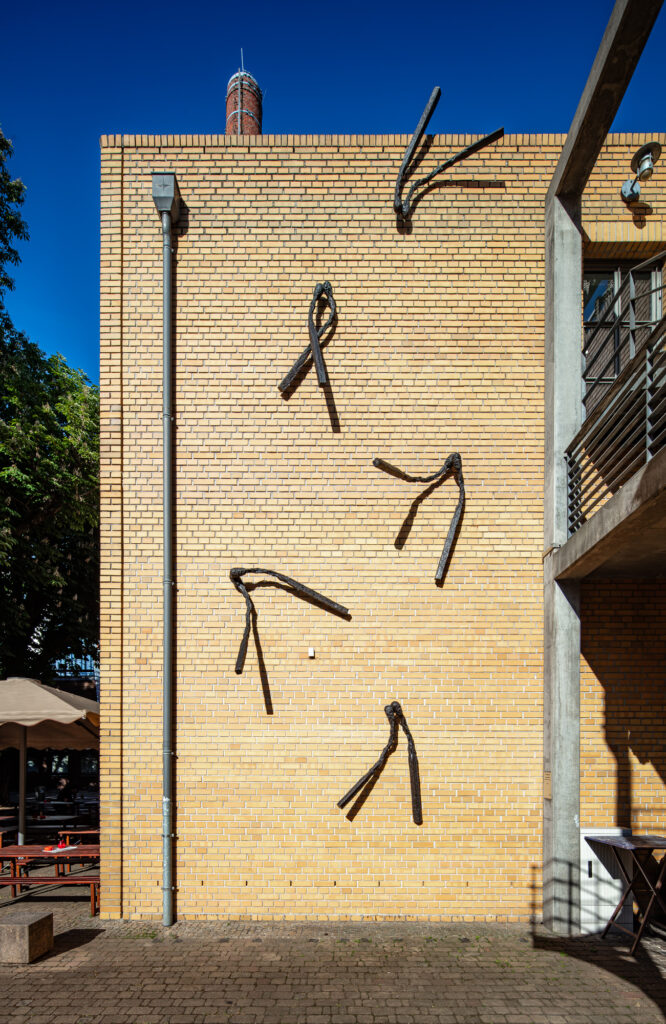
Burning matches almost dance in the breath of a moment, testifying to impermanence. The matchbox is also a medium of transition: between rest and action, potential and release, order and disorder. It contains everything that interests me as an artist—in concentrated form.
EDUCATION
M.A. Freie Kunst Art Academy Düsseldorf, Düsseldorf
Grants, awards, recognition
- Navigate to the location

A Closer Look at the Work
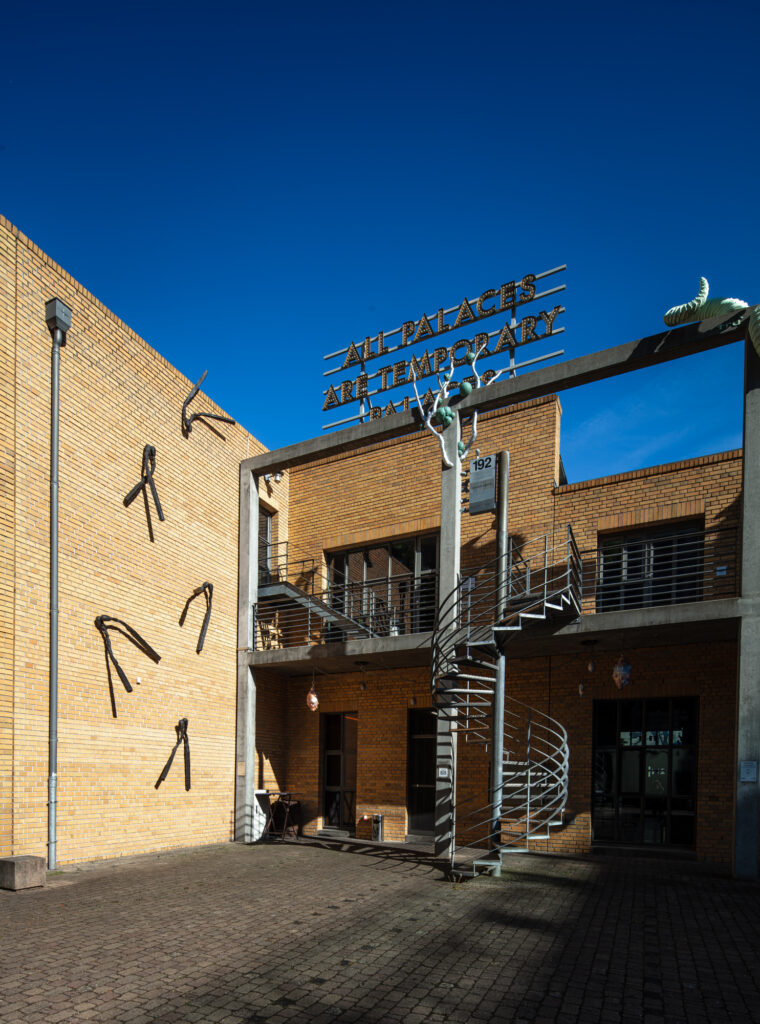
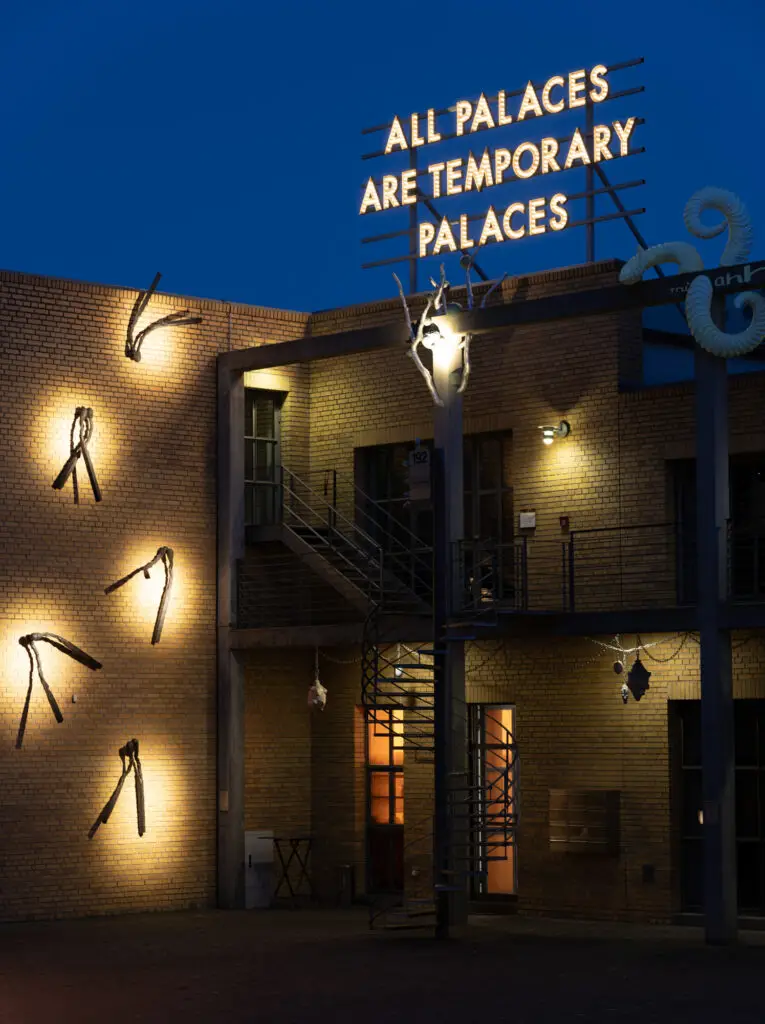
The installation „The Kiss of Heaven“, specially Union-Gelände created for this purpose, continues to address these questions in public space. Five filigree bronze sculptures, abstract pairs of matches, climb up the wall in a loving embrace, kissing the surface. Their seemingly fragile state is deceptive: the movement they embody is a dance, tender, defiant, alive. The kiss becomes the anchor point of the bodies, holding them in balance and simultaneously moving them. As a development of the „Dancing“ series of floor sculptures, these objects also pose the question: what remains when an object is burned, when its function is fulfilled?
The answer remains open. For some, the sculptures dance with a joie de vivre; for others, they evoke the impermanence of life, loss, or the fact that even the ashes can burn again. Love, hope – and not least the unmistakable smell of a matchstick – suffuse the air.
In the metaphor of love, the match is a powerful image: Through friction, chemistry, and physical exertion, it ignites. Wachholz takes this moment seriously. He is interested in the transitions: from the object to the abstraction, from the sign to the feeling, from the object of use to the bearer of meaning. His paintings and sculptures draw upon the visual language of pop culture and transform it into a formally reduced, geometrically structured vocabulary. In doing so, he creates works that are as systematic as they are poetic.
The artistic approach is always conceptually grounded: Wachholz abstracts, reduces, isolates, and layers. He often finds his inspiration in found materials: old matchbooks, advertising graphics, and signs. These become the starting point for condensed compositions that point beyond the present – sometimes humorously, sometimes melancholically, and always multi-layered.
In an expanded sense of meaning, the burned wood can also be read as a carrier of collective experiences. As a fiery metaphor for destruction, memory, but also resilience. In this interpretation, the characters – in the face of history – dance beyond death. Wachholz’ work gently touches upon existential questions: What makes us who we are when our function in the world becomes questionable? What traces do we leave behind?
About the Artist
The artist Thomas Wachholz (*1984 in Cologne) studied with Katharina Grosse and Marcel Odenbach at the Kunstakademie Düsseldorf and graduated as a master student in 2016. His artworks explore associations and semiotic processes inherent in the formal characteristics of everyday objects. Following an atelier scholarship from the Cologne Art Society in 2016, numerous group and solo exhibitions followed, such as „Whiteout“ at Nymphius Projekte in Berlin, „Alcohol Works“ at Roberts & Tilton in Los Angeles, and at the Centre d’art contemporain Meymac in France. His works are currently in collections such as the Deji Art Museum in Nanjing, China, the Marciano Art Foundation in Los Angeles, and the Frost Foundation in Santa Fe, USA.
Thomas Wachholz His artistic practice moves across media, between painting, sculpture and object art. He always pays special attention to the formal and symbolic characteristics of everyday objects. A central motif in his work is the match: small, inconspicuous yet charged with meaning, function and poetic power.
What began as a collecting passion—the preservation of matches and their packaging—developed into a profound artistic reflection on form, memory, and meaning. In his works, he explores the semiotic processes hidden within everyday objects: how does meaning emerge from materiality? And what remains when an object is stripped of its function?
Wachholz’ works always move in a tension between clarity and irritation: the repetition of graphic elements, the reduction to structure, grids and color fields, as well as the conscious omission of narrative details, produce images that oscillate between recognition and abstraction. In his more recent groups of works – such as the large-scale “cigarillos” paintings or bronze sculptures of burned wood – personal memory is combined with collective codes and symbolism.
Photos: © Stefan Gröpper Photography, Marie Ruck
Ardi Goldman Kunst-
und Kulturstiftung gGmbH
Uniongelände
Hanauer Landstraße 188, 60314 Frankfurt am Main