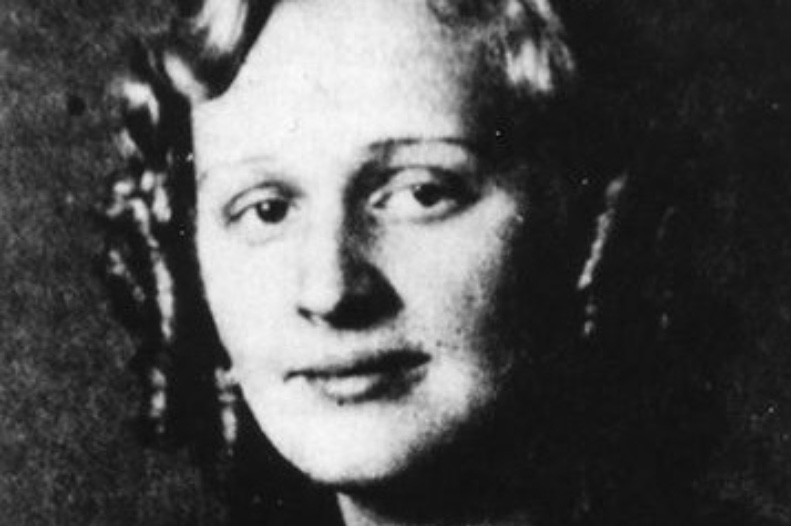
Maraldo Gretel
Hopefuls
–
PORTRAIT
- Navigate to the location
Disturbing forces – they open our eyes.
Personal example of:
–
·
„I’m already getting my head hurt anyway; I don’t want my hair getting damaged by that.“
Gretel Maraldo When her hair was shaved.
Gretel Maraldo She was born on March 28, 1923 in Offenbach. She grew up in modest circumstances and worked after completing elementary school as a seamstress in an Offenbach factory. At the age of 18, she married tile worker Romano Maraldo and became the mother of a son, Tito. When her husband was drafted into the military in April 1942 to serve in Italy, she followed him. However, life in a foreign country without language skills soon led her to return to her family with Tito.
Her grandfather was a Social Democrat and trade unionist, with connections to the military and civil resistance. Resistance ran in the family – and Gretel also did not want to conform. In Offenbach, she joined the „Snake Band“, a group of young people who stood up against the National Socialist ideology.
They rejected assimilation, cherished their own culture, and refused to participate in the Hitler Youth. Their conspicuous behavior and protest were noticed.
In January 1944, Gretel was arrested and taken to the Gestapo prison in Darmstadt. The charge: breach of the peace and membership in a criminal youth gang. She spent six months in custody before being released. The persecution by the Gestapo did not stop and she knew that she had to go underground. With other members of the group, she planned to escape to Switzerland. On January 6, 1945, they set out, but only a few days later a Wehrmacht patrol discovered them in Villingen. They were arrested, handed over to the Gestapo, and Gretel was sent to the Bensheim prison. There she was repeatedly interrogated and mistreated.
As the American troops approached, the Gestapo began to destroy evidence. On March 24, 1945, the guards led the prisoners to Kirchberg near Bensheim. There they were to be shot. On the way there, Gretel saw her last chance. She ran away. Later she was discovered and shot. On March 27, 1945, Bensheim was liberated by the US army. Three days separated Gretel from freedom, four days from her 22nd birthday.
Sources: Angelika Amborn-Morgenstern, Karin Dörr, Anjali Pujari, Christina Uslular-Thiele – about the Women’s Office and City Archive (ed.): Cora Mohr: Gretel Maraldo. In: Frauen prägen Offenbach. Offenbach 2019, p. 154 f.
Studienkreis Deutscher Widerstand (ed.): Nothing was in vain. Women in the resistance against National Socialism. Frankfurt am Main 2016, pp. 32-33.
- Today, a plaque in front of her former home in Offenbach commemorates this event Gretel Maraldo, and a street in Bürgel bears her name.
- On the memorial stone at Kirschberg in Bensheim, she is mentioned along with other victims of Gestapo murders.
In Bensheim, a self-managed youth center has also been named after her.
- Adolf Mirkes, Karl Schild: Testimonies: Offenbach 1933-1945. Persecution and Resistance in the City and District of Offenbach. Cologne 1988.
- Studienkreis Deutscher Widerstand (ed.): Nothing was in vain. Women in the resistance against National Socialism. Frankfurt am Main 2016, pp. 32-33.
- Geschichtswerkstatt Jakob Kindinger e.V. (ed.): 3 Days Shortening Freedom: The Nazi Murders in Kirchberg. Bensheim 2008, pp. 39 ff.
- Angelika Amborn-Morgenstern, Karin Dörr, Anjali Pujari, Christina Uslular-Thiele – about the Women’s Office and City Archive (ed.): Cora Mohr: Gretel Maraldo. In: Frauen prägen Offenbach. Offenbach 2019, p. 154 f.
„I’m already getting my head hurt anyway; I don’t want my hair getting damaged by that.“

Ardi Goldman Kunst-
und Kulturstiftung gGmbH
Uniongelände
Hanauer Landstraße 188, 60314 Frankfurt am Main