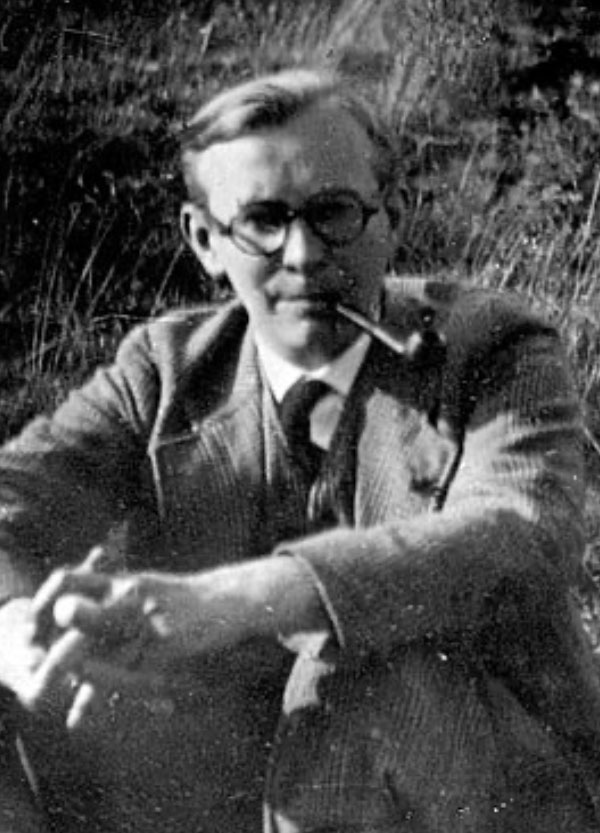
Arvid Harnack He grew up in an academic family and joined a free corps after the war-related emergency graduation in 1919. A Rockefeller scholarship enabled the lawyer from 1926 to 1928 to study in Madison, Wisconsin. There he met his wife Mildred. In 1931 Harnack received his doctorate in Gießen on the pre-Marxist workers’ movement in the USA. With a delegation of the society he co-founded to study the Soviet Russian planned economy (ARPLAN), he traveled to the Soviet Union in the summer of 1932. After 1933, Harnack begins to build a training circle, to which initially young workers, later the writer Adam Kuckhoff, his wife Greta Kuckhoff, temporarily the religious socialist and former Prussian Minister of Culture Adolf Grimme, the entrepreneur Leo Skrzypczynski, and others belong.
Harnack aims to enable the participants to address the political and economic contexts of National Socialism and to prepare them for the time after the fall of the Nazi regime. He expands his contacts with government officials critical of the Nazi regime. In conversations with representatives of the American and Soviet embassies, Harnack provides assessments of the political and economic situation in Germany. Active in the American Ministry of Economic Affairs since 1935, he became a member of the NSDAP in 1937 and advanced to the rank of Oberregierungsrat by 1942.
Since 1940, Harnack has been collaborating with Harro Schulze-Boysen, whom he met in 1935. In early 1941, they inform a member of the Soviet Embassy about the preparations for the military attack on the Soviet Union. In early 1942, Harnack drafts the study „The National Socialist Stage of Monopoly Capital,“ which circulates in resistance circles in Berlin and Hamburg. Harnack is arrested on September 7, 1942, sentenced to death by the Reich War Tribunal on December 19, and murdered on December 22, 1942 in Berlin-Plötzensee by order of Hitler.
© Memorial to the German Resistance
- In 1990, a memorial plaque was unveiled at the home of Mildred Arvid Harnack in Neukölln, Berlin. In 2002, another plaque was unveiled at the birthplace Arvid Harnackin Darmstadt (Hochstraße 68).
- On September 20, 2013, in front of the Genthiner Straße 14 house in Berlin-Tiergarten, in the presence of US Ambassador John B. Emerson, Stolpersteine were placed for Mildred and Arvid Harnack dedicated.
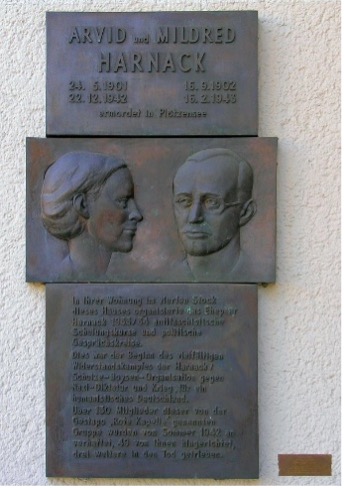
Berlin-Neukölln, Hasenheide 61
Podcast Rote Kapelle. On a walk through Berlin, you will learn the story of the legendary resistance group. A project by Stefan Roloff, produced by the German Resistance Memorial and When 6 is 9 Productions GmbH. In German, English and Spanish.
Excerpt from the last letter Arvid Harnack from him to his wife Mildred
December 14, 1942
On Christmas Eve, we will celebrate together at 7 p.m. in our thoughts.
My dearly beloved heart – if in the past months I have had the strength to remain inwardly calm and composed, and if I face the coming events calmly and composedly, then I owe this above all to the fact that I feel connected to the good and beautiful in this world, and that I have the feeling that the poet Whitman sings to the whole Earth. As far as people are concerned, it was those close to me and especially you who embodied both of these for me.
Despite all the difficulties, I like to look back on my life so far. The lightness outweighed the darkness. And to a large extent, our marriage was the reason for that. Last night I had many of the beautiful moments in our marriage flash before my eyes, and the more I thought about it, the more they became so. It was as if I were looking into a starry sky where the number of stars is constantly growing, the more closely one looks […].“
Source: Memorial to the German Resistance
Letter of farewell from Arvid Harnack him to his family – excerpt
December 22, 1942
My dear ones –
In the coming hours, I am withdrawing from life. I would like to thank you all once again for the love you have shown me, especially in recent times. The thought of it has made everything so much easier for me. I am calm and happy.
I also think of the immense nature with which I feel so connected. This morning I said out loud: „The sun is setting in its old way…“ Above all, however, I think of humanity’s ascent. (…).
It was a special joy to learn that there will be a wedding in the next family in the near future. I would like my wedding ring, which comes from my father, to be given to E. His wedding ring can then be given to L. (…). Tonight I will also be hosting a small pre-Christmas celebration where I will read the Christmas story. (…).
I would have loved to have seen you all again, but unfortunately that is no longer possible. However, my thoughts are with all of you, and I embrace each and every one of you; everyone should feel that, especially Mother.
Let's all be hugged and kissed again
from your Arvid.
You must celebrate Christmas properly. That is my last wish. Then sing: „I pray to the power of love.“
Bundesarchiv 2506/2 – Mildred and – Arvid Harnack Material collection