Kolbe
Hopefuls
–
PORTRAIT
- Navigate to the location
Hope sees the invisible and achieves the inexplicable.
–
·
„Life flies by too quickly. Not a single second returns. Let us strive to provide as many proofs of love as possible.“
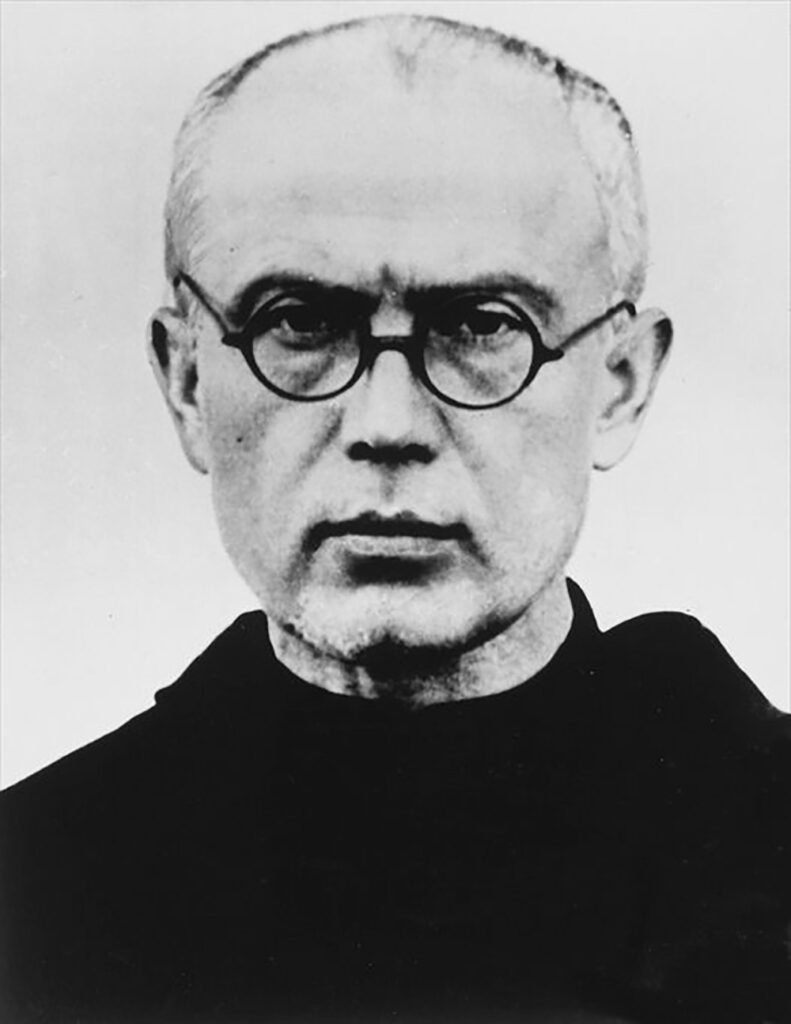
Father Piotr Maximilian Kolbe, a Catholic Franciscan monk from Poland, heads one of the largest monasteries in Europe in Niepokalanów. During the Second World War, he hides thousands of Jewish refugees and other persecuted people there from the Nazis. In 1941, he is arrested and deported to the Auschwitz concentration camp. Despite hunger, violence, and inhumane conditions in the camp, Kolbe remains steadfast in his faith and convictions: a life of love for one’s neighbor – even in the hell of Auschwitz.
When a prisoner manages to escape from Auschwitz, the revenge follows on the morning of July 29, 1941. SS Hauptsturmführer Karl Fritzsch has the prisoners march to the muster point to set an example. He randomly selects ten men who are to die in the hunger bunker. One of them, Franciszek Gajowniczek, breaks down in despair. He has a wife and two children and is begging for his life. No one can help him.
He Maximilian Kolbe quietly steps out of his ranks and asks to be allowed to take Gajowniczek's place. Fritzsch hesitates for a moment, then orders the exchange. Kolbe is locked in a windowless, seven-square-meter bunker with nine other prisoners – without food, water, or light. One by one, they lose their lives. Kolbe prays, offers comfort, and does not give up. After 16 days, Kolbe still lives and three other prisoners do. On August 14, 1941, by order, they are killed with injections of poison.
Franciszek Gajowniczek survived the concentration camp. He was present on October 17, 1971 as Father Maximilian, to whom he owed his life, was beatified by Pope Paul VI and also died on October 10, 1982, at the time of his beatification by Pope John Paul II, at the age of 93.
- Maximilian Kolbe He is still honored worldwide to this day Dietrich Bonhoeffer. One of the most significant awards is his statue at the West Portal of Westminster Abbey in London. There it stands since 1998 – as one of ten martyrs of the 20th century – right next to symbols such as Martin Luther King and .
- Three popes visited his death cell in Auschwitz: John Paul II, Benedict XVI and Francis.
- Kolbe is the patron saint of journalists and radio amateurs. Schools, churches, and institutions in many countries bear his name.
- He remains present in art and literature: Rolf Hochhuth dedicated a central character to him in the drama The deputy. And in 2018, a life-size statue of Kolbe was erected in the Basilica of San Francesco in Ravenna.
- Maximilian Kolbe Works
The Maximilian Kolbe Foundation is a German organization that supports survivors of the Nazi concentration and extermination camps and other victims of violent rule. Founded in 1973, it is named Maximilian Kolbes. „Our most important task is to provide compassionate care and support to survivors of the Nazi terror in their final stages of life,“ says Christoph Kulessa from the Maximilian Kolbe Foundation. - Maximilian Kolbe Foundation
The foundation, founded in 2007 by the bishops of the European Union, promotes reconciliation and peace in Europe and worldwide. It builds on the message of Maximilian Kolbe An, which stands for willingness to sacrifice, humanity, and Christian charity. Through its work, it sets a sign of hope and connects the memory of the past with efforts for a peaceful future.
- Gianfranco Grieco: – Maximilian Kolbe His life. Würzburg 2002.
- Walter Heinrich: The Hour of the Pelican. The Life Story of Maximilian Kolbe. Novel. Zurich 2009.
- André Frossard: Maximilian Kolbe. Don't forget love. A Biography. Illertissen 2015.
Life for life – Maximilian Kolbe Director: Krzysztof Zanussi. Poland/ Germany 1991.
An article by Christine Seuss about – Maximilian Kolbe with original excerpts from the sermon of Pope John Paul II on the beatification on October 10, 1982. Vatican News, August 3, 2018.
„Life flies by too quickly. Not a single second returns. Let us strive to provide as many proofs of love as possible.“
Ardi Goldman Kunst-
und Kulturstiftung gGmbH
Uniongelände
Hanauer Landstraße 188, 60314 Frankfurt am Main