Bauer Fritz
Hopefuls
–
PORTRAIT
- Navigate to the location
We cannot make a heaven out of the earth, but each of us can do something that will not lead to hell.
„Nothing belongs to the past. Everything is still present and can become the future again.“
Fritz Bauer
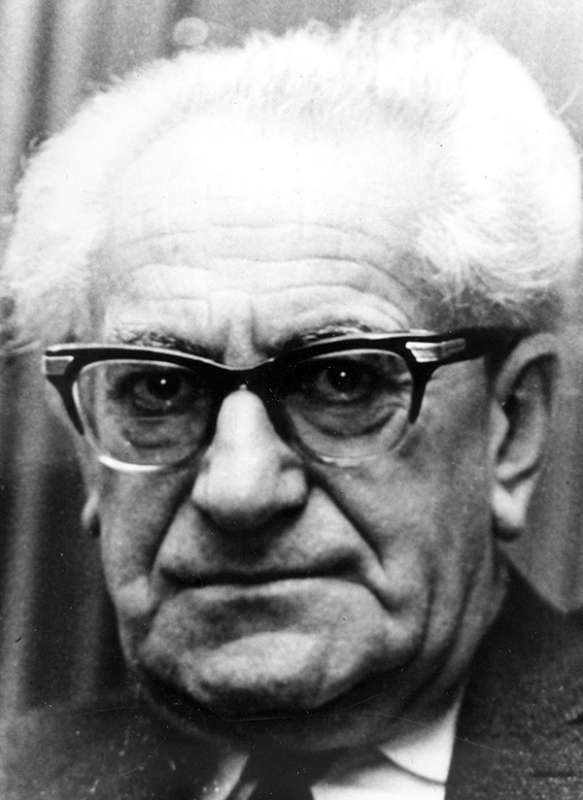
Fritz Bauer In 1930, at the age of just 27, he was appointed the youngest magistrate in Germany in his hometown of Stuttgart. Three years later, as a Jew and SPD member, he was banned from practicing law. After being imprisoned in a concentration camp and exiled to Sweden and Denmark, Bauer returned to the devastated post-war Germany. The jurist wanted to actively participate in building a democratic society. Without the consistent investigation of the Nazi crimes, there could be no new beginning for him. As long as perpetrators remain unpunished, Nazism is also part of the present. As a general prosecutor in Braunschweig and later in Frankfurt, Bauer encountered a judiciary in which many former National Socialists are still active.
One of his first major cases is the prosecution of Otto Ernst Remer in 1952. Remer had publicly defamed the resistance fighters of July 20, 1944 as traitors. Bauer accuses him of malicious slander and defamation of the memory of the deceased. Remer is convicted For the first time, a German court officially recognizes that the resistance against Hitler was legitimate and that the Nazi regime was an unlawful state.
In 1960, Bauer gives the Israeli intelligence agency Mossad the crucial clue to the arrest of Adolf Eichmann. The former SS guard who organized the transport of Jews to the extermination camps lived unmolested in Argentina. Three years later, under Bauer’s leadership, the first Frankfurt Auschwitz trial begins. It is the most significant trial in German post-war history – for the first time, the Holocaust is discussed in a broad public sphere. It is about justice, about the recognition of the suffering, and above all, he hopes that the trials will reveal the mechanisms and mindsets that led to the inhumane German atrocities. Bauer makes even more enemies and narrowly escapes an assassination attempt.
Following the Auschwitz trials, Bauer intends to bring further perpetrators to justice. His focus is on former Nazi judicial officials who were involved in the murder of tens of thousands of so-called „mentally ill“ people. But no trial ever takes place. Bauer is found dead in his bathtub on July 1, 1968.
Fritz Bauer died, as he had lived: alone. „I am abandoned by God and by the world,“ he once wrote to a friend. But he never let Fritz Bauer himself be discouraged. He always continued, and against all odds, he fought for his dream of „freedom, justice and fraternity.“ And with the Auschwitz trial and its numerous implications for legal history, he changed the Federal Republic.
Source: (Ardi Goldman Ed.): Stella Friedrichs: . Fritz Bauer In: PEOPLE LIKE US, p. 111-112. Frankfurt am Main 2013. Lemo-Lebendiges Museum Online.
- Ronen Steinke: Fritz Bauer or Auschwitz in Court. Munich/Zurich 2013.
- Fritz Backhaus, Monika Boll, Raphael Gross (ed.): Fritz Bauer. The Public Prosecutor. Nazi crimes in court. Frankfurt am Main/New York 2014.
- Irmtrud Wojak: Fritz Bauer 1903–1968. A Biography. New edition, Munich 2016.
- Fritz Bauer The roots of fascist and National Socialist behavior. Series of publications by the Fritz Bauer Institute, Volume 34. Hamburg 2016.
- Fritz Bauer War criminals in court. Series: Fritz-Bauer-Schriften; Vol. 1. Göttingen 2026.
- Ronen Steinke: Fritz Bauer or Auschwitz in Court. Munich/Zurich 2013.
- Fritz Backhaus, Monika Boll, Raphael Gross (ed.): The Public Prosecutor Fritz Bauer.
Nazi crimes in court. Frankfurt am Main/New York 2014. - Irmtrud Wojak: Fritz Bauer 1903–1968. A Biography. New edition, Munich 2016.
- Fritz Bauer The roots of fascist and National Socialist behavior. Series of publications by the Fritz Bauer Institute, Volume 34. Hamburg 2016.
- Fritz Bauer War criminals in court. Series: Fritz-Bauer-Schriften; Vol. 1. Göttingen 2026.
- Death in installments. Documentary film. Directed by Ilona Ziok. Germany 2010.
- Fritz Bauer Institut (ed.): Fritz Bauer Conversations, Interviews and Speeches from the Television Archives 1961-1968. Editor: Bettina Schulte Strathaus. Berlin 2014.
- The State versus Fritz Bauer. German feature film. Directed by Lars Kraume. Germany 2015.
- The Investigation. Film about the first Frankfurt Auschwitz trial. Directed by RP Kahl. Germany 2024.
David Johst, commissioned by the Fritz Bauer Institute (ed.): . Fritz Bauer His Life, His Thought, His Work. Sound documents with original recordings from , Fritz Bauer commented and introduced by Burghart Klaußner. Berlin 2017.
Euthanasia crimes
The term used to describe the systematic murder of people with disabilities and mental illnesses during National Socialism. Between 1939 and 1945, over 200,000 people were killed as „not worth living“ as part of the „Action T4“ and subsequent measures – through gassing, medication, or starvation.
„Nothing belongs to the past. Everything is still present and can become the future again.“
Ardi Goldman Kunst-
und Kulturstiftung gGmbH
Uniongelände
Hanauer Landstraße 188, 60314 Frankfurt am Main