Discher Günter
Hopefuls
–
PORTRAIT
- Navigate to the location
Disturbing elements – through them and with them we remain alive.
„Swing music was freedom – boundless freedom.“
Günter Discher
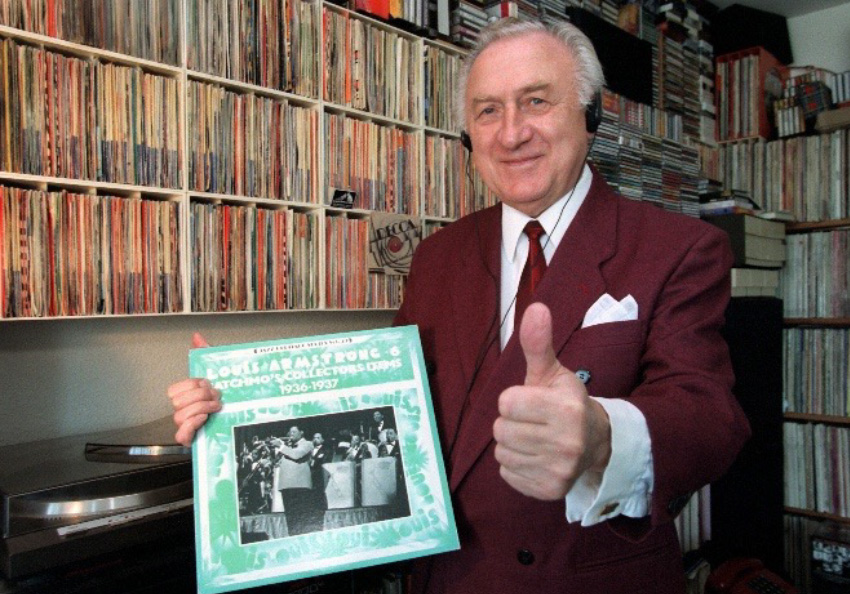
Günter Discher Born in Hamburg-Eimsbüttel, he became fascinated with records at an early age and received a table gramophone as a gift at the age of ten. From 1937 onwards, he began assembling his own record collection, which increasingly consisted of swing and jazz records. His penchant for swing led him to connect with other swing youths. After completing his schooling, he began Günter Discher an apprenticeship in commerce. Since swing is considered undesirable music by the National Socialists, it becomes increasingly difficult to obtain records. However, Günter Discher there are ways to obtain records, and this is how pubs in Hamburg-St. Pauli are supplied with them: A friend of mine, stationed in Denmark, sends the records to Germany. The packages are labeled with „Heerespost” and can thus, without the customs opening them, reach Günter Discher the border. When the requirement to return two old records when buying a new record is imposed in 1941, it is possible to obtain old swing records Günter Discher through negotiations with the dealers. In 1942, he has Günter Discher a collection of about 400 records. He becomes increasingly in the Gestapo’s sights and is arrested on November 1, 1942. However, during the house search, the Gestapo finds no records because the then 17-year-old had hidden them three days earlier. Following a tip-off—neighbors had heard swing music coming from his home—he is arrested again in January 1943 and sent to the Moringen youth concentration camp. In May 1945, he is liberated by allied troops and returns to Hamburg. As a result of his imprisonment, he suffers from chronic health problems and must undergo several operations.
© Memorial to the German Resistance
- Franz Ritter (ed.): Heinrich Himmler and his love of swing: memories and documents. Leipzig 1994.
- Michael Kater: Bold play. Jazz in National Socialism. Munich 1998.
- Foundation Gedenkstätte Deutscher Widerstand (ed.): Resistance of young people.
Thematic catalogue 13. Berlin 2018, 2nd edition. - Cornelia Franz: Swing High. A youth book about the Hamburg swing scene. 2nd edition, Hildesheim 2022.
- The attempt at a touch. Documentary film. Book and direction: Nina Gladitz. Germany 1988.
In the film he talks Günter Discher about his imprisonment. - The Undesirables. Documentary film. Directed by Renate Günther-Greene. Germany 2009. Günter Discher depicts his fate of persecution.
- Hessischer Rundfunk: The Swing Kids: Jazz against Hitler. In: Hessischer Bildungsserver, 23.11.2004.
- Witnesses Günter Discher: Dancing for Freedom. Witness portal, YouTube.
„Swing music was freedom – boundless freedom.“

Ardi Goldman Kunst-
und Kulturstiftung gGmbH
Uniongelände
Hanauer Landstraße 188, 60314 Frankfurt am Main