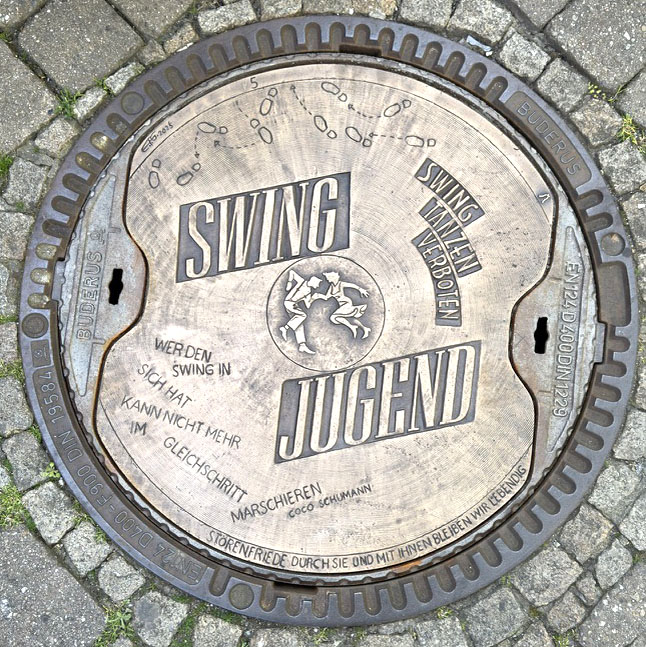
Swing Youth
Hopefuls
Ground relief
- Navigate to the location
Disturbing the peace - through them and with them we remain alive.
„Anyone who has the swing in them can no longer march in step with the beat.“
Coco Schumann
Frankfurt, early 1940s. In a back room on Goetheplatz, a record is playing, then danceable jazz fills the room. Young people begin to dance – enthusiastically, freely, and defiantly. Outside, the war rages on; inside, a different rhythm prevails. Yet what sounds like harmless music is, in truth, a form of resistance.
The National Socialists pursued the Swing with all their might. Its African-American roots, its open style, and its association with „undesirable“ culture did not fit the regime’s worldview. Yet despite prohibitions, repression, and intimidation, a youthful subculture emerged in cities such as Frankfurt, Hamburg, and Berlin: the Swing Youth.
In Frankfurt, they met at the „Harlem Club“, the „O.K. Gang“ or at the „Club der Kameruner“. The youths were not a political movement in the strict sense – but their lifestyle was a silent provocation. They wore long suits, long hair, hats and umbrellas. The girls dressed confidently: short skirts, wide trousers, open gestures. They danced swing – and thereby against the rigid ideal of discipline, community and unison.
Subculture under observation
The regime’s reactions were brutal. Young people like Emil Mangelsdorff Wolfgang Lauinger Günter Discher were arrested, imprisoned, or sent to so-called „youth protection camps.“ They were accused of „improper behavior“ or „behavior that undermines the defense of the state“ – simply because they danced, listened to music, or behaved independently.
A patrol unit of the Hitler Youth, which had infiltrated a dance event, wrote:
„The sight of about 300 people dancing was devastating. Negroes in hysteria during war dances are comparable to what was taking place there.“
This derogatory language shows how much the regime perceived a cultural youth movement as a threat. And how strongly it tried to impose control through coercion.
Swing as resistance
The swing movement was not a uniform movement – but it united a way of life: freedom, individuality, independence. In a time when conformity was demanded, that was already a courageous act.
Many young people paid for it with their freedom. Some with their lives. But the swing survived. After the war, the music returned – and with it the memory of those who remained faithful despite all the danger.
To this day, the swing youth movement stands for the power of culture in resistance – for the courage to be different, and for the belief that music can be more than entertainment: it can be a stance.
- Bernd Polster (ed.): Swing Heil! Jazz in National Socialism. Berlin 1989.
- Franz Ritter (ed.): Heinrich Himmler and his love of swing: memories and documents. Leipzig 1994.
- Sascha Lange: Meuten, Swings & Edelweißpiraten. Youth culture and opposition in National Socialism.
Mainz 2015. - Cornelia Franz: Swing High. A youth book about the Hamburg swing scene. 2nd edition, Hildesheim 2022.
- Swing Kids. Directed by Thomas Carter. USA 1993.
- Schlurf – In a swing against the same pace. Directed by Monica Ladurner. Austria 2007. YouTube.
- Ulrike Knapp: Stories Experienced: Emil Mangelsdorf. Editor: Mark vom Hofe. WDR 5, 14.04.2013.
- Blues Forever – Emil Mangelsdorff Quartet. On Spotify.
„Anyone who has the swing in them can no longer march in step with the beat.“

Ardi Goldman Kunst-
und Kulturstiftung gGmbH
Uniongelände
Hanauer Landstraße 188, 60314 Frankfurt am Main