Trocmé Magda
Hopefuls
–
PORTRAIT
- Navigate to the location
Island of the Fearless
„Certainly, come in—just come in.“
Magda Trocmé When a Jewish refugee knocked at her door in 1941
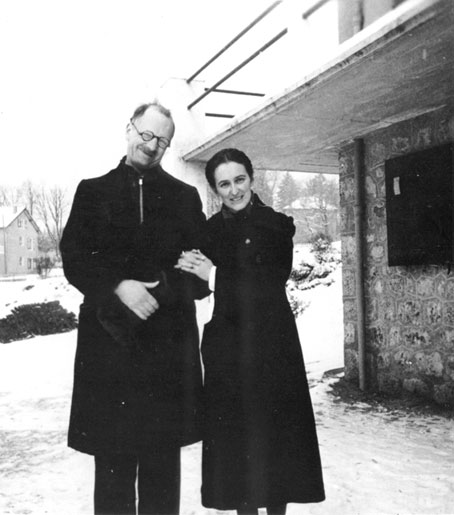
Magda Grilli di Cortona, the daughter of an Italian nobleman and a Russian mother, grew up in an environment characterized by a spirit of freedom. After her mother’s early death, her grandmother Varia Wissotzky became her role model – a strong woman who stood for independence and solidarity with others. In 1925, Magda received a scholarship to attend Columbia University in New York. There she met the French student of theology André Trocmé They both shared the conviction that lived-out love of neighbor is more important than religious dogmas.
After her return to France, André Pastor was engaged in social work in Le Chambon-sur-Lignon. When France was occupied in 1940, André called on his community to provide protection to the persecuted. Under the leadership of André, Magda and the vicar Edouard Theis, a far-reaching network of aid was established that over the years saved the lives of hundreds of refugees. They hid people in houses, farms, schools, and organized false papers and escape routes to Switzerland.
Until 1944, around 5,000 people found refuge in Le Chambon and the surrounding villages. Magda coordinated accommodation and care, while André openly opposed the authorities’ orders. His courage was contagious. The rescue became a communal effort, driven by the awareness that humanity is not negotiable.
The authorities responded with raids and interrogations. In 1943, André Trocmé he was arrested after he refused to hand over Jewish refugees. „I don’t know what a Jew is. I only know people,“ he replied. After his release and hiding, Magda continued to provide help unhindered. She continued to organize accommodations, procure food, and connect with supporters.
The rescue operation in Le Chambon-sur-Lignon was made possible by the moral clarity and determination of Magda and – André Trocmé and by the courage of an entire village community that resisted the inhumanity.
Source: Yad Vashem
Magda Trocmé On May 14, 1984, Yad Vashem honored him as a Righteous Among the Nations.
Albert Camus: The Plague. Novel. Paperback, 2nd edition Berlin 2021.
In 1942, Albert Camus was near Le Chambon for about a year. There he began to write „The Plague“ and incorporate parts of the rescue story into it.
Hanna Schott: Of love and resistance. The life of Magda & André Trocmé. Neufeld, Schwarzenfeld 2011.
André Trocmé Angels don't sing for money. And other stories about Christmas. Neufeld, Schwarzenfeld 2010.
The Story of André and Magda Trocmé. Righteous Among the Nations. Yad Vashem, 2022. YouTube. In English.
Heroes who did not want to be heroes. Documentary film by Marc Villiger and Tom Sommer, Switzerland 2015.
The memorial in Chambon-sur-Lignon. The memorial, opened in 2013, tells the story of refuge and resistance in Chambon-sur-Lignon and the surrounding villages during the Second World War.
Rhoda G. Lewin: Oral history interview with Magda Trocme. October 2, 1984.
United States Holocaust Memorial Council, online. In English.
„Certainly, come in—just come in.“
Ardi Goldman Kunst-
und Kulturstiftung gGmbH
Uniongelände
Hanauer Landstraße 188, 60314 Frankfurt am Main