Trocmé André
Hopefuls
–
PORTRAIT
- Navigate to the location
Island of the Fearless
I don't know any Jews; I only know people.
André Trocmé
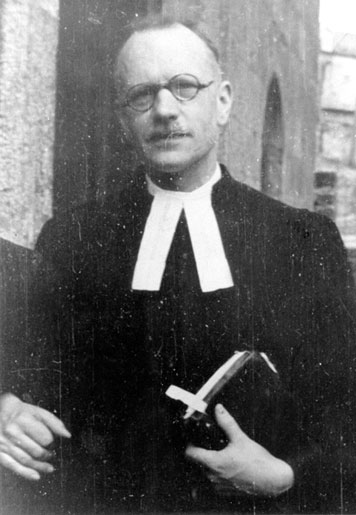
André Trocmé He was born in 1901 as the son of a Protestant textile industrialist in St. Quentin. His mother came from an old family of pastors. From an early age, the values of his family influenced him: responsibility, conscience, and a deep sense of justice.
After his schooling, Trocmé studied evangelical theology. In Paris and later in New York, he deepened his understanding of the gospel message – but for him, it was never just words. He believed in a faith that must be made visible in life.
In 1934 he took up his first parish position in Le Chambon-sur-Lignon, in a remote place in the south of France. The people there were descendants of Huguenots, themselves the offspring of persecuted people who had never betrayed their faith. It was a community that knew what it meant to live in resistance – even without weapons.
When the German Wehrmacht occupied France and the Vichy regime collaborated with the Nazis, life in Le Chambon-sur-Lignon changed abruptly in June 1940. Amidst these upheavals, the pastor André Trocmé approaches his congregation. Quietly but firmly, he urges them to offer refuge to the persecuted—people who have no other place to go.
The residents of the small Protestant village and the surrounding villages in southeastern France listen – and act. They open their doors, share food, and save lives. Between December 1940 and September 1944, about 5,000 people find refuge here – including up to 3,500 Jews who flee from the Vichy authorities and the German occupation.
Under the leadership of Pastor Trocmé, his wife Magda And a far-reaching network of support is created for the young priest Edouard Theis. Refugees are hidden in private homes, on farms, in hotels and schools. Passports are forged, food cards are procured, and escape routes to Switzerland are organized. The rescue is not a secret undertaking by a few, but an act of shared solidarity.
The authorities become suspicious, observe, search, and interrogate. But Trocmé remains steadfast. When he is asked to deliver Jewish refugees, he replies: „These people have come here to find help and refuge. I am their shepherd. A shepherd does not abandon his flock. I do not know what a Jew is. I only know people.“ In February 1943, Trocmé is arrested and held for five weeks in the Saint-Paul d’Eyjeaux camp. He refuses to make a loyalty declaration to the regime and goes underground after his release.
Even in Trocmés absence, the help does not stop. The community stands together and continues to take in refugees. It Magda Trocmé organizes accommodations, supplies food, and connects supporters. Their commitment shapes the spirit of the resistance as much as that of their husband.
This extraordinary rescue work in Le Chambon-sur-Lignon is primarily thanks to Pastor André Trocmé and his wife Magda. With moral clarity, unwavering faith, and deep compassion, Trocmé shaped the thinking and actions of his congregation. He not only provided guidance to the people there, but also gave them the courage to confront inhumanity with determination and resolve.
Source: Yad Vashem
On January 5, 1971, Pastor André Trocmé and May 14, 1984 Magda Trocmé Honored by Yad Vashem as a Righteous Among the Nations.
Hanna Schott: Of love and resistance. The life of Magda & André Trocmé. Neufeld, Schwarzenfeld 2011.
André Trocmé Angels don't sing for money. And other stories about Christmas. Neufeld, Schwarzenfeld 2010.
Albert Camus: The Plague. Novel. Paperback, 2nd edition Berlin 2021.
In 1942, Albert Camus was near Le Chambon for about a year. There he began to write „The Plague“ and incorporate parts of the rescue story into it.
The Story of André and Magda Trocmé. Righteous Among the Nations. Yad Vashem, 2022. YouTube. In English.
Heroes who did not want to be heroes. Documentary film by Marc Villiger and Tom Sommer, Switzerland 2015.
The memorial in Chambon-sur-Lignon. The memorial, opened in 2013, tells the story of refuge and resistance in Chambon-sur-Lignon and the surrounding villages during the Second World War.
I don't know any Jews; I only know people.
Ardi Goldman Kunst-
und Kulturstiftung gGmbH
Uniongelände
Hanauer Landstraße 188, 60314 Frankfurt am Main