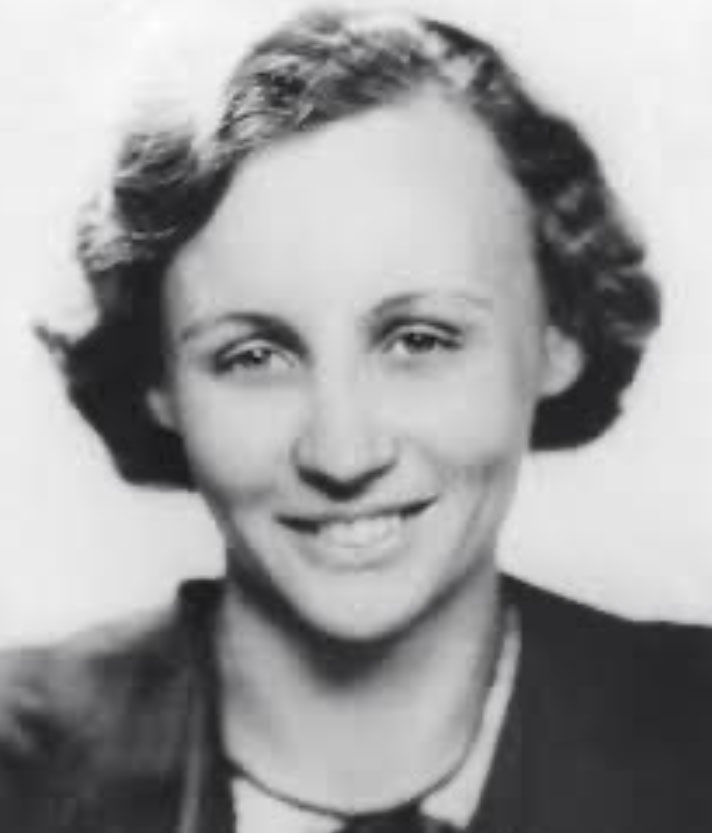
The youth worker Rose Ennenbach belongs to the Socialist Workers' Youth. In 1931/32 she married the merchant teacher Friedrich Heinemann and in 1932 they had their daughter Marianne.
After her mother, who was politically active on behalf of the Social Democrats, imposed a measure of political control on her, she was dismissed from an internship and temporarily became unemployed. Subsequently, she moved to Chemnitz, worked at the Wanderer typewriter factory and took care of the family’s finances alone.
In 1939 she married the interpreter working at the Foreign Office Bodo Schlösinger and moved to Berlin. There she worked as chief secretary at the Continental Office Machine Company. She, her husband and their mother participated in a discussion and training group about Arvid and . In Mildred Harnack 1942 she sent Rose Schlösinger Hans Coppi several coded radio messages from Arvid Arvid Harnack that could not be sent.
Rose Schlösinger She was arrested on September 18, Rose Schlösinger 1942. The Reichskriegsgericht sentenced her to death on January 20, 1943 for „espionage.” She was murdered in Berlin-Plötzensee on August 5, 1943.
In Rose Schlösingers birth city Frankfurt am Main, a bronze memorial plaque with his portrait was installed in 1994 at his former residence at Münzenbergstraße 4. On September 1, 2018, Stolpersteine for him and Bodo Schlösinger were placed in front of his former home at Sebastianstraße 42 in Berlin-Mitte.
© Memorial to the German Resistance.
Women in Resistance 1933-1945.
- In his novella of 1963, Rolf Hochhuth recalled: The Berlin Antigone to his mother-in-law Rose Schlösinger.
- On October 5, 1993, in Frankfurt, in the presence of her daughter Marianne Sideri-Heinemann, the ‚Initiative 9th November‘ planted an Rose Schlösinger apple tree in the ‚Allee der Erkenntnis‘ at the Synagogue Memorial Site in the Friedberger Anlage.
- Since 1994, a small park on the Bornheimer Hill in Frankfurt has been named after him. Rose-Schlösinger plant. In the same year, a memorial plaque was installed at her birthplace at Münzenberger Straße 4.
- On September 1, 2018, in front of the site of their residential house that was destroyed in the war in the Sebastianstraße 42 In Berlin-Mitte, Stolpersteine were erected in memory of Rose and Bodo Schlösinger placed. In 2021, a room in the Bürgerhaus Frankfurt-Bornheim was named after her.
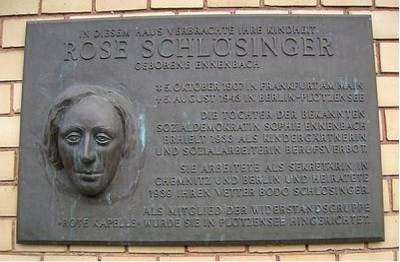
On October 5, 1994, the city of Frankfurt am Main installed a memorial plaque with a portrait relief for the resistance fighter at the former home of the Münzenberger family, Münzenberger Straße 4.
Podcast Rote Kapelle. On a walk through Berlin, you will learn the story of the legendary resistance group. A project by Stefan Roloff, produced by the German Resistance Memorial and When 6 is 9 Productions GmbH. In German, English and Spanish.
Letter of Rose Schlösinger farewell from her mother on August 5, 1943
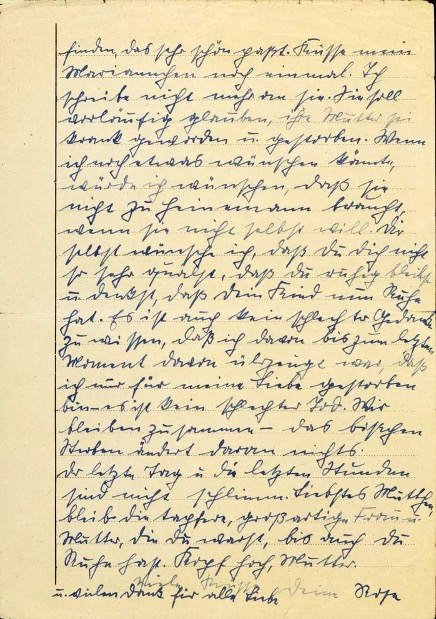
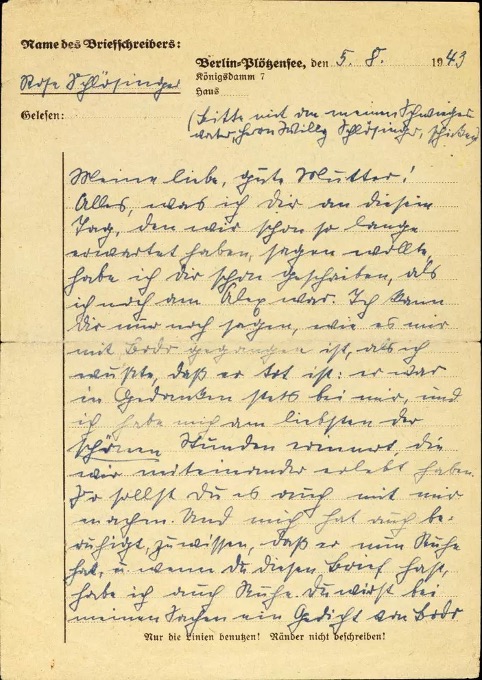
© Private property/ Reproduction German Resistance Memorial
It was Rose’s last wish that her then eleven-year-old daughter Marianne should not know anything about her mother’s terrible death. It was only on her 18th birthday that Marianne received her mother’s farewell letter. In it she wrote to her daughter:
And then you are supposed to have children – when you are holding your first child in your arms, maybe you will then think of me, that it was also a highlight of my life when I first held you in my arms and then think of the evenings when we talked in bed about the many important things in life – I tried to answer your questions – and think of the beautiful three weeks at the seaside – the sunrise, and when we ran barefoot from Bansin to Ückeritz on the beach… – we had so much good together, my child, and you are supposed to experience all that again and even more. And one more thing I want to tell you: If you have to die, every bad word you have ever said to a loved one hurts; if you could live on, you would remember it and control yourself much better.
Perhaps you can remember that – you make life easier for yourself and others, and later even for your own death. And be happy as often as you can – every day is precious; it’s a shame to waste a single minute of sadness. My love for you will accompany you for a lifetime. – I kiss you – … Farewell my love – until the last moment, think of you with the utmost love, your Mama
Rose Schlösinger Letter of farewell. In: Helmut Gollwitzer, Kathe Kuhn, Reinhold Schneider (ed.): You haunted me at night. Letters of farewell and records of the resistance 1933–1945. Munich 1954.