Which one
Hopefuls
–
PORTRAIT
- Navigate to the location
No one wanted to hear about civic courage and courage.
–
·
„After having taken cognizance of the oath from the ceremony on February 8, 1935, as an evangelical Christian I have the following to say about its content: The oath requires unconditional loyalty and obedience to the leader… For the evangelical Christian, however, every obligation… is limited and conditional by the commandment of God as attested to in the Holy Scriptures.“
Heinz Welke February 13, 1935
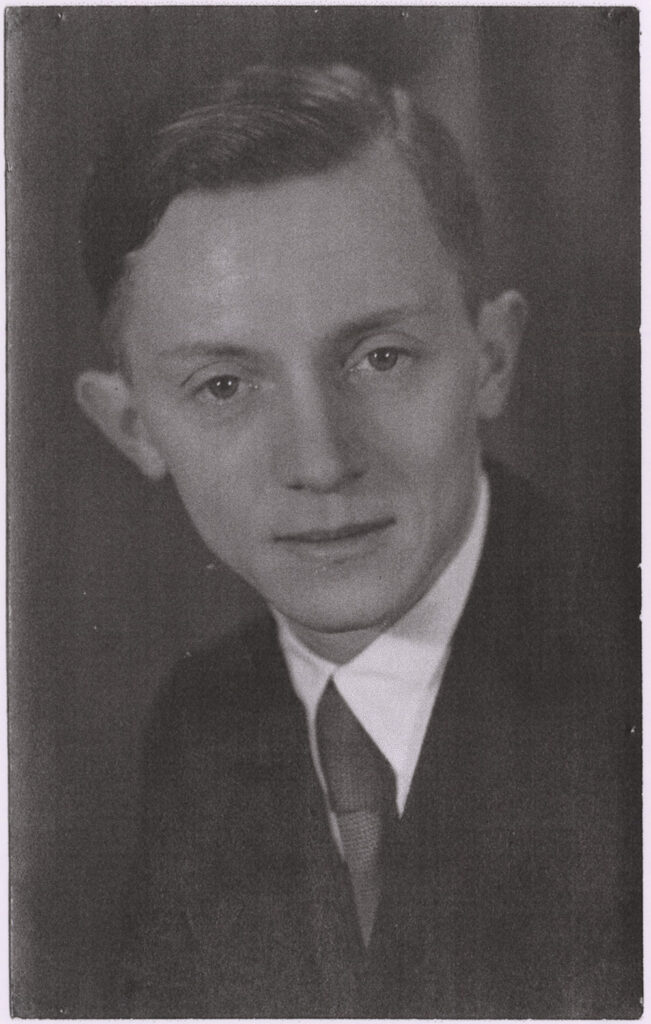
In 1934, Heinz Heinrich Welke, a young evangelical theologian, joined the Confessing Church and therefore repeatedly encountered difficulties with the church leadership and the Nazi regime.
When he stayed in Davos for health reasons in 1940, he established contact with the refugee department of the World Council of Churches in Geneva. In 1942, he took over the representation of Pastor Otto Fricke at the Dreifaltigkeitskirche in Frankfurt-Bockenheim. Through Fricke, he also met his friend, the doctor Fritz Kahl Dr. Welke. A relationship of trust developed between them. Together with Kahl and his wife Margarete, Welke sought for Frankfurt Jews ways to flee to Switzerland. When Eva Müller and Robert Eisenstädt managed to escape, they turned to Geneva, where they received support thanks to Welke’s recommendation. Presumably, the pastor could still help other persecuted people in this way.
© Memorial to the Silent Heroes
Many of Pfarrer Welke’s rescue operations remain shrouded in darkness – written records have been destroyed, and few of his contemporaries are still alive. His children also learned only fragments; his wife Annemarie, who died in 2004, was never thoroughly questioned. His son Dieter, born in 1946, is convinced that so far only the „tip of the iceberg“ has been known – for example, Welke’s contacts with French Protestant protesters during the resistance are hardly explored. He would have wished for a „more conversational father“.
The father’s silence and „dull sadness“ are attributed to the political climate of the Adenauer era: Civil courage did not fit the widespread desire to quickly suppress the Nazi era. Even in the Paul-Gerhardt parish in Frankfurt, where Welke was pastor from 1945 to 1976, few knew of his involvement. Only the 1968 movement and its demand for restitution gave him some breathing space. However, his „anger over the cowardice and conformity of the church hierarchy“ remained, as Dieter Welke recalls.
Source: Doris Stickler: The mastermind of the rescue. Heinz Welke and the Bockenheim network. Faust Kultur. 10.1.2022, online.
- In Frankfurt am Main, a priest Heinz Welke is honored for his courageous efforts in the resistance against National Socialism. To mark his 100th birthday, an extensive exhibition about his life and his help for persecuted Jews was opened in the Katharinenkirche in 2011.
- The Paul-Gerhardt Parish remembers him as the former parish priest and pays tribute to his commitment to persecuted people. His legacy is kept at the Institute of City History in Frankfurt and is available for historical research and the public.
- Doris Stickler: The mastermind of the rescue. Heinz Welke and the Bockenheim network. Faust Kultur 10.1.2022.
- Petra Bonavita: Civil courage and resistance. Exhibition on the 100th anniversary of the priest's birth Heinz Welke. 2nd edition 2024.
„After having taken cognizance of the oath from the ceremony on February 8, 1935, as an evangelical Christian I have the following to say about its content: The oath requires unconditional loyalty and obedience to the leader… For the evangelical Christian, however, every obligation… is limited and conditional by the commandment of God as attested to in the Holy Scriptures.“
Ardi Goldman Kunst-
und Kulturstiftung gGmbH
Uniongelände
Hanauer Landstraße 188, 60314 Frankfurt am Main