Prior, Antenato (Vorfahre, Urahn), 2003
The Art Walk
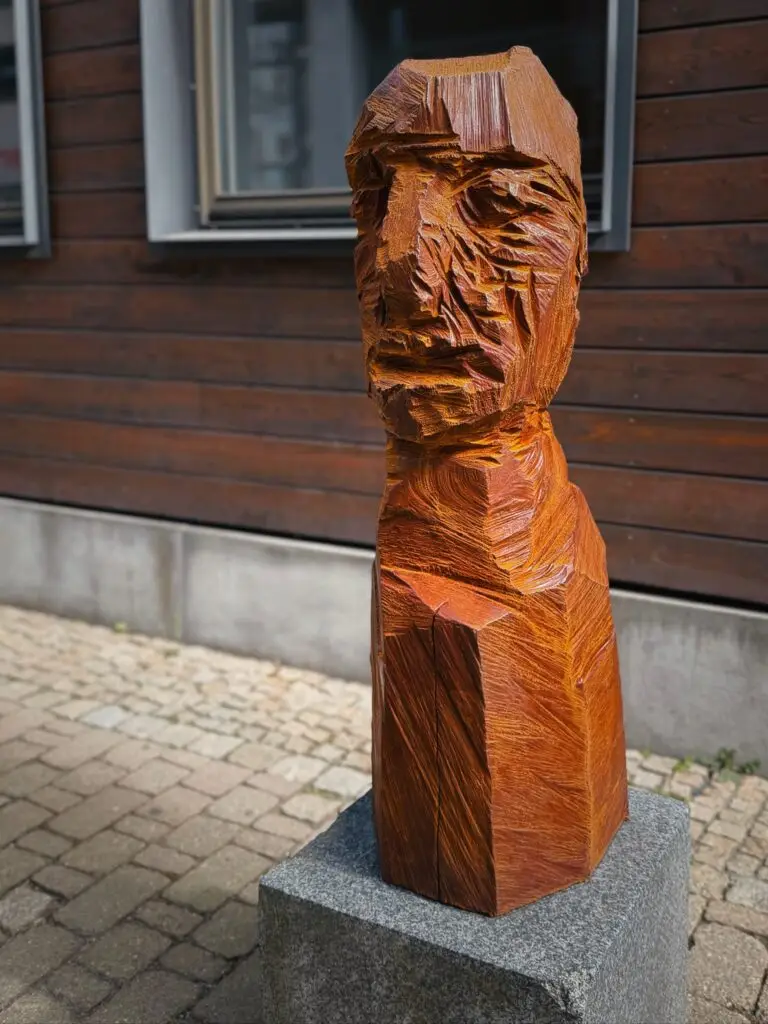
Antenato (Vorfahre, Urahn), 2003
Every material is a challenge, whether it is a six-metre-tall tree trunk or a piece of paper.
EDUCATION
- Navigate to the location

A Closer Look at the Work
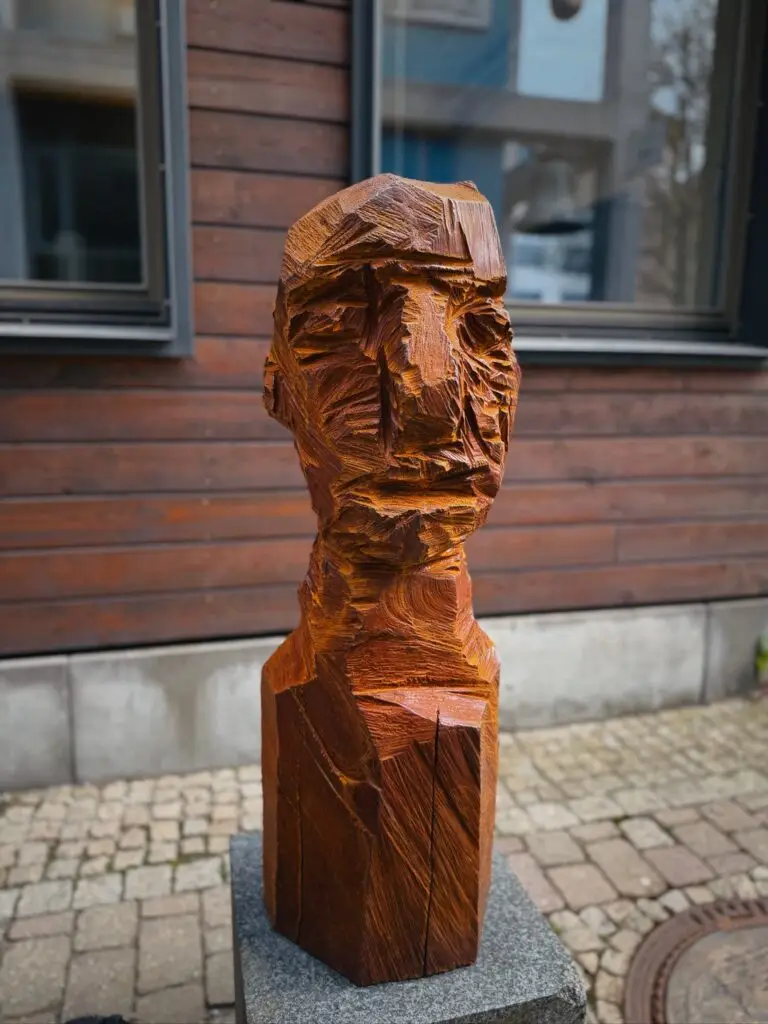
Sein Gesicht trägt die Schwere einer Zeit, in der Europa zwischen Industrialisierung, Fortschrittsglauben und den Wunden zweier Weltkriege zerrissen wurde.
Die rohe Oberfläche des Eisengusses erinnert an verbrannte Erde, an Stahl, Maschinen und die Narben einer Epoche, in der der Mensch seine eigene Zerbrechlichkeit erkannte.
Nichts an dieser Gestalt sucht Schönheit im klassischen Sinn; ihre Würde liegt im Widerstand. Ecken, Brüche und Furchen erzählen von Verlust, Entbehrung und einer Menschheit, die ihre Leichtigkeit verlor.
Wie ein stiller Zeuge steht „Antenato“ im Raum – archaisch, schwer und zugleich von einer eigentümlichen Aura umgeben. Walter Benjamins Gedanke des Auratischen wird hier spürbar: die unwiederholbare Gegenwart eines Werkes, das Erinnerung nicht abbildet, sondern in sich trägt. Der rostende Eisenkörper verschließt seine Oberfläche wie eine Wunde, die sich über Jahrzehnte hinweg selbst konserviert hat. So wird der Rost nicht zum Zeichen des Verfalls, sondern zu einem Schutzmantel der Zeit.
In der kompromisslosen Form liegt eine neue Beobachtung des Menschen: nicht heroisch, nicht idealisiert, sondern gezeichnet von Geschichte. „Antenato“ blickt zurück auf Herkunft und Vergangenheit – und zugleich auf das, was vom Menschen bleibt, wenn alle Masken der Zivilisation gefallen sind.
About the Artist
Klaus Prior’s artistic work takes shape without preparatory sketches or models. Depending on their size, his sculptures and works on canvas and paper are often completed in a single, concentrated session. Spontaneity and condensation define the process. Through a form of psychic automatism, Prior gives visual expression to his state of mind at that moment. The works reflect raw, intuitive sensations and immediate emotional states.
Using spontaneously chosen colours, impulsive gestures and swiftly applied brushstrokes, the artist develops the silhouettes of his motifs out of an inner necessity. Crossing the boundaries of form, deliberately exaggerating heads, faces, limbs and gestures, and leaving the traces of the working process visible are central stylistic devices. They embody the expression of the moment and give the works their compelling presence.
As a sculptor, Prior works primarily with wood, one of the oldest artistic materials. His iron sculptures also originate in wooden works. He consistently avoids narrative contexts, attributes and representational references that might place his figures within particular stories. The figures stand on their own: existential, vulnerable and isolated.
Prior’s art is deeply shaped by his childhood and youth in post-war Germany, by his awareness of the human condition and its fragility, and by the lived realities of an industrial working-class culture shaped by many nationalities. His paintings and sculptures explore pain, injury and isolation as recurring conditions of human existence.
As a member of the generation born after the perpetrators, Prior rejected their repression of the past and refusal to acknowledge guilt. He avoided conscription in West Germany during the economic miracle by emigrating to Switzerland. From there, he followed the Auschwitz trial in Frankfurt am Main closely and, although he bore no personal guilt, engaged deeply with Germany’s crimes against humanity.
This historical awareness and his engagement with philosophy after Auschwitz underpin his thinking and creative work. Prior’s oeuvre expresses an existential struggle with memory, responsibility and the fragile dignity of human beings.
Photos: © Marie Ruck
Ardi Goldman Kunst-
und Kulturstiftung gGmbH
Uniongelände
Hanauer Landstraße 188, 60314 Frankfurt am Main