Jabbari Shore Zadeh, 2024
The Art Walk
Shore Zadeh, 2024
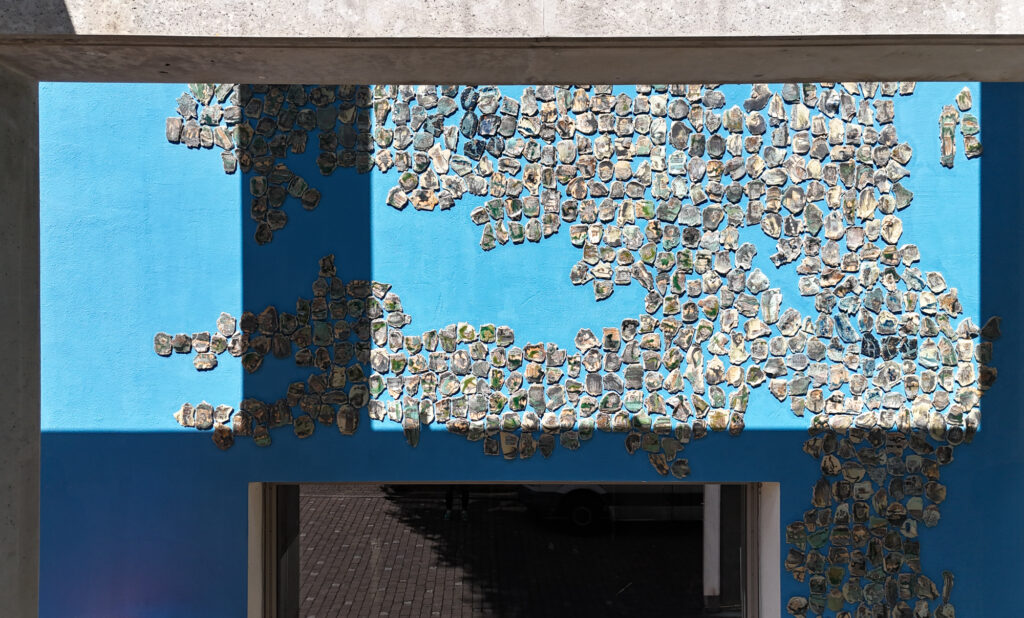
Sometimes what happened is not told, but its surface stores salt, like a landscape after the flood. What remains is not a memory, just a trace of the absence.
EDUCATION
M.A. Freie Kunst, HfG (College of Design), Offenbach am Main
Grants, awards, recognition
- Navigate to the location
A Closer Look at the Work
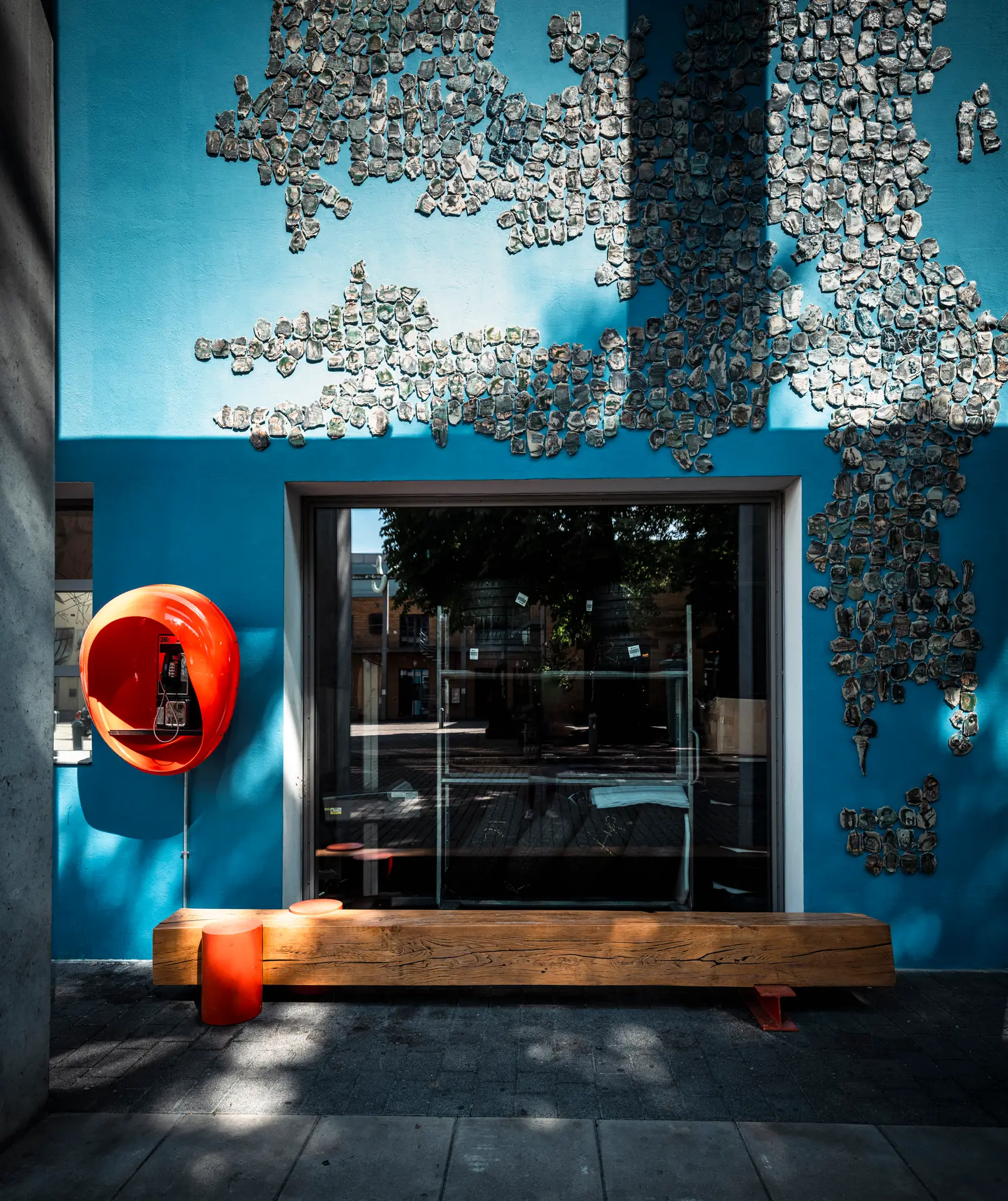
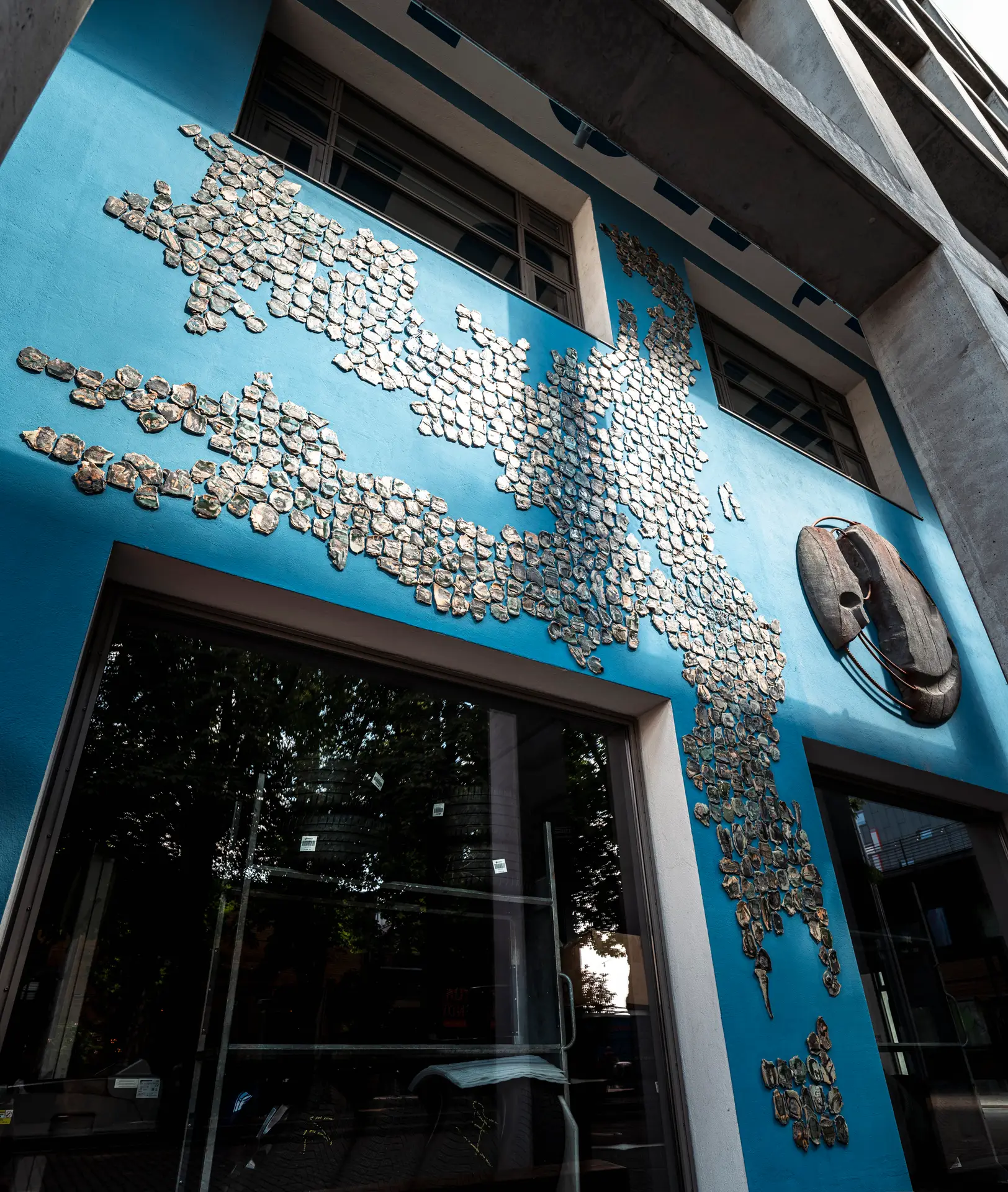
Beautiful, small, mosaic-like ceramic tiles in blue, turquoise and gray lettering were hand-crafted by the Iranian artist over a period of four months to create a monumental design for the Union area. The title Shore Zadeh, literally „salt crust“ or „salt trail“, describes a surface on which the water has long since evaporated and only the salt remains as a silent memory. These fine traces refer to something past without directly telling us about it. They mark the imprint of an absence, the visible manifestation of what is no longer there. In this tension between memory and emptiness, between presence and loss, the work’s thematic and formal depth unfolds.
The tile fragments appear at the same time fragile and resistant. Their surfaces bear traces of brilliance and dullness, of destruction and renewal. They are pieces that evoke walls, bodies, or landscapes without concretely depicting them. They are fragments that remind of walls, bodies, or landscapes, without actually representing them. Their liveliness arises precisely from what appears broken or damaged. Every crackline, every irregularity becomes part of a larger rhythm of material and meaning.
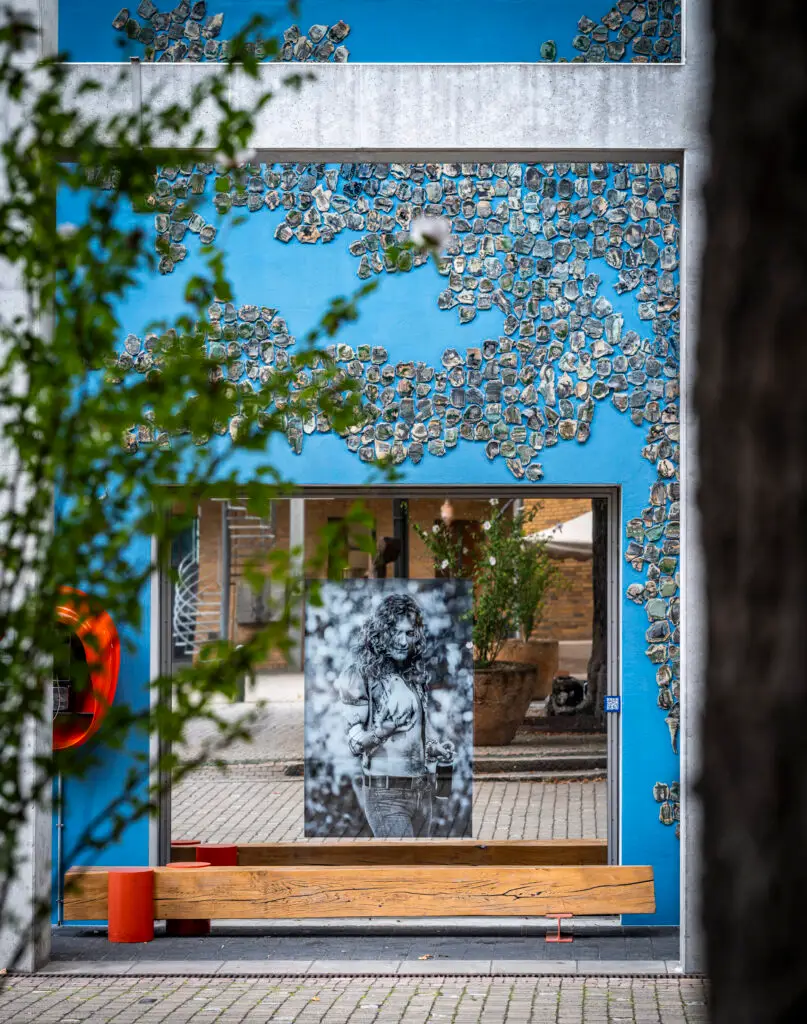
The empty spaces between the individual fragments are also central. They do not merely form intermediate spaces; they are zones of resonance: places where memory, movement, and perception overlap. The work is based on the interplay between object and distance, between the visible and the invisible. Thus, the fragmented surface itself becomes a place of movement, where viewing becomes a physical, almost searching act. This idea continues in the spatial context of the Union area: two columns obstruct the direct view of the wall work, making the work never fully comprehensible from a single perspective. The audience is encouraged to move, change the location, and discover ever new sections. This makes seeing itself a process. A moment that, from the artist’s perspective, reminds Anna Boghiguians’s thoughts of „the wall not for constraints but for movement.“ The architectural space is not perceived here as a boundary, but as a dynamic structure in which perception, body, and thought interact with each other.
The material plays a central role in this work. The glaze used, originally matte, was transformed into a glossy finish through an experimental process; an effect the artist used for the first time here. This unpredictable luminescence gives the surface a floating quality in which light, depth, and illusion blend together. The contrast between matte and glossy becomes a symbol of the deceptive nature of memory and hope, as the Iranian poet Mehdi Akhavan-Sales describes in his poem Winter describes and is taken up in the artwork:
the light that promises the morning but deceives, a light that brings no true renewal.
In Shore Zadeh Thus poetic, political and material levels meet. The work combines architectural structure, literary references and ceramic surfaces to form a silent, ambiguous narrative. It speaks of the fragility of memory, the beauty of the incomplete and the echo of the past in the present. What remains is not a concrete memory but the imprint of an absence. A salty veil on the surface of the objects that makes the invisible tangible.
About the Artist
The artist Raha Jabbari (*1993 in Qom, IRN) has been studying Fine Arts at the HfG (Higher School of Design) in Offenbach am Main since 2021. For the city of Isfahan, she designed a 250 square meter wall installation made of ceramics, stone, and metal for the art-in-architecture project „Beruhigungsland“ and a 100 square meter mural. As part of the Afip! Academy, she realized the project „57 Kacheln“ for interdisciplinary processes with Stareh Alipour. In 2024, Raha Rabari received the German scholarship for her artistic work.
Photos: © Stefan Gröpper Photography
Ardi Goldman Kunst-
und Kulturstiftung gGmbH
Uniongelände
Hanauer Landstraße 188, 60314 Frankfurt am Main