Warburg Vergangenheit, die nicht vergehen will, 2024
The Art Walk
Vergangenheit, die nicht vergehen will, 2024
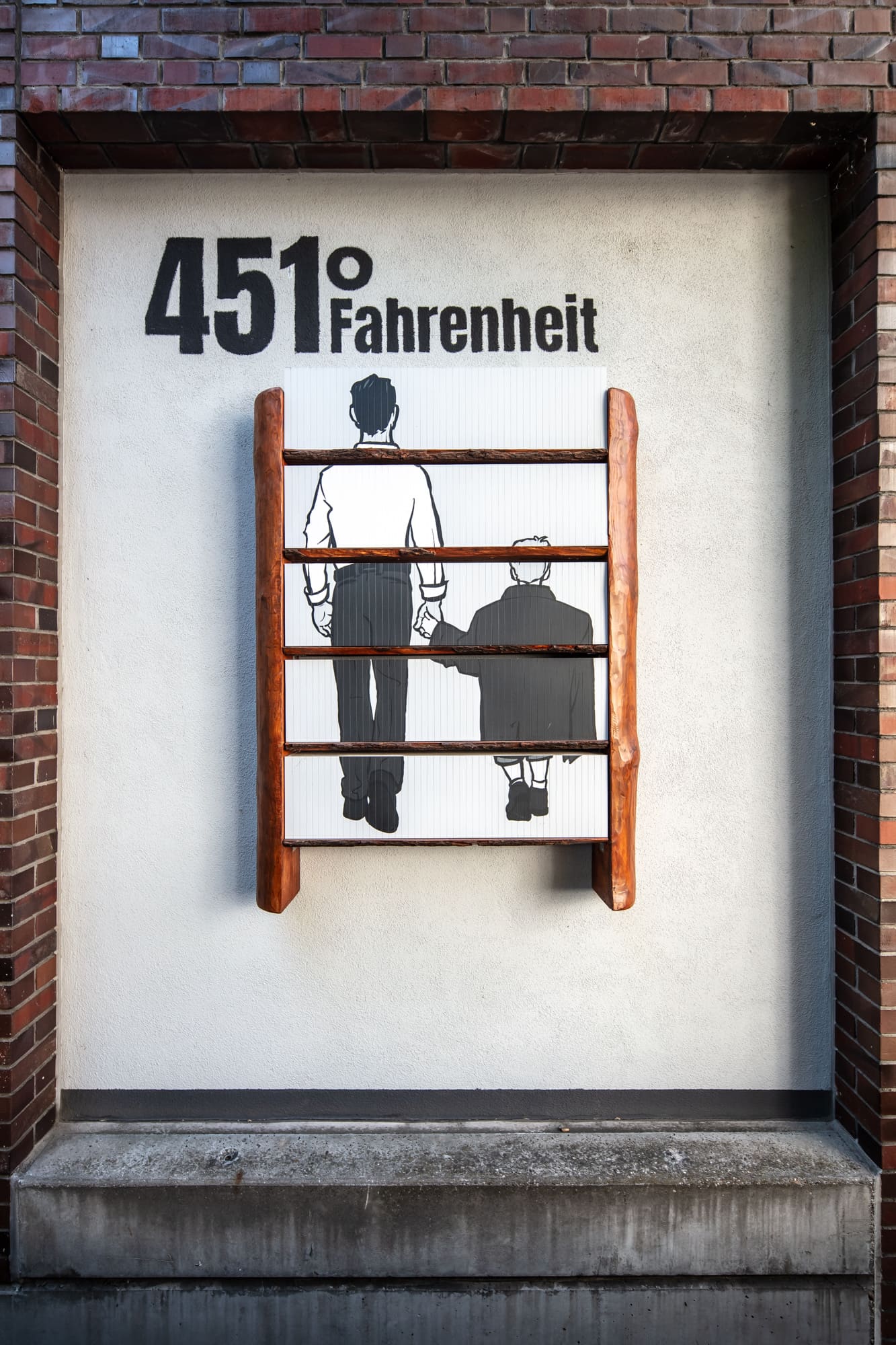
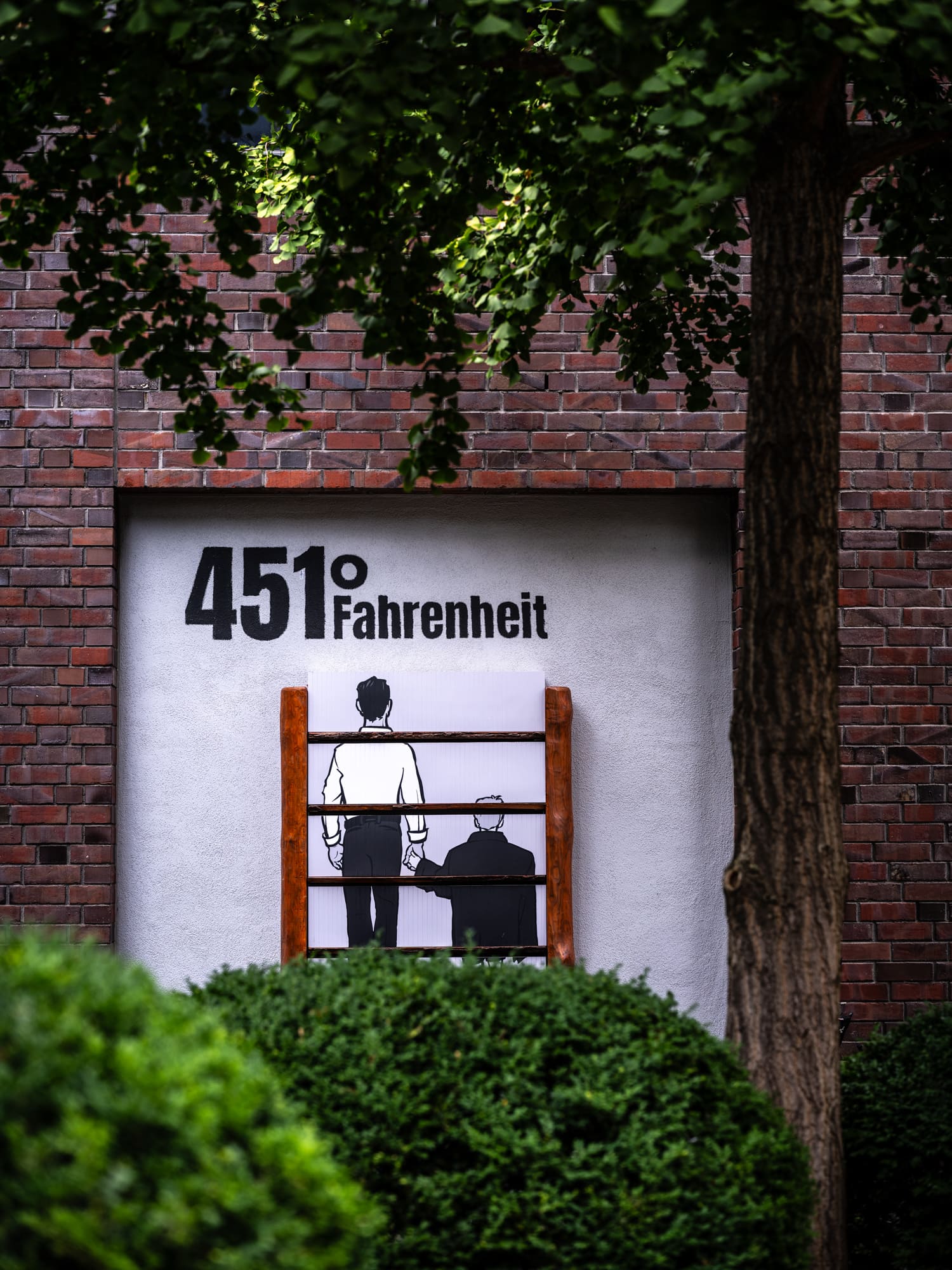
I searched for a suitable motif for the book covers for a long time. It became quite clear to me relatively quickly that it would have to be a figure on the back, like Caspar-David-Friedrich. At first I thought of Helmut Kohl and Francois Mitterrand hand in hand in Verdun in 1984. But Kohl is such a joke figure. When you see a picture of him you immediately think of the Titanic. I didn’t want that. I couldn’t think of anything. One morning I sat very early in the Main River because I had bought a small dog that needed to be trained. It was summer but the air was still fresh in the morning. A man in a suit walked past me hand in hand with his son. The son was wearing shorts and because he was probably cold, his father had given him his jacket. I found that image immediately great; a slightly kitschy side, memorable, comical, perfect. Fathers and sons, big footsteps, big jackets, big guilt.
EDUCATION
Study in the field of Fine Arts / Master's student, Städelschule – State Academy of Fine Arts, Frankfurt am Main
Grants, awards, recognition
2021 Lichter Art Award, Q21, Vienna
- Navigate to the location


A Closer Look at the Work
Nicholas Warburg – Vergangenheit, die nicht vergehen will
With his work – „Vergangenheit, die nicht vergehen will“ – the artist Nicholas Warburg addresses the repressed, selectively remembered history of the Holocaust, a painful gap in Germany’s collective memory culture.
The title of the work consciously quotes the formulation of the historian Ernst Nolte, whose eponymous contribution was published in 1986 in the Frankfurter Allgemeinen Zeitung It appeared and triggered the „Historians“ Dispute„. In a series of later debates – starting with Martin Walser’s speech at the German Book Trade’s Peace Prize award ceremony in 1998, in which he spoke of the “Morale Tower of Auschwitz„ and the “monumentalisation of our shame„, to Björn Höcke’s 2017 speech in which he described the Berlin Holocaust Memorial as a “memorial of shame” – a line of blatant historical forgetfulness is evident.
The current debate over the Historikerstreit 2.0 also once again questions the singularity of the Holocaust; this time, however, it is not German intellectuals but international scholars, primarily from the postcolonial spectrum, who are questioning it. Warburg opposes these tendencies – and at the same time reflects the ambivalence with which the German memory culture approaches its own past.
Nicholas Warburg became known as a co-founder of the collective. Frankfurt High School, Since 2013, he has attracted attention through media-savvy, often provocative actions. His works address German myths, authoritarian figures, and the blind spots of a society that considers itself enlightened. His work thrives on irritation, humor, and analytical precision. He intervenes where it hurts.
The figures in Warburg’s work Vergangenheit, die nicht vergehen will„appear like back views from an old comic book; not “Duck House Heroes,„ but “Father and Son,„ symbolically representing the generation of perpetrators and their offspring. The seemingly innocuous references falter when one asks what narratives are missing—and why some images are so present while others have been systematically suppressed.
Warburg’s art analyzes and takes seriously the forms of pop culture, the media, and design as repositories of collective ideas, desires, and projections. Between kitsch of prosperity and the gap between the present and the past, his visual language becomes a scalpel.
His work refers to what sociologists Oliver Decker and Elmar Brähler later called the „narcissistic patch“: a society that – when no figurehead is any longer tangible – seeks more abstract identification symbols such as a strong D-mark. Wealth obliterates guilt and memory is replaced by historical settings.
The work speaks of displacement, transformation, and forgetting, without being moralizing. With „Vergangenheit, die nicht vergehen will“, Nicholas Warburg formulates a wise and multifaceted commentary on the cultural memory of the Federal Republic and confronts the audience with the question: which stories do we tell, which do we conceal? And how do we situate ourselves within this narrative?
About the Artist
Nicholas Warburg (*1992, Frankfurt am Main) studied art at the California Institute of the Arts in Santa Clarita and at the Städelschule in Frankfurt am Main (under the mentorship of Tobias Rehberger). His works, which deal with German history and art history in an ambivalent way, have been shown at the Kunstpalast Düsseldorf, the Kunstmuseum Marburg, the Neuen Aachener Kunstverein, and the Kunstraum Potsdam. He was awarded prizes, scholarships, and residencies from the Kunstfonds Foundation, the new Society for Fine Arts in Berlin, the Mousonturm Frankfurt, the Q21 Wien, the Lichter Art Award, and the Author*s Prize of the Heildeberger Stückemarkt. Since 2021, he has taught at the University of the Arts Berlin.
Photos: © Stefan Gröpper Photography, Marie Ruck
Ardi Goldman Kunst-
und Kulturstiftung gGmbH
Uniongelände
Hanauer Landstraße 188, 60314 Frankfurt am Main