Auerbach Philipp
Hopefuls
–
PORTRAIT
- Navigate to the location
I cannot bear the humiliating verdict.
–
·
„I have never personally profited and cannot continue to bear this humiliating judgment. I fought until the very end, in vain... My blood will be on the head of the evildoers.“.
From the farewell letter from Philipp Auerbach
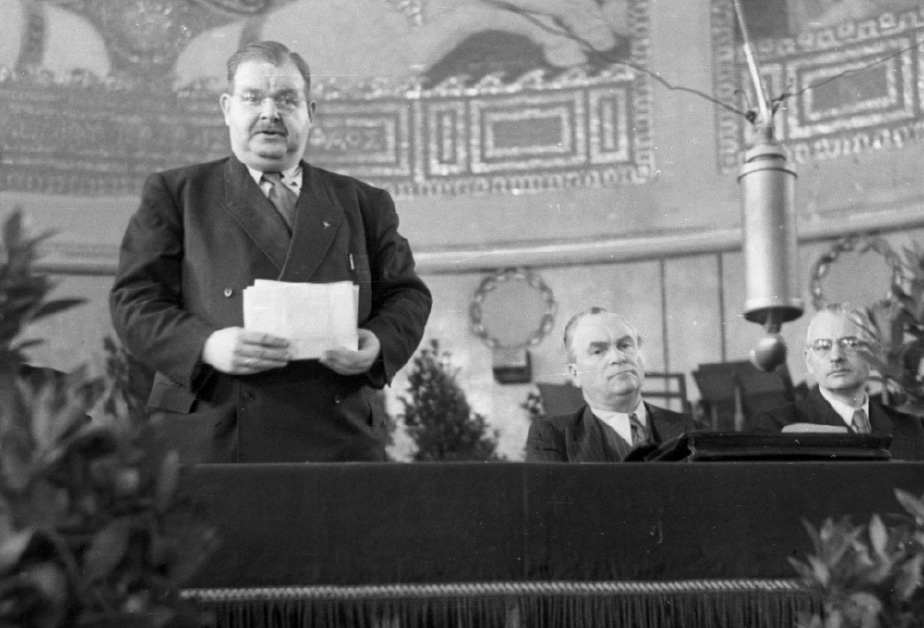
Philipp Auerbach He was born in 1906 into a German-Jewish merchant family. The trained merchant, pharmacist, and chemist fled with his wife and young daughter in 1934 to Belgium before the National Socialists. But even there he was not safe: in 1940 he was arrested, deported to France, and interned in several camps. In 1944 the Nazis deported him to Auschwitz, later to Buchenwald. In April 1945 he was liberated by U.S. troops – severely wounded but alive.
Despite everything, Auerbach remains in Germany after the war. He firmly believes in a new beginning, in a democratic Germany where Jewish life is once again possible.
Early on, he advocates for the compensation of the victims of National Socialism – not only for Jewish survivors, but for all those persecuted. At the request of Jewish organizations and the Bavarian Interior Minister, he is appointed State Commissioner for Racially, Religiously and Politically Persecuted Persons in 1946. In 1949, he additionally takes over the leadership of the state compensation office in Munich. Thousands of Holocaust survivors, so-called Displaced Persons (DP), seek help from his authority. Many are destitute, without a place to stay or prospects. Auerbach helps unbureaucratically, mediates departures, and provides protection. During his five-year term as State Commissioner, he supports up to 100,000 Jews in leaving Bavaria.
But his commitment not only earns him respect but also makes him vulnerable. In a federal republic influenced by the Cold War and focused on Western integration and stability, Auerbach’s efforts to achieve consistent restitution and the process of uncovering the Nazi past are considered disturbing. He is increasingly in the crosshairs of politics and the judiciary. In 1951, he is vilified, removed from his post, and arrested. The charges: embezzlement of compensation funds, bribery, extortion, and abuse of title. After 13 months of detention, a sensational trial begins – under judges who, during the Nazi era, had also served in the judiciary. Some of the charges, such as the unlawful holding of a doctorate degree, are found to be true; many others prove to be unfounded. Nevertheless, Auerbach is sentenced to two and a half years in prison. Two days later, he takes his own life.
He survived a SS prison in Paris, several internment camps, the concentration camps of Auschwitz and Buchenwald, and a death march in January 1945. He did not survive the trial and the verdict. Thousands of DP demonstrators demonstrated against the verdict. His gravestone reads: „Helpers of the poor, victims of their duty.“
In 1954, Auerbach was fully rehabilitated by the Bavarian state parliament. The investigation committee concluded that his duties were extraordinary – and that they could not have been accomplished with the means of ordinary administrative procedures.
Sources: Hans-Hermann Klare: Auerbach. A Jewish-German Tragedy or How Anti-Semitism Survived the War, Berlin 2022.
Karl Bachsleitner: The case Philipp Auerbach. In: Geschichte lernen, 20, 2007, pp. 33-41.
- Hans-Hermann Klare: Auerbach. A Jewish-German tragedy or How Anti-Semitism survived the war. Berlin 2022.
- Karl Bachsleitner: The Case Philipp Auerbach. A Lesson from the 1950s, pp. 33-41. In: Fachzeitschrift: Geschichte lernen. Volume 20/ 2007.
We are here! Jews in Germany after 1945. In 1999, a TV documentary in four parts of 45 minutes each. Part 2: „Reconciliation? The Auerbach Case.“ Book and direction: Richard Chaim Schneider. Production: Janusch Kozminski. Film production, Munich. TV premiere on WDR: 31.03.2000.
Podcast Jewish History – LMU Ludwig-Maximilians-Universität – EP 52: Hans Hermann Klare presented Auerbach’s biography at Aufbau Verlag, which he discussed with Dr. Rachel Salamander in the Chair of Jewish History and Culture. October 25, 2022.
A „displaced person“ was a civilian (forced laborer, captive) who was staying outside their home country and could not return or settle in another country without help.
© Memorial to the Silent Heroes
„I have never personally profited and cannot continue to bear this humiliating judgment. I fought until the very end, in vain... My blood will be on the head of the evildoers.“.

Ardi Goldman Kunst-
und Kulturstiftung gGmbH
Uniongelände
Hanauer Landstraße 188, 60314 Frankfurt am Main