Block
Hopefuls
–
PORTRAIT
- Navigate to the location
I knew what I was doing.
–
·
„I didn’t know what would happen in the camp, but I knew that I would either be killed or that my life would be over. I had always known that. When that comes out. We had expected it to happen 90 percent of the time. But with ten percent, you always think you can get by with it.“
Irene Block
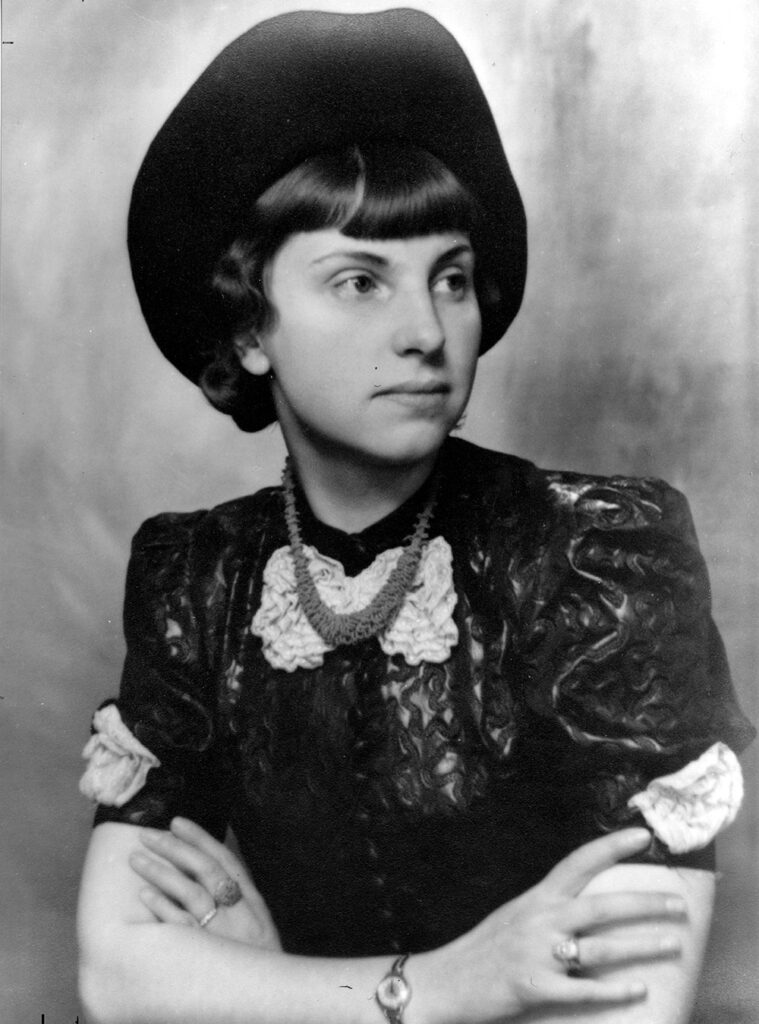
Irene Block She studied law in Frankfurt am Main but was not admitted to the Second State Examination in 1938 because of her Jewish grandparents. Subsequently, she specialized in foreign exchange and tax law and, after her doctorate in Frankfurt, began working as a tax consultant. It was mainly Jewish families and businessmen who wanted to emigrate and whose accounts were frozen; they asked her for help. She processed applications, issued certificates, and occasionally also took on the costs of doctors or lawyers. In 1942, the Nazi Party leadership in the Gau directed that she be disbarred and prohibited from advising Jewish clients. Block moved the law firm into her apartment – and continued to help. When Maria Fulda, the Jewish sculptor, was to be deported, Block arranged for her medical certificates, which she was then expelled as being unfit to travel. Fulda was sent back four times, but in September 1942 she was back on the list. Irene Block He removed the star from Fulda’s coat and took her to Ziegenhain near Kassel, where she had rented a room for emergency purposes. The landlord introduced her to Maria Fulda, her ailing aunt from Berlin, who needed to recover from a nervous breakdown.
Once again in Frankfurt, Block destroyed Fulda’s ID card and reported it missing and at risk of suicide. Then she picked the artist up and hid her in her apartment. Only Block’s secretary and a few neighbors knew about it. The two women lived together for a year and a half – with only one food card. During the major air attack on Frankfurt on March 22, 1944, Block’s house was also destroyed. She saw the opportunity and took it: Block drove with Maria Fulda to Ziegenhain, reported both as Frankfurt residents who had been bombed, and applied for new papers with a new name for Maria Fulda. When Maria Fischer received her own food stamps, Block now officially lived under a new identity Irene Block.
When asked if they were afraid of being discovered, they answered Irene Block: „At ninety percent we expected it to be discovered. But we built on the ten percent hope.“
Sources: Petra Bonavita: With a fake passport and Zyankali, p. 54-57, Stuttgart 2009.
Ursula Kern: Dr. Irene Block. In: Frankfurter Frauenzimmer von A-Z, online.
On March 4, 1992, Dr. Irene Block von Yad Vashem was honored as a Righteous Among the Nations.
- Beate Kosmala Claudia Schoppmann (ed.): Surviving in the Underworld. Aid for Jews in Germany 1941-1945. Monica Kingreen: Persecution and Rescue in Frankfurt am Main and the Rhine-Main Region, pp. 179-180. (Series Solidarity and Aid, Vol. 5). Berlin 2002.
- Maximilian Preisler: Silent Heroes in the Third Reich. Deutschlandfunk Kultur Archive, 27.09.2007. The article includes, among other things, an interview with the historian Barbara Schieb from the Stille Helden memorial from 1987 Irene Block.
- Petra Bonavita: With a fake passport and Zyankali. Stuttgart 2009, pp. 54-57.
„I didn’t know what would happen in the camp, but I knew that I would either be killed or that my life would be over. I had always known that. When that comes out. We had expected it to happen 90 percent of the time. But with ten percent, you always think you can get by with it.“
Ardi Goldman Kunst-
und Kulturstiftung gGmbH
Uniongelände
Hanauer Landstraße 188, 60314 Frankfurt am Main