Harnack Mildred
Hopefuls
–
PORTRAIT
- Navigate to the location
A resistance network that never called itself that.
Personal example of:
–
·
„And I loved Germany so much.“
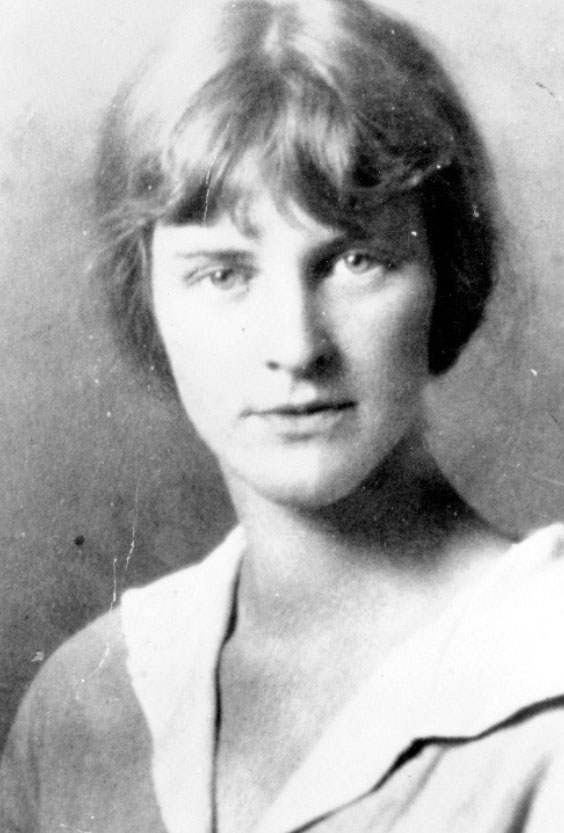
Dr. Mildred Harnack
Mildred Fish grew up in a family of merchants in the US state of Wisconsin as the youngest of four children. After studying English philology and literary history, she teaches literature at the University of Madison and Arvid Harnack meets the man she marries in the summer of 1926.
In 1929 she followed her husband to Germany and in 1931 was employed as an instructor of American literary history at the University of Berlin. In 1933 she was dismissed and began working as a teacher of English literature and literary history at the Berlin City Evening Gymnasium.
Her students Karl Behrens Bodo Schlösinger and Wilhelm Utech participate in a training circle on economic and political issues that she runs. She Mildred Harnack uses her good relations with the American Embassy to obtain speeches by Roosevelt and other politicians, news about the Spanish Civil War, comments on Hitler'Arvid Harnack s policies, and other information that she compiles and passes on to like-minded people.
She makes connections with people who are opposed to the Nazi regime or critical of it, gains some support for active resistance activities, and supports the illegal work of Arvid Harnack the Red Chapels. In November 1941, she graduates from the University of Gießen and becomes a lecturer at the University of Berlin. She does not use the ticket she Arvid Harnack obtained to travel to the United States because she wants to stay with her husband in Germany.
After the Red Chapel was uncovered, Mildred Harnack on September 7, 1942 she and her husband were arrested together and on December 19, 1942 sentenced by the Reich War Tribunal to six years’ imprisonment initially. However, on Mildred Harnack December 21, 1942, Hitler reversed the sentence and so she was sentenced to death on January 16, 1943 and murdered in Plötzensee on February 16, 1943.
© Memorial to the German Resistance
- Since 1986, all schools in the US state of Wisconsin have observed a memorial day for Mildred Fish-Harnack on September 16; in her hometown of Milwaukee, an art school bears her name.
- In 1990, Arvid Harnack a memorial plaque was unveiled at the residence of Mildred.
- On July 6, 2009, the Peter-A.-Silbermann School received the name Mildred-Harnack-Fish College, and on September 20, 2013, in the presence of US Ambassador John B. Emerson, Stolpersteine Arvid Harnack were placed in front of the Genthiner Straße 14 building in Berlin-Tiergarten.
- In 2015, the Gießen Student Union converted the Otto-Eger Home into the Mildred-Harnack-Fish House; in Gießen, the Mildred-Harnack Way also commemorates her.
- At the Zehlendorf cemetery in Berlin, a memorial stone commemorates Mildred and Arvid Harnack.
- Mildred Harnack-Fish: Variations on the theme of America. Studies on the literature of the USA. Edited by Eberhard Brüning. Berlin (East) and Weimar 1988.
- Shareen Blair Brysac: Mildred Harnack and the Red Chapel. The story of an unusual woman and a resistance movement. Bern 2003.
- Rebecca Donner: Mildred. The story of her Mildred Harnack and her passionate resistance to Hitler. Berlin 2022.
- Women in the Resistance against National Socialism. Foundation Gedenkstätte Deutscher Widerstand (ed.): Johannes Tuchel: „…considering how young we are, one cannot believe in death.“ Liane Berkowitz, Friedrich Rehmer and the Resistance actions of the Berlin Red Chapel. Berlin 2022.
- Bianca Walther – „Mildred Harnack (1902–1943) – A Woman in Resistance“. Interview with Mildred’s Great-Auntie and Biographer Rebecca Donner. Podcast (Episode 21/22, 05.05.2022); available on Spotify and in popular podcast apps, either in the original English or with German simultaneous translation.
- Podcast Rote Kapelle. On a walk through Berlin, you will learn the story of the legendary resistance group. A project by Stefan Roloff, produced by the German Resistance Memorial and When 6 is 9 Productions GmbH. In German, English and Spanish.
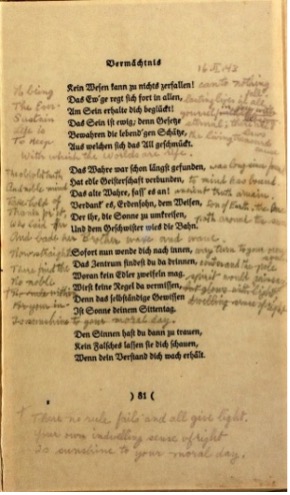
Goethe poem translated from Mildred Harnack the day of his murder in custody, February 16, 1943

© Memorial to the German Resistance, Collection of Dr. Falk Harnack
„And I loved Germany so much.“
Ardi Goldman Kunst-
und Kulturstiftung gGmbH
Uniongelände
Hanauer Landstraße 188, 60314 Frankfurt am Main