Moltke Freya
Hopefuls
–
PORTRAIT
- Navigate to the location
It is always worth doing something that you wouldn’t do for yourself. That can be found almost everywhere on this earth.
Personal example of:
–
·
I’m not complaining either, because we have to be prepared to sacrifice our lives for our lives. I condone everything you did out of pure heart.
Freya von Moltke in a letter to Helmuth James von Moltke, January 6, 1945.
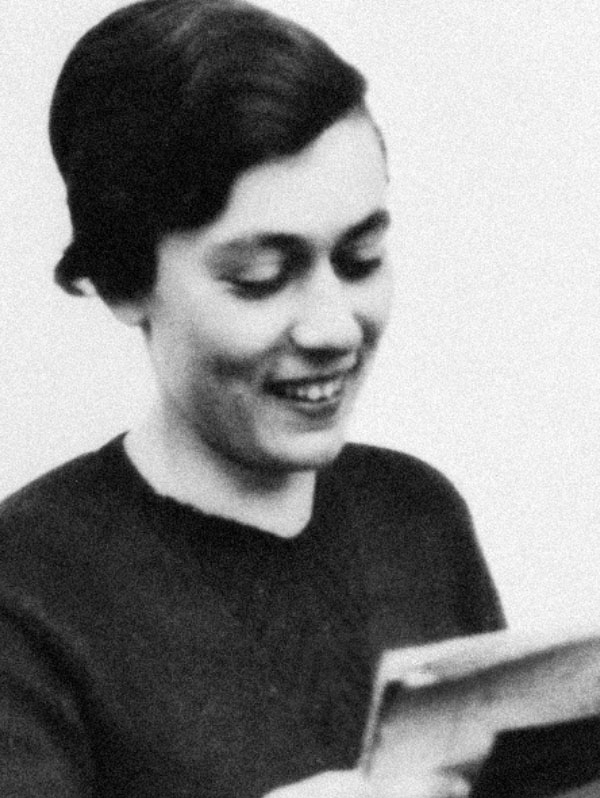
Freya Deichmann grew up in Cologne as the youngest child of banker Carl Theodor Deichmann and his wife Ada, with two brothers. In 1930, Freya Deichmann completed her high school education, studied law, and in 1935 received a doctorate in Berlin. She Helmuth James Graf von Moltke met in 1929, and two years later they married. Two children were born from the marriage.
Freya von Moltke supports the resistance network founded by her husband in 1940, the so-called Kreisauer Kreis, which consists of women and men of different social backgrounds and fundamental beliefs who are in opposition to the Nazi regime. She participates in secret meetings where discussions are held about new plans for a democratic Germany after the end of National Socialism. In January 1944, Helmuth von Moltke is arrested. Freya von Moltke unsuccessfully attempts to have him released. On January 11, 1945, he is sentenced to death by the „People’s Tribunal“ and murdered in Berlin-Plötzensee on January 23, 1945. Freya von Moltke’s involvement within the resistance group remains hidden from the Gestapo. After 1945, she works for German-Polish reconciliation.
© Memorial to the German Resistance
1989: Sister-Scholl Prize.
1999: International Bridge Prize.
2009: Adam-Mickiewicz Prize.
On her 100th birthday, an ecumenical memorial service was celebrated, at which the then Federal President Christian Wulff preached to Margot Käßmann, member of the board of trustees of the „Freya-von-Moltke-Stiftung für das Neue Kreisau“.
On her 101st birthday, at the initiative of the „Freya von Moltke Foundation for the New Kreisau“, the city of Cologne and evangelical and Catholic institutions, in the presence of her son, a glass statue was erected in front of Freya von Moltke’s birthplace.
In 2018, Freya-von-Moltke Street in Cologne-Deutz was named after her.
On September 11, 2024, Freya von Moltke was included in the list of Women’s Places in NRW as part of the project Frauenorte and a memorial plaque was installed in the building at Georgplatz 16.
Foundation Gedenkstätte Deutscher Widerstand (ed.): Thematic catalogue 12. The Kreisauer District. Berlin 2018, 2nd edition.
Helmuth James and Freya von Moltke: Farewell letters from Tegel Prison. September 1944–January 1945. 3rd edition. Munich 2011.
Frauke Geyken: Freya von Moltke. A century of life 1911–2010. Munich 2011.
Sylke Tempel: Freya von Moltke. A life. A century. Reinbek 2010.
Freya von Moltke: Memories of Kreisau 1930–1945. 2nd edition. Munich 2006.
Dorothee von Meding: With the courage of the heart. The women of July 20, Berlin 1992.
Beate Ruhm von Oppen (ed.): Helmuth James von Moltke: Letters to Freya 1939-1945. 2nd edition, Munich 1991.
Documentary film: A Story of Love – Freya. Director: Antje Starost, Hans Helmut Grotjahn. Germany 2016.
Documentary film: Hellmut Schlingensiepen in conversation with Freya von Moltke (1911–2010), directed by Hellmut Sitó Schlingensiepen, Christian Bimm Coers. Germany 2010.
The Moltke Project – When the World Falls Apart. In: Dramatic reading based on the „Farewell Letters from Tegel Prison“ by Helmuth James and Freya von Moltke (Flyer). Directed by Michael Becker. Available for booking at: 0170/ 2158453.
Excerpt from a letter from Helmuth to Freya
Tegel, October 10, 1944
Dear*, yesterday the food arrived from you and it was very welcome, because I had just eaten the last piece of bacon this morning and my sugar was almost gone too. Besides that, it was very cold and therefore the need to eat was very great. So I immediately ate one, no, two honey buns and many cookies. The sight of real butter, which I haven’t had since August 17th, is somewhat pleasingly gratifying. Are the peaches from that little trellis tree? The apple was especially good. If you send me more sugar again, then preferably in cubes; because I eat the sugar like this and I don’t want to ruin it with bad coffee. Will you be there again today and change your outfit?
My dear, I am concerned about the food because first it is cold, second it is such a pleasant change from eating during the day, and third I count on being dead by morning after 36 hours and by evening after 24 hours. These short-term prolongations of life stifle all normal saving tendencies. It must come after all; but I am not nervous about whether it will come. (…)
My heart, as much as I try to deny it, my mind is always occupied with your future life. The time now will not be so bad for you; the time immediately after my death will also pass, but after a while everyday life will come, and that will be the worst moment. But you must overcome this low point and bear the pain. Do not try to brush it off by being overly busy; you will not reap the fruit of your tears then, and you will squeeze the space in you where I want to continue to live. The pain widens this space.
My dear, I have been a little hesitant to write this to you, because it seems so arbitrary to go beyond the grave and because it is roughly a cruel piece of advice that is cheap for me and difficult for you. But in the end, I thought that I had given you so many unpleasant advice in my life that I can’t miss it on this one. (…)
My heart, I have nothing to say. Everything is fine as it is. I trust the Lord completely and surely that He will continue to guide me and you and us in the way that is good for us. I ask Him to save me from this situation and this time of my life as well, but I am very certain that nothing and no one can harm me and that your pain, when you have to bear it, will also bear its meaning and its fruit.
Farewell, my very beloved heart; keep me safe with your sons in His hat.
J.
* The masculine address refers to Freya's given name Pim, which is used for a male.
Helmuth J. Graf von Moltke: Letters to Freya 1939-1945. P. 58.
I’m not complaining either, because we have to be prepared to sacrifice our lives for our lives. I condone everything you did out of pure heart.
Ardi Goldman Kunst-
und Kulturstiftung gGmbH
Uniongelände
Hanauer Landstraße 188, 60314 Frankfurt am Main