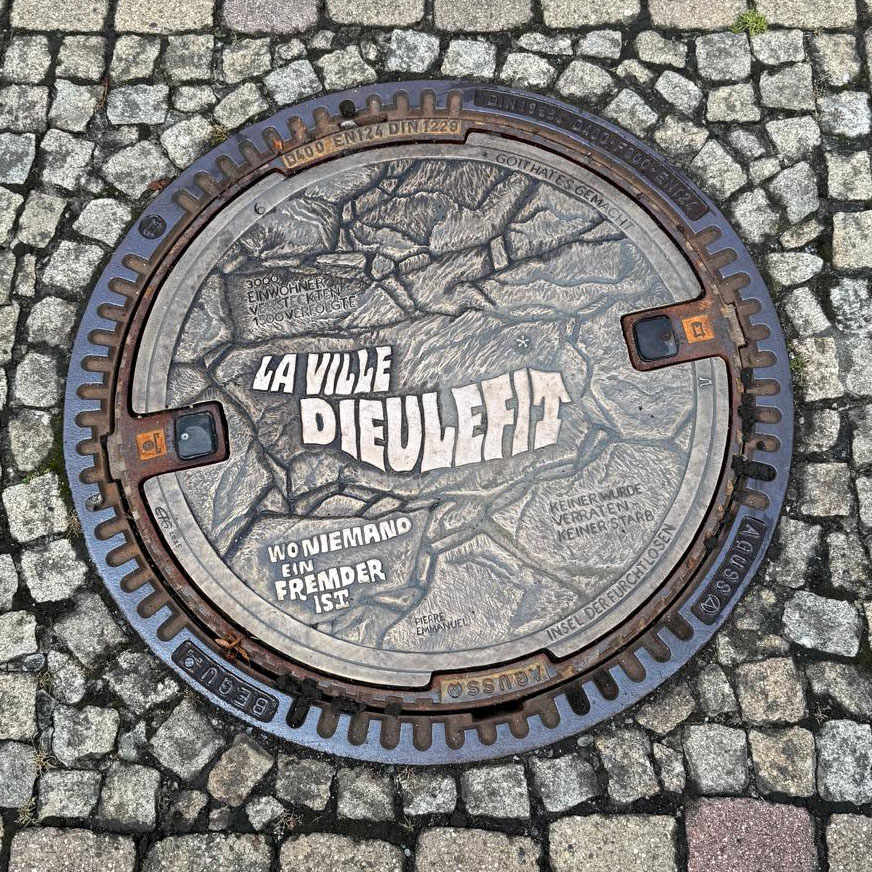
Dieulefit
Hopefuls
Ground relief
- Navigate to the location
3,000 inhabitants – 1,500 rescued. No one betrayed. No one lost.
„Dieulefit – Where no one is a stranger.“
Pierre Emmanuel
3,000 inhabitants – 1,500 rescued. No one betrayed. No one lost.
Thus begins the extraordinary story of a small southern French town that became a site of civil resistance between 1940 and 1944 – quietly, consistently, and with solidarity.
In the summer of 1940, thousands fled from German troops in northern and western France to the seemingly safe south. But even there, democracy collapsed: The authoritarian Vichy regime under Marshal Pétain increasingly supported the German occupation. Anti-Semitic laws, repression, and deportations soon spread to the Zone libre to themselves.
Amidst this threat, Dieulefit, a small town in the Drôme département, became a refuge. 1,500 persecuted people – including Jews, opponents of the regime, intellectuals, and children – found refuge here. The municipality had only 3,000 inhabitants. Yet no one was denounced, no one was extradited.
Civic courage as a collective effort
Dieulefit was prepared – not institutionally, but in spirit. As a health resort with clinics, pensions, and sanatoria, the city offered places of retreat. The people exercised discretion; many actively helped, some silently; all were guided by a common consciousness: humanity precedes obedience.
What was crucial was the commitment of individuals at key points. The young parish secretary forged documents and identification cards with the connivance of the mayor. At the Jeanne Barnier Beauvallon school, Marguerite Soubeyran, Catherine Krafft and Simone Monnier worked – they hid hundreds of Jewish children, kept the classes going and provided comfort. The number of students doubled – despite rationing and danger.
Solidarity without words
Communists organized escape routes, peasants shared their harvests. The gendarmerie looked the other way. Priests issued baptismal certificates for Jewish children. The prefect ignored what he knew. Solidarity was complete – no one spoke about it, everyone acted.
The attitude of Dieulefit had a tradition: Since the 17th century, the place had been a refuge for Huguenots. Over generations, Protestants and Catholics had learned to respect each other. In war, this tolerance gave rise to resistance.
„A city where everyone tacitly showed resistance.“
When the Wehrmacht occupied southern France in 1944, many places became sites of reprisals. Dieulefit remained miraculously untouched.
On August 21, 1944, the war was over for the town – and 1,500 people were still alive.
Film historian Bernard Eisenschitz describes Dieulefit in retrospect as follows:
„A small town where everyone was tacitly a resistance fighter […] everyone knew about it, but no one ever said anything.“
Remembrance and recognition
Nine people from Dieulefit were recognized by Yad Vashem as Fairness among the peoples Honored – for their courage to save lives without demanding anything in return:
Jeanne Barnier Catherine Krafft, Simone Monnier, Marguerite Soubeyran, Emmeline and Elie Abel, Madeleine and Pol Arcens, and Henri Morin.
Today, a plaque in the town hall commemorates her actions. Her spirit continues to live on in the school in Beauvallon.
- Nine residents of Dieulefit were honored by Yad Vashem and the State of Israel as Righteous Among the Nations for their civil resistance and for saving Jews at the cost of their lives.
- Since 2008, a plaque with the names of the rescuers in the entrance hall of the town hall commemorates this: Emmeline Abel, Elie Abel, Pol Arcens, Madeleine Arcens, Jeanne Barnier Catherine Krafft, Simone Monnier, Marguerite Soubeyran and Henri Morin. Separated by bullet points.
- Bernard Delpal, Anna Tüne (ed.): Resistance in Dieulefit: Topographies of Humanity. Bielefeld 2013.
- Hans Woller: Fluchtpunkt Dieulefit. Switzerland 2013.
Part 1: Dieulefit – the small town that saved the Jews.
Part 2: The escape point Fluchtpunkt Dieulefit, the boarding school Beauvallon.
Part 3: German Communists in the French Resistance.
Part 4: The double game – everyone knew, no one reported it.
Journal 21.ch., online. - Anna Tüne: From the Restoration of Happiness: A German Childhood in France. Berlin 2013.
- Bernard Delpal: Dieulefit. The resistance of a village in Provence during the Nazi occupation. Translated from the French by Ursula Bös. Frankfurt am Main 2021.
- Johannes Winter: Resistance in the Lavender Country. Faust Kultur, online, 09.02.2022.
- Bettina Storks: The Children of Beauvallon. A historical novel based on true events. Munich 2023.
- The radio version of the four-part series „Dieulefit – Refuge in Times of Barbarism“.
Deutschlandfunk- Archiv, August 27, 2013. - Thomas Pfaff: 07.1940 – The miracle of Dieulefit begins. The prerequisite for this was the exemplary civil courage of many citizens of Dieulefit and the long liberal tradition of the town – but also many fortunate circumstances. Editor: Ronald Feisel. WDR Timepieces, 10.07.2015.
- Thomas Pfaff: 08.1944: The city of Dieulefit is liberated. Over 1,500 refugees survived in this small town because the population achieved something that entered history as the „Miracle of Dieulefit“. SWR 2 Zeitwort, 21.8.2023.
Recent research by Lucie Mouscadet and Nadège Tribouillard proves that, contrary to previous assumptions, a Jewish woman was indeed arrested and deported in Dieulefit. Amalia „Mila“ Sztejnberg, born in 1909, sought refuge in Dieulefit in 1942, but was arrested by the Gendarmerie on August 26, 1942. She was transported to Auschwitz via Crest, Vénissieux, and Drancy and murdered on September 4, 1942. This discovery corrects the image of Dieulefit as a completely safe place of refuge.
© Patrimoine Mémoire et Histoire, Dieulefit
„In Dieulefit everyone is the neighbor of the other. The one who arrives there comes from a terrible bus journey, exhausted, perhaps persecuted and terrorized by the looks directed at him; here he can breathe a sigh of relief; peace will finally reach him. He will feel himself among equals, because here he is simply the neighbor for whom the table is always set. My attachment to Dieulefit has always remained the same; my gratitude towards those who between 1940 and August 1944 kept the loyalty to justice and freedom remains unchanged. I experienced my most beautiful moments in Dieulefit…“
Pierre Emmanuel
In Dieulefit, the École de Beauvallon, an internate founded in 1929 during the German occupation, took in persecuted people and became an important place of refuge and rescue. The entries in the school’s „Golden Book“ show how significant this experience was:
- „In July 1942, in the darkest hours of France, thank the fairies of Beauvallon, who quietly show that there is no reason to despair about man and his infinite possibilities, and that it is about securing that future for which it is worth dying because they assure us that France will live.“
Louis Aragon
- „Happy to sign the guestbook of hope.“
Elsa Triolet - „The world can change, Beauvallon remains young. Haters will hang their heads; Beauvallon will keep his pride. Dear Aunt Marguerite, dear Catherine. …During my one-year stay, you accomplished something that I no longer considered possible. You gave me hope.“
Eve Steinthal

Louis Aragon's entry in the Beauvallon gold book, July 5, 1942 © Patrimoine Mémoire et Histoire, Dieulefit
„Dieulefit – Where no one is a stranger.“
Ardi Goldman Kunst-
und Kulturstiftung gGmbH
Uniongelände
Hanauer Landstraße 188, 60314 Frankfurt am Main