Mangelsdorff Emil
Hopefuls
–
PORTRAIT
- Navigate to the location
Disturbing elements – through them and with them we remain alive.
Personal example of:
–
·
„Jazz is a music that represents freedom.“
Emil Mangelsdorff
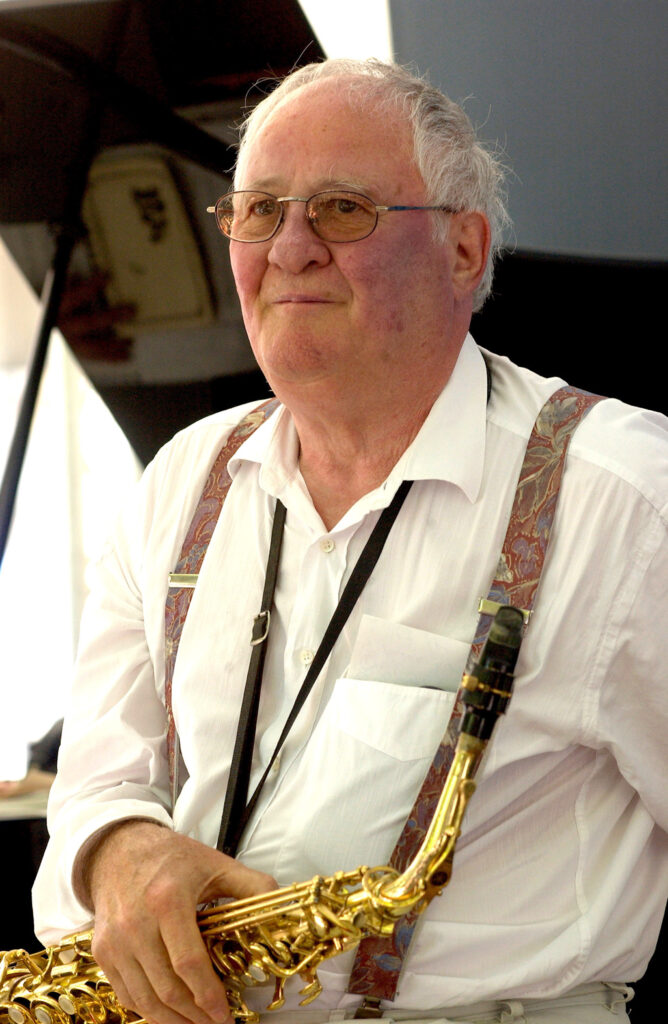
The first notes of Louis Armstrong made his heart beat faster. He was electrified. This music, this rhythm – it felt like freedom. He immediately knew that he wanted to play jazz. But in Nazi Germany, swing and jazz were forbidden. They were considered „un-German,“ „degenerate,“ and uncontrollable. That didn Emil Mangelsdorff’t stop Emil. He learned the accordion, later switched to clarinet and saxophone. With his Frankfurt Hotclub Combo, he brought the banned jazz onto the stage. Crazy young people stood in line, but every performance could be detected. The Gestapo and the Hitler Youth patrol were everywhere. Yet they continued to play – even in the Rokoko Bar at the Kyffhäuser Hotel in Frankfurt.
„It was about the jazz that I loved, but also about a sign against the Nazis,“ Emil recalled later. His father was a convinced Social Democrat, and he himself refused to attend the events of the Hitler Youth. But his resistance remained unnoticed. Emil was under surveillance. He was controlled, bullied, and had to have his hair cut several times – but he always let it grow back. In April 1942, the big shock came: Emil was arrested for desertion. A charge that could have resulted in the death penalty. The reason: an insulting remark about a friend’s call-up order that his worried mother had denounced. He spent twenty days in custody. But on April 20, Hitler’s birthday, the surprising release came. Later, Emil said that the Frankfurt Gestapo had been less rigorous – perhaps that saved his life. But the danger was not over. In 1943, at the age of 18, Emil was sent to the Eastern Front. In the winter of 1945, he fought in East Prussia, then he was taken into Soviet captivity.
Emil Mangelsdorff In 1949 he returned to Frankfurt – scarred by the years of imprisonment, yet undeterred in his passion for jazz. The music that had shaped him in his youth did not leave him. Hardly back, he picked up the saxophone again. He played in local bands, then with his younger brother Albert Mangelsdorff, who became world-renowned as a percussionist. Soon he was part of the German and international jazz scene, shaping German jazz with the Mangelsdorff Quartet and playing in the jazz ensemble of the Hessian Broadcasting Corporation.
Until his old age, Emil performed on stage. On November 1, 2021, he once again performed in his own concert series at the Holzhausenschlösschen in Frankfurt. But he was not only a musician, but also a witness to history. For decades, he reported in interviews, schools, and cultural institutions about his experiences as a swing youth. Because for him it was clear: Music can be resistance.
Source: Jonas Lohse, Jazz Initiative Frankfurt: Obituary on Emil Mangelsdorff. Jonas Kontrabass Blog, January 23, 2022.
- Emil Mangelsdorff He was awarded numerous prizes. In 1991 he received the Johanna-Kirchner Medal, followed in 1995 by the Goethe plaque from the city of Frankfurt am Main and the Hessian Jazz Prize.
- In 2001 he was awarded the Wilhelm Leuschner Medal, the highest award of the state of Hesse. In 2006 the state of Hesse honored him with the Goethe Plaque, and in 2008 he was awarded the 1st Class Cross of Merit of the Federal Republic of Germany.
- In addition, he was appointed a „Knight of Jazz“ at the Ronneburg Festival. In December 2015, the Hessian Minister for Science and Art awarded him the title of „Honorary Professor“ at the concert hall of the Landesmusikakademie Schloss Hallenburg.
- Franz Ritter (ed.): Heinrich Himmler and his love of swing: memories and documents. Leipzig 1994.
- Michael Kater: Bold play. Jazz in National Socialism. Munich 1998.
- Kerstin Rathgeb: Heroes against their will. Frankfurt swing youth – persecution and idealization. Münster 2001.
- Blues Forever – Emil Mangelsdorff Quartet. On Spotify.
- The Swing Kids: Jazz against Hitler. Hessischer Rundfunk, November 23, 2004.
- Ulrike Knapp: Stories Experienced: Emil Mangelsdorf. Editor: Mark vom Hofe. WDR 5, 14.04.2013.
- Simonetta Dibbern: Emil Mangelsdorff. He fought for jazz and freedom. Deutschlandfunk Kalenderblatt, April 11, 2025.
- Jazz in the Spring – Swing Spring 2021/ Emil Mangelsdorff Quartett feat. Scott Hamilton.
03.2021 in the Frankfurter Holzhausenschlösschen. On YouTube. - Emil Mangelsdorff Quartett & Lorenzo Petrocca – Sophisticated Lady, Duke Ellington. On YouTube.
„Jazz is a music that represents freedom.“
Ardi Goldman Kunst-
und Kulturstiftung gGmbH
Uniongelände
Hanauer Landstraße 188, 60314 Frankfurt am Main