Lauinger Wolfgang Leopold
Hopefuls
–
PORTRAIT
- Navigate to the location
Disturbing elements – through them and with them we remain alive.
„We only heard marching music or folk songs, and that got to be a bit much after a while, because it had to do with keeping time in time.“
Wolfgang Lauinger
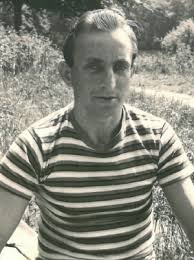
Wolfgang Lauinger loved swing music, which for him was a symbol of freedom. He rejected march and folk music, which stood for uniformity and obedience. He wanted to live independently, ride the Main Boat with friends, and go on excursions in the surrounding area. In their circle, he felt respected, safe, and at ease as a homosexual.
In January 1940, Wolfgang Lauinger was drafted into the Wehrmacht. But after only a few months, the order to discharge him came – as a „half-Jew“ he was undesirable. Back in Frankfurt, he joined the „Harlem Club,“ a group of young swing enthusiasts who met in cafes and parks, danced, and listened to their music – despite all the prohibitions. Long hair, striking clothing, English-speaking conversations – for the regime, all of this was an affront. The „Harlem Club“ did not want to conform, but to remain true to its way of life.
The Gestapo had long been aware of the Frankfurt swing scene; they observed its meeting places and recorded the names of its members. In the autumn of 1941 they took action. The first member of the group to be arrested was Franz Kremer. He was held in custody for two months. They interrogated him, beat him, and tried to force him to confess that Wolfgang Lauinger was homosexual. But Kremer remained silent. Perhaps by doing so he saved Lauinger’s life.
In early December 1941, Wolfgang Lauinger was also arrested. The charge: listening to „enemy broadcasts“ and having Anglo-Saxon tendencies. Until his trial in March 1942, he was held in solitary confinement in the Klapperfeldgasse in Frankfurt. However, neither the house searches nor the interrogations yielded anything incriminating; nevertheless, the court eventually sentenced him to three months in prison for illegal gambling and possession of a piece of leather. Altogether, he spent seven months in prison. After his release in June 1942, he went into hiding with his mother in Pforzheim until the end of the war.
In 1950, Wolfgang Lauinger was arrested as part of the Frankfurt homosexual trial – like many others, also on the charge of violating § 175 of the Criminal Code. He was held in solitary confinement for six months without being charged and was only acquitted in February 1951.
In the 1970s, he co-founded the Balduinstein Youth Camp and served as a witness. He saw education as the key to strengthening democracy. He fought for the rehabilitation of those convicted under § 175 of the StGB and called for the investigation of national-socialist influences in the judiciary of the early Federal Republic.
In early 2017, the Federal Republic passed a law to compensate those persecuted under the § 175 StGB, which was abolished in 1994. Lauinger subsequently applied for compensation for his time in custody in the years 1950/51, but in the autumn of 2017 his application was rejected – on the grounds that he had been acquitted at the time.
Despite all the setbacks, Wolfgang Lauinger never let himself be defeated – he remained a humorous free spirit who fought for his convictions.
Sources: The Lauinger Archive at the Jewish Museum Frankfurt am Main; Raimund Wolfert: Lauinger, Wolfgang. The Frankfurt People's Dictionary. A project of the Frankfurt Citizens' Foundation. Lauinger, Wolfgang; Bettina Leder: Lauingers. A Family History from Germany. (Jewish Memoirs, Volume 26). Berlin 2015.
- In 1993, Wolfgang Lauinger received the Johanna-Kirchner Medal of the City of Frankfurt am Main.
- Since 2005, he has been an honorary citizen of his long-time hometown of Balduinstein.
- In 2008 he was awarded the Federal Cross of Merit with the ribbon.
- Kerstin Rathgeb: Heroes against their will. Frankfurt swing youth – persecution and idealization. Münster 2001.
- Bettina Leder: Lauingers. A family history from Germany. (Jewish Memoirs, Volume 26). Berlin 2015.
- Wolfert, Raimund: Lauinger, Wolfgang. In: Frankfurter Personenlexikon 2022. Online edition.
- Podcast: Eyewitness Steven Hensel – Steven & Wolfgang: A History of Homosexual Persecution. Immerse yourself in Wolfgang’s life and let Steven tell you his life story. Episode #3, 2023. Zweitzeugen e. V.
- Joachim Telgenbüscher and Nils Minkmar: Frankfurt Homosexual Trials. §175 and its Victims. In: Wondery. What Has Happened So Far – History Podcast, October 15, 2024, Episode 32.
„Ruined Lives“ – Animated biopics by Dorota Gorski, including Wolfgang Lauinger, in the permanent exhibition
„WE ARE NOW“ at the Jewish Museum Frankfurt and online.
„We only heard marching music or folk songs, and that got to be a bit much after a while, because it had to do with keeping time in time.“

Ardi Goldman Kunst-
und Kulturstiftung gGmbH
Uniongelände
Hanauer Landstraße 188, 60314 Frankfurt am Main