Arndt Madrepora Wandobjekt, 2024
The Art Walk
Madrepora Wandobjekt, 2024
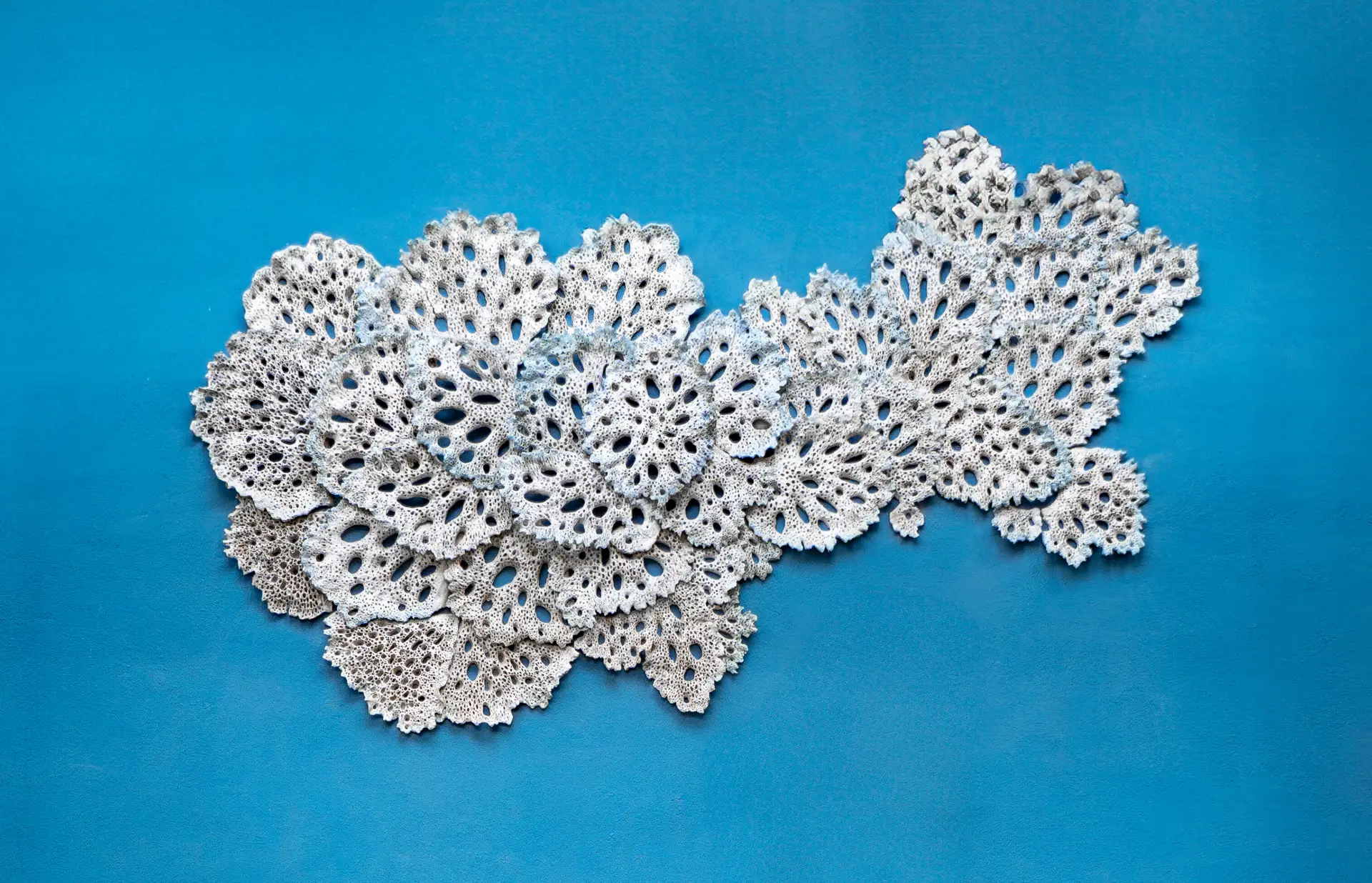
The organic structures of fungi, mosses, marine life, and plants are the source of my inspiration for sculptures. My works invite the viewer to explore them not only visually but also haptically – a connection between human and nature. In them lies an optimistic view of a possible future of harmonious coexistence.
EDUCATION
Grants, awards, recognition
2024 Artist Residency Jingdezhen Ceramic University, Jingdezhen
- Navigate to the location
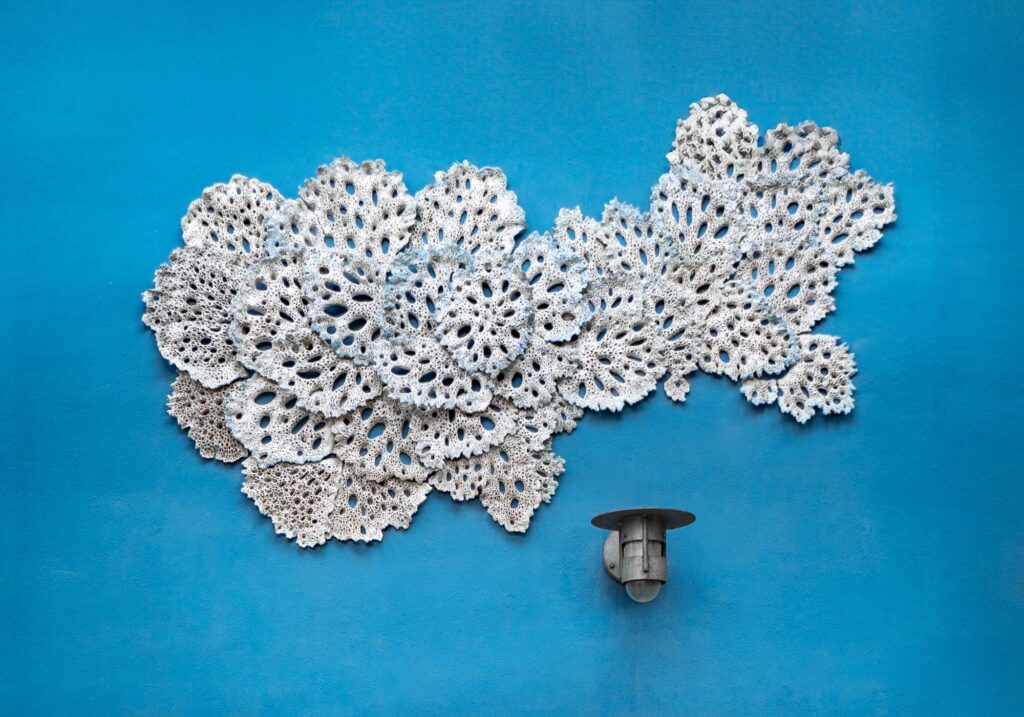
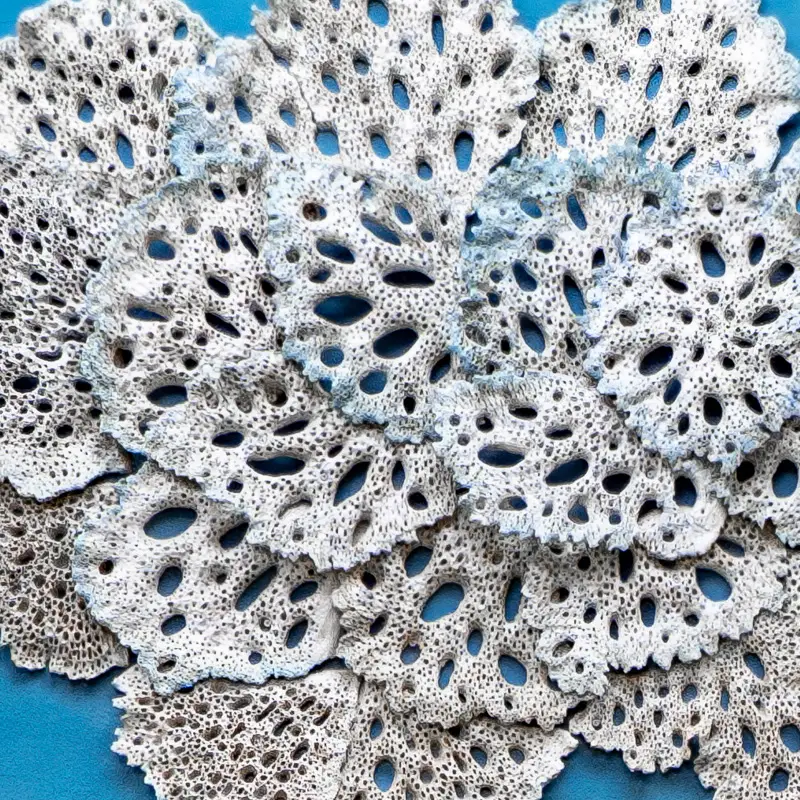
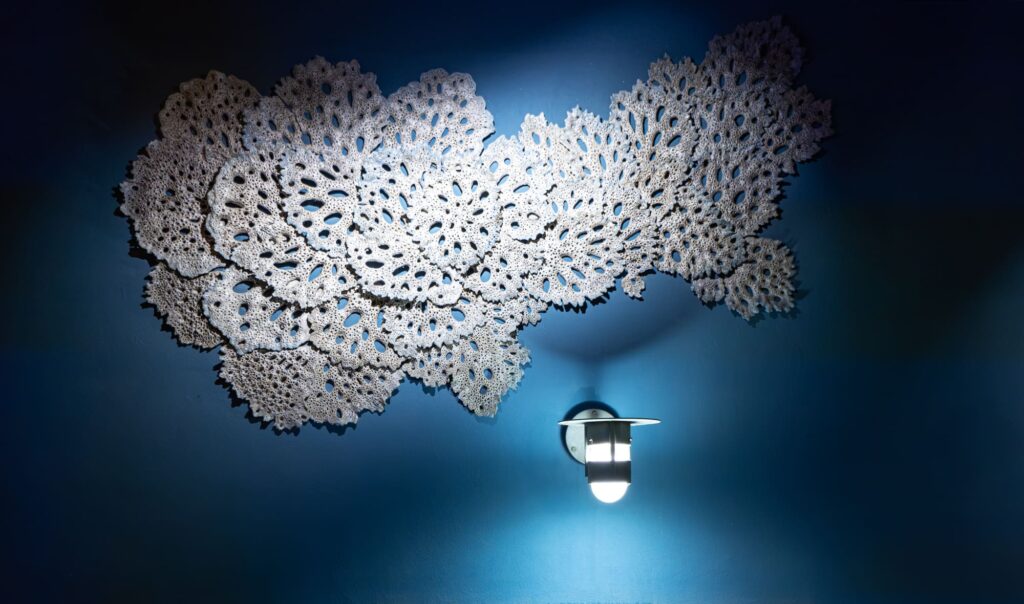
A Closer Look at the Work
In her work, the ceramic artist Felicithas Arndt combines traditional craftsmanship with new technologies to create lifelike, organic objects. She Felicithas Arndt studied Southeast Asian studies and Sinology before turning to art at the University of Design Offenbach in 2014. A formative journey to the Chinese porcelain capital of Jingdezhen led her not only to a deep exploration of ceramic materials but also to the naturalistic pictorial worlds of traditional Chinese painting, which continue to inspire her work to this day.
Arndt’s works consciously move between sculpture and design object, between art and function. They question the strict separation between the inner and outer world, between man and nature. Through the use of traditional construction techniques, special casting processes, and ceramic 3-D printing, autonomous sculptural forms with relief-like surfaces are created that evoke visual and tactile stimuli. Their objects invite touch, contemplation, and dialogue with the environment, not as decorative elements but as active participants in an ecological exchange.
At the center of their 2022-initiated series of works Motherpora It is a combination of hand-modelled stoneware and additive-manufactured modules from the 3D printer. The pink-glazed, richly textured sculpture grows mushroom-like out of the ground and spreads upwards. Its appearance shifts between artificially created and naturally grown elements, a hybrid form that makes the categories of plant, animal, object, and habitat permeable.
The title Motherpora Refers to a deep-sea stony coral whose calcareous skeleton branches off in fernlike or tubular forms. These cold-water corals have existed for over 30 million years; their habitats were only made visible by modern underwater technology. Arndt draws not only on the aesthetic forms of these marine creatures, but also on their ecological significance: in their choice of materials and design, they are inspired by ceramic research objects developed to rehabilitate damaged coral reefs, as their porous surfaces provide ideal conditions for the settlement of new life forms.
The Motherpora-The sculpture was specifically designed for the outdoor space as an artistic intervention that not only creates aesthetic space but also provides a tangible living space. Insects, lizards, mosses and lichens inhabit the structure, retreat into it during heat periods, survive without care and return. A cycle that takes place beyond human control. By doing so, the artist draws on ecological principles based on resilience, self-regulation and coexistence.
Formulated in times of growing ecological crises Motherpora A silent utopia: a space of possibility beyond anthropocentric dominance. The sculpture thematizes the mutual dependencies of all living beings and stands symbolically for a changed, non-hierarchical relationship between human beings, objects, and the environment. It is a work of art that returns what has been taken from nature and at the same time takes back itself in order to enable coexistence..
In its form, structure, and materiality, the sculpture transgresses the classical categories of the fine arts: it is simultaneously a living space, an aesthetic object, a figure of thought, and an experimental arrangement. At the same time, it is closely linked to current theoretical approaches, as formulated by the sociologist and philosopher Bruno Latour: the departure from the separation between human and nonhuman, towards a planetary cosmology., in which the coexistence of all actors – human and non-human – is rethought.
Felicithas ArndtHer work is not only remarkable in its formal and technical aspects, but also embodies a consistently sustainable approach. Her works reflect an artistic practice that neither idealizes nor instrumentalizes nature, but rather incorporates it, enables it, and makes it visible.. Motherpora In this sense, it is not just a sculpture; it is also a proposal for how art can play a cooperative role in the Anthropocene era.
About the Artist
The artist Felicithas Arndt (*1992 in Offenbach am Main) lives and works in Offenbach am Main and Darmstadt. Her artistic focus is ceramics and painting. In 2023 she was a finalist in the renowned international Faenza Prize for contemporary art ceramics. In 2024 she took over the workshop management of the Ceramic Art Lab at the HfG (College of Design) in Offenbach am Main and completed an artist residency at the Jingdezhen Ceramic University in the porcelain capital Jingdezhen (China).
Photos: © Stefan Gröpper Photography
Ardi Goldman Kunst-
und Kulturstiftung gGmbH
Uniongelände
Hanauer Landstraße 188, 60314 Frankfurt am Main