Kriwet Sehtext Rot-Schwarz, 1971
The Art Walk
Sehtext Rot-Schwarz, 1971
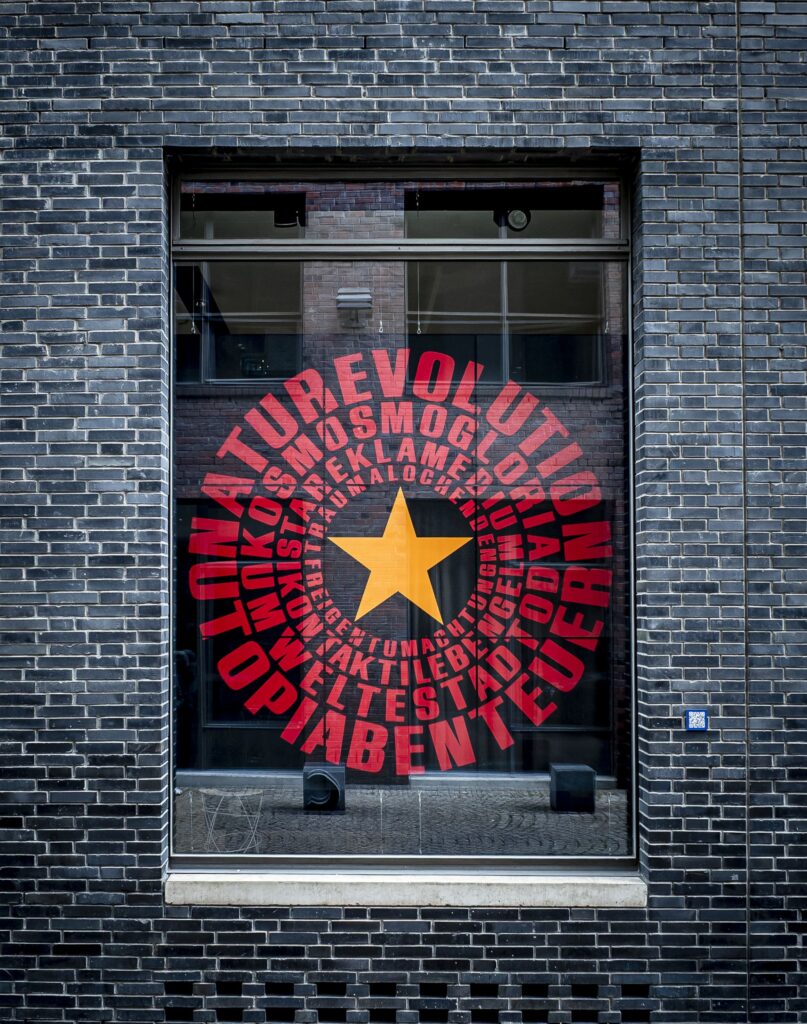
Art is information. Literature is the art of language in all its dimensions. All objects, materials, and media are suitable as carriers of linguistic information. The virtualization of language as writing is only one dimension.
EDUCATION
Grants, awards, recognition
2012 Audiobook of the Month July for „Rotoradio“, NRW
- Navigate to the location
About the Artist
In the context of the project, Ferdinand Kriwet, who died in Bremen in 2018 at the age of 76, plays a special role: he exemplifies the historical dimension of media art forms. From the 1960s onwards, Kriwet engaged intensively with the phenomenon of mass media. In addition to writing his own texts, he used audio and visual material from TV, radio, and print media in his artistic practice. Early on, his works, which could not clearly be classified under a single art form, gained international attention. Whether literature, music, or fine art: Kriwet consciously crossed the boundaries of genres and created his own artistic language. Today, he is regarded as a pioneer of word-image-sound..
He himself described himself as a writer, but was also understood as a „visual poet“, someone who deals with language in a figurative way. In addition to his typographic text works, which were shown, among other places, at the Heinrich-Heine-Institut in 2021 and in a retrospective at the Kunsthalle Düsseldorf in 2011 (Kriwet – Yesterday and Today) being recognized, he developed a series of experimental audio plays for radio.
Kriwet achieved his artistic breakthrough with his so-called Round discs, dense, circularly arranged letterforms that were created between 1961 and 1963. These works belong to the group of Viewing texts, The texts are deliberately played with through the perception of reading. The texts are neither linear nor clearly readable. Instead, they spiral, are mirrored upside down, or fragmented. The usual reading direction is disrupted; there is no clear beginning and no clear end. The viewers are invited to search for meaning themselves, decipher the text, and recognize patterns.
An example of this is the Sehtext Rot-Schwarz from 1971, which is shown in public space in the Union area. In this work, two contrasting colors meet: red and black. Their effect is visually impressive and ambiguous; they can be emotionally, politically, or symbolically charged: red as a color of passion, rebellion, or warning; black as a sign of power, sorrow, or control.
Kriwets’ works show how language can be not only content but also form and image. They call for us to understand reading itself as a visual and sensory experience. His large-scale text collages, often realized as prints, posters or spatial installations, have also found their way into the urban space. There they demonstrated how language can have an impact on the public: as structure, as a stimulus, as an overload or an invitation to think.
Ferdinand KriwetHis work moves between literature, image and sound, and it is precisely in this crossing of boundaries that its artistic power lies.
Photos: © Stefan Gröpper Photography
Ardi Goldman Kunst-
und Kulturstiftung gGmbH
Uniongelände
Hanauer Landstraße 188, 60314 Frankfurt am Main