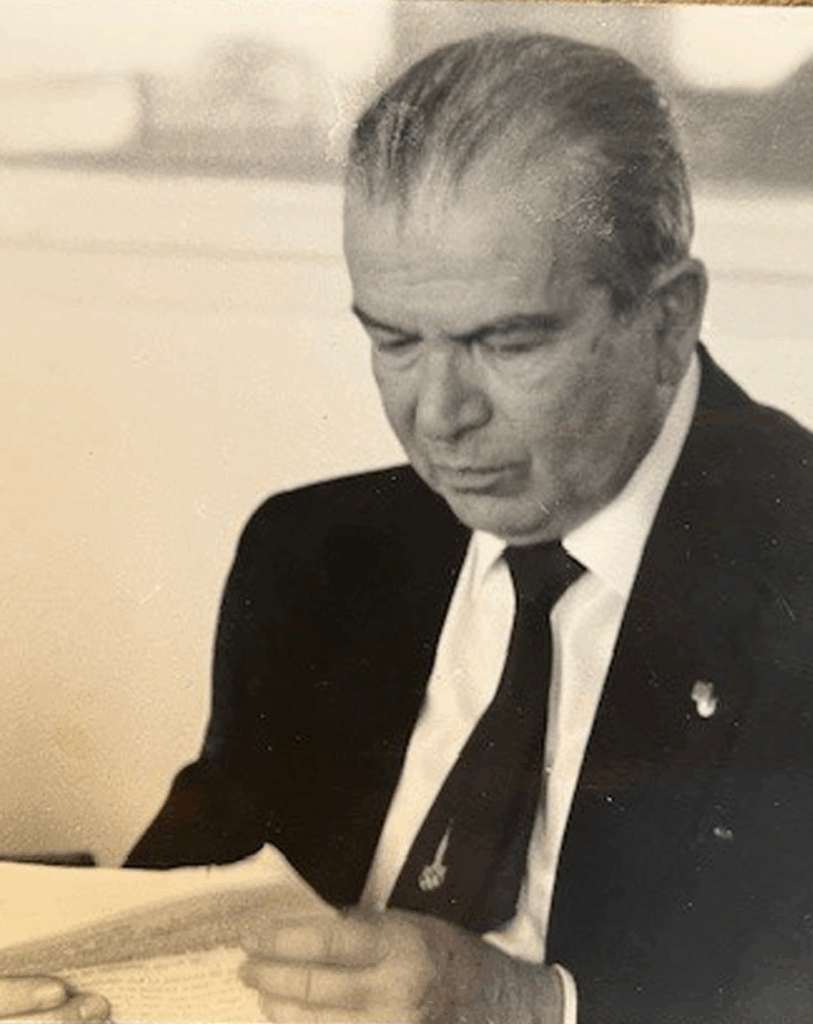
Emil Carlebach
Hopefuls
–
PORTRAIT
- Navigate to the location
Hitler was not an industrial accident.
–
·
,The bourgeoisie should be kept from getting their beak stuck in the roast goose! Down, down, down!“
Emil Carlebach, Christmas 1931
On July 10 Emil Carlebach, 1914, he was born in Frankfurt am Main in a prestigious Jewish family. He described the Justizmord (murder for justice) of the anarchist American workers Nicola Sacco and Bartolomeo Vanzetti as a defining experience. After the controversial court verdict against the two politically active workers and strike leaders for alleged involvement in a double robbery murder, mass demonstrations against the planned execution took place worldwide. He witnessed such a gathering in Frankfurt, which protested against the execution on August 23, Emil Carlebach 1927.
At the age of 16, he joined the Socialist Student League and in 1931 also the Communist Youth League of Germany (KJVD). After graduating from high school, he began an apprenticeship in a leather goods store in Frankfurt in May 1932 and became a member of the Central Federation of Employees (ZdA) on the same day.
On May 1, 1933, Emil had arranged with a group of young Communists to listen to Hitler’s speech on the radio, immediately respond to it with a flyer, and distribute it in Frankfurt the following night. Despite their lack of experience regarding the necessary precautions, the young people carried out this action: Their flyer, written by Emil, exposed Hitler’s speech and urged them to avoid following the lies of the fascists.
In early 1934, Emil Carlebach due to the production and distribution anti-fascist The newspapers sentenced him to three years in prison. After the regular sentence, he was sent to the Concentration camp Dachau deported, a year later he was sent to Buchenwald where he remained until the liberation of the concentration camp. There he continued his resistance: he was active in both the international illegal resistance organization and in responsible positions as a „block elder“.
His granddaughter Lena Sarah Carlebach reports in the interview with the Frankfurter Rundschau From May 2, 2025: „The members of the camp committee tried, at the risk of their lives, to mitigate the violence and arbitrary actions of the SS and protect fellow prisoners. They stood for solidarity within the inmate community. They advocated for a more equitable distribution of food and for no one to be disadvantaged. Weapons were also stolen and hidden in order to prepare for an uprising.“
The rescue of 904 children, who were spared from forced labor and abuse and were secretly provided with food, clothing, and heating material by fellow prisoners, was particularly impressive. Carlebach was among the prisoners who gave the signal for the uprising on April 4/5, 1945, and handed over the camp to the advancing U.S. troops on April 11, 1945, with the freed prisoners and captured SS guards.
Influenced by eleven years of fascist imprisonment, he remained Emil Carlebach a convinced and active anti-fascist. On August 1, 1945, he was appointed editor-in-chief of the newly founded newspaper by the Allied authorities in the American occupation zone. Frankfurter Rundschau appointed. In addition, he was a city councilor of the KPD in Frankfurt, a member of the Hessian State Assembly and participated in the drafting of the Hessian state constitution. However, with the onset of the Cold War, in 1947, at the behest of US authorities, Carlebach was removed from his leadership position. Frankfurter Rundschau removed.
He continued to work as a journalist, was a co-founder of the VVN (Association of Victims of the Nazi Regime) and First Vice President of the International Committee Buchenwald Dora and Kommandos. After the KPD ban of 1956, he was again persecuted as a communist and fled to the GDR. In 1969, after the lifting of the arrest warrant and the re-establishment of the DKP, he returned to Frankfurt am Main.
For Emil, working as an editor and long-time editor-in-chief for the weekly magazine „Die Tat“ published by the VVN was a focus of his further political and journalistic activities.
He was involved in various capacities in the VVN-BdA, the DKP, the Deutsche Journalisten-Union (dju), and later the IG Medien. As a witness, Emil often spoke to youth groups, in trade union organizations, at demonstrations and rallies, and never tired of pointing out the political backgrounds and connections that had enabled the Nazi state. His articles and speeches were characterized by incisive warnings of the impending social legal developments, growing neo-fascism, and a renewed threat of war.
His life was marked by his fight against fascism from his youth until his death. He Emil Carlebach died on April 9, 2001 in Frankfurt am Main.
© Lena Sarah Carlebach, Mathias Meyers
Further source: Theresa Stoll: „His political convictions certainly gave him strength.“ FR, 02.05.2025.
- Because of his resistance to National Socialism, he was awarded the Johanna-Kirchner Medal of the City of Frankfurt am Main in Emil Carlebach 1991.
- In 2019, a plaque will be dedicated to him in Gaußstraße in Frankfurt am Main.
- Emil Carlebach: Hitler was no industrial accident. Behind the scenes of the Weimar Republic. With a preface by Wolfgang Abendroth. Frankfurt am Main 1982.
- Emil Carlebach At the beginning was a double murder: Communist in Germany, Volume 1. Cologne 1988.
- Association of Campmates Buchenwald-Dora/Friends Circle e. V. (ed.): Christoph Leclaire, Ulrich Schneider: – Emil Carlebach Resistance fighters and former prisoner of the concentration camp Buchenwald. Bonn 2014.
- Witnesses Emil Carlebach in the six-part interview on the Zeitzeugen portal of the Foundation Haus der Geschichte of the Federal Republic of Germany about the years 1932/1933.
- Thomas Knecht: Carlebach 1 – Emil Carlebach talks about Buchenwald and the liberation of the camp
on April 11, 1945. YouTube.
Sacco and Vanzetti They were Italian immigrants and anarchist activists who were convicted in Massachusetts in 1920 for the murder of a shoemaker and his companion. The trial was marked by injustices and prejudices, and many believed they had been convicted based on their political views and origins. Their execution on August 23, 1927, sparked worldwide protests and remains a symbol of injustices in the justice system.
,The bourgeoisie should be kept from getting their beak stuck in the roast goose! Down, down, down!“
Ardi Goldman Kunst-
und Kulturstiftung gGmbH
Uniongelände
Hanauer Landstraße 188, 60314 Frankfurt am Main