Jülich Jean
Hopefuls
–
PORTRAIT
- Navigate to the location
Disturbing elements – we need them. They disturb the peace of the government.
„We let the healthy common sense of young people prevail. We sensed that something was wrong with the Nazis.“
Jean Jülich
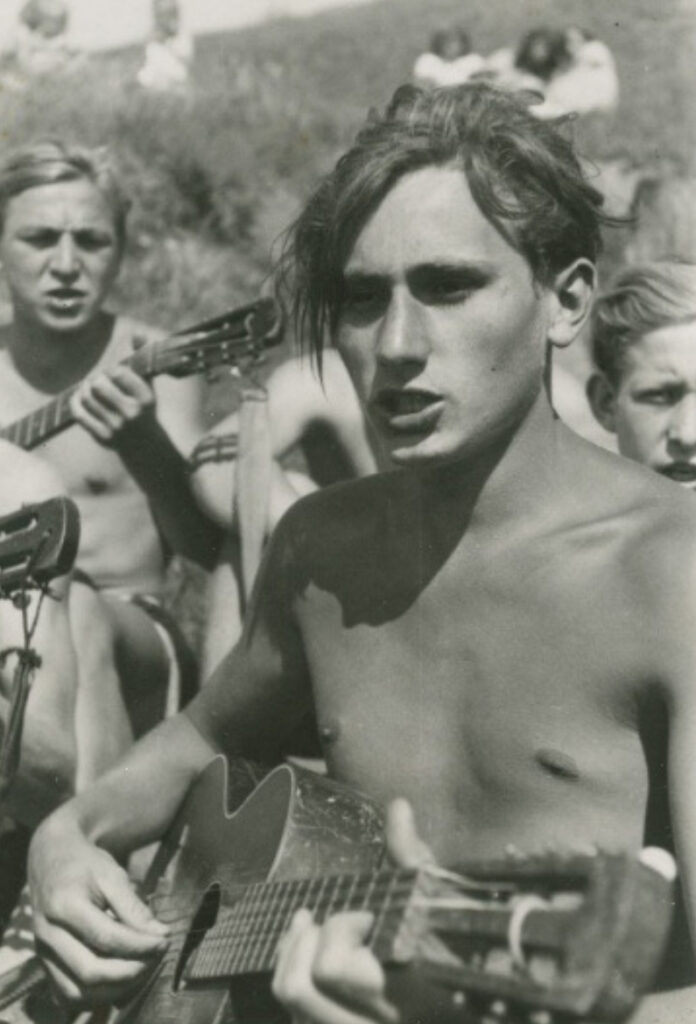
Jean Jülich He grew up in Cologne with his grandparents. His father was a Communist and was sentenced in 1935 to ten years in a labor camp. His mother Anna Maria worked in a umbrella factory and could not care for the child. After the grandmother was also arrested, he had to Jean Jülich be placed in an orphanage for several months and only returned to his family after the grandmother was released from prison. In Jean Jülich 1939 he joined the „Young People’s League“ and later the „Flying Youth League“. After attending elementary school, he began training at the Reichsbahn repair shop in Cologne-Nippes in the spring of 1943 as a machine locksmith. He is called up for service at the Westwall, but deserts from there. Jean Jülich In late autumn Jean Jülich 1942, he comes into contact with Edelweiß pirates. He learns to play the guitar and goes on a trip with his friends to the Cologne area. There are frequent confrontations with the „Hitler Youth”. Through his friend Ferdinand Steingass, he gets involved with the group around Hans Steinbrück in Cologne-Ehrenfeld. They provide Steinbrück with a bomb device that they found in a cellar after a bombing attack. However, he avoids further contact with the Steinbrück group because he does not like the „activity there”. In connection with the persecution of the Steinbrück group, Jean Jülich he was arrested on October 10, 1944 and imprisoned in the Gestapo prison Brauweiler. Before the advancing Allied troops arrived in February 1945, he was transferred to the Rockenbach prison, but in March 1945 he was freed by American troops. After that, he lived in Cologne.
© Memorial to the German Resistance
Jülich has made it its life’s mission to counter these accusations that the Edelweißpiraten were „criminals“. He gives interviews, holds lectures at schools, takes part in discussion rounds and events. After extensive historical research, the „Edelweißpiraten“ are finally rehabilitated and recognized as resistance fighters.
- In Jean Jülich 1982, Yad Vashem honored him as a „Righteous Among the Nations.“.
- For his commitment „against the forgetting of the events of the National Socialist era“, Jülich received the Federal Cross of Merit in 1991.
- For his publications, lectures and actions, he received the Rheinlandtaler of the Rhineland Landscape Association in May 2007.
- With the Heine bust of the Heinrich Heine Friends’ Circle, he was awarded in 2008 – as a tribute to his commitment to the spirit of criticism.
- In 2013, a footpath near his apartment in the southern part of Cologne was named after him.
- Matthias von Hellfeld: Edelweißpiraten in Cologne. Youth rebellion against the Third Reich. Cologne 1983.
- Jean Jülich Carbon dioxide, prison and camellias – An Edelweißpirat tells his life story. Cologne 2003.
- Simone Dittmar: „We want to be free from Hitler.“ Youth resistance in the Third Reich through the example of three Cologne Edelweißpiraten (White Rose Youth). Frankfurt am Main 2011.
- Sascha Lange: Meuten, Swings & Edelweißpiraten. Youth culture and opposition in National Socialism.
Mainz 2015. - Foundation Gedenkstätte Deutscher Widerstand (ed.): Resistance of young people.
Thematic catalogue 13th edition, Berlin 2018.
- The Edelweiss Pirates. Directed by Niko von Glasow. Germany 2004. He Jean Jülich also appears in the film and takes on the role of the older Karl Ripke.
- The Edelweiß Pirates of Ehrenfeld. The documentary features, among others, Gertrud „Mucki“ Koch and Wolfgang Schwarz. November 2013. YouTube.
- Burghard Laugwitz: In an interview with WDR 5, Jülich recounted his time with the Edelweißpiraten and the challenges of the Second World War. Editor: Mark vom Hofe. WDR 5 – Erlebte Geschichten, 07.11.2004.
- Alfried Schmitz: Jean Jülich, Edelweißpirat and Resistance Fighter. Deutschlandfunk Archive, 19.10.2021.
„We let the healthy common sense of young people prevail. We sensed that something was wrong with the Nazis.“
Ardi Goldman Kunst-
und Kulturstiftung gGmbH
Uniongelände
Hanauer Landstraße 188, 60314 Frankfurt am Main