Leipzig riots
Hopefuls
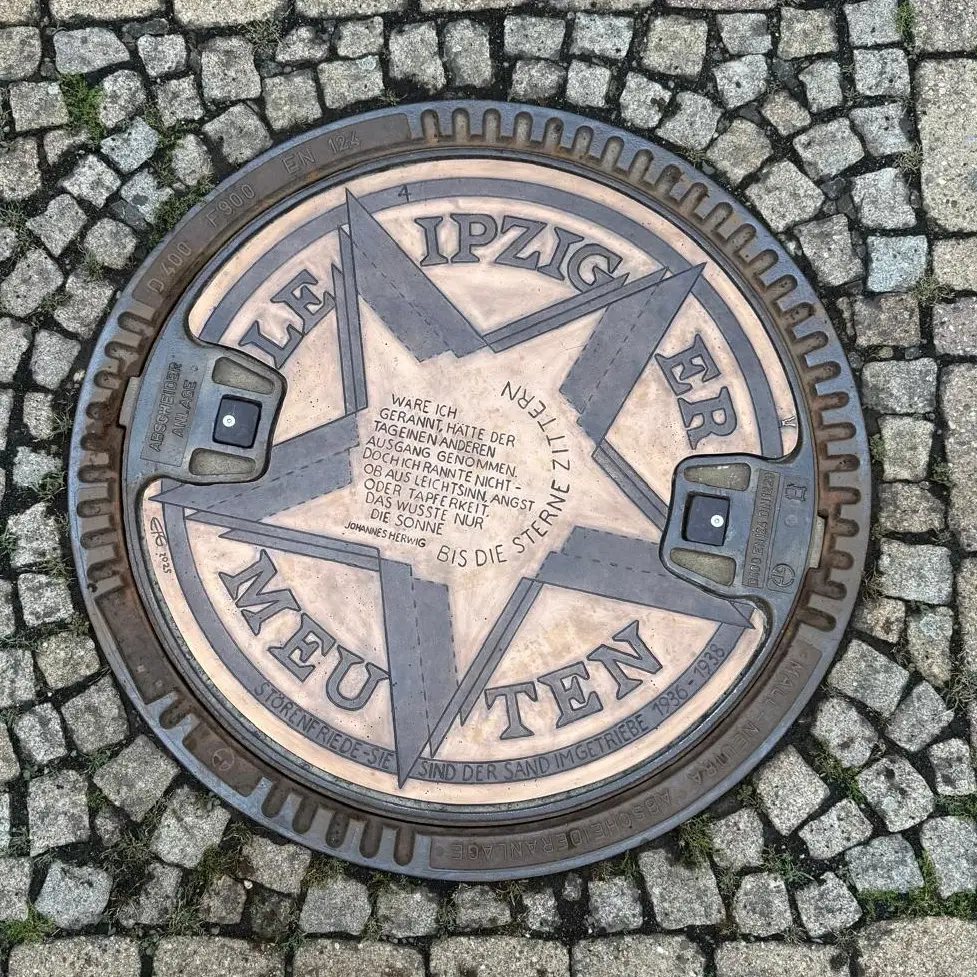
Ground relief
- Navigate to the location
Disturbing elements - they are the sand in the gears.
People:
Tool locksmith Wolfgang Schieweg
„If I had run, the day would have taken a different course. But I didn’t run—whether from carelessness, fear, or bravery, only the sun knew that.“
Johannes Herwig: Until the stars tremble
In Leipzig at the end of the 1930s, a youth movement is growing that consciously ignores the pressure of national-socialist conformity. While peers in the Hitler Youth march, greet with flags and chant slogans, they take a different path: freedom instead of obedience. Music instead of marching. Friendship instead of leader cult.
They call themselves Meuten – and they mean it seriously.
The members come primarily from the working-class milieu. In parks, on swimming lakes or on bicycle tours in the surrounding area, they find their niches. There they play banned music, sing their own songs, talk openly – places of free thinking in the midst of a repressive state. In Leipzig there are over 20 of these groups: „Hundestart“, „Texas“, „Lille“ or „Reeperbahn“. Between 1937 and 1939, up to 1,500 young people joined the riots.
Their appearance is a given: checkered shirts, lederhosen, long hair, red headscarves, sometimes with skull stickers. No uniform. No „Heil Hitler“. Their message is clear – to be different. Many refuse to join the HJ. Some write slogans like „HJ is gone“ on flyers, others attack HJ members who are no longer afraid to go out alone at night.
These groups are not a classic resistance movement. Their protest begins with a longing for self-determination: a youth life free from discipline and dogma. But precisely this makes them dangerous for the Nazi regime.
Persecution and destruction
The Gestapo watches the crowds early on. Their size, their steadfastness – all of this is perceived as a threat. In 1939, a targeted wave of arrests follows. Around 90 young people are arrested – the charges: „state-enemy activities“ and „preparation for treason“. Some end up in detention centers, minors in reeducation camps. Some of them later disappear altogether – in concentration camps.
With that, the story of the Leipzig riots ends – for now.
But their example remains: a movement without central organization, without a political agenda – driven solely by the desire to be able to live differently. In a time when that was life-threatening.
Action instead of a slogan
The demonstrations show what resistance can be: a silent no that becomes loud when it cannot be broken. No big speeches, no manifestos – but a determined everyday life against a system that did not tolerate any deviation.
The resistance of Leipzig youth continued – starting in 1942 under new names such as the Broadway Clique. But that is a different story.
- Kurt Schilde: Leipzig Mutinies. In: Wolfgang Benz/Walter H. Pehle (eds.): Dictionary of German Resistance. Frankfurt am Main 1994, pp. 254 f.
- Alexander Lange: Mutiny – Broadway Clique – Young Guard. Leipzig youth groups in the Third Reich.
Cologne/Weimar 2010. - Sascha Lange: The Leipzig Mutins: Youth Opposition in National Socialism. Leipzig 2013, 3rd edition.
- Johannes Herwig: Until the Stars Shake. Youth novel. Hildesheim 2017, 5th edition.
- Foundation Gedenkstätte Deutscher Widerstand (ed.): Resistance of young people.
Thematic catalogue 13. Berlin 2018, 2nd edition.
- Sascha Lange: The Leipzig mob „No Bock on HJ“. Screenplay/direction: Gunther Fischer. A short film project by the school museum. Leipzig 2011. YouTube.
- Since 2012, a permanent exhibition in the Schulmuseum Leipzig has been dedicated to the history of the Leipzig riots.
- Sounds of Resistance is a project of The Theater der Jungen Welt Leipzig and the Deutsche Oper am Rhein Duisburg. Under the direction of Schorsch Kamerun, young people and professional artists tackled youth resistance against the Nazi regime. The result is a musical theater project with two performances, a memorial site, and a digital archive that connects youth culture and resistance then and now.
- „Meuten Memorial“ at the Lindenauer Market (May 2025): LED running inscriptions commemorate the Meuten in Leipzig and make the voices of young people in public space visible.
- Wolfgang Schieweg“Strike the HJ wherever you meet them.” Buchenwald Memorial Museum Media Library.
- The digital archive „Sounds of Resistance“ has been online since June 2025. The platform shows where in Leipzig the riots left their traces (soundsofresistance.de – Sound Archive).
„If I had run, the day would have taken a different course. But I didn’t run—whether from carelessness, fear, or bravery, only the sun knew that.“

Ardi Goldman Kunst-
und Kulturstiftung gGmbH
Uniongelände
Hanauer Landstraße 188, 60314 Frankfurt am Main