Rosenstraßen protest
Hopefuls
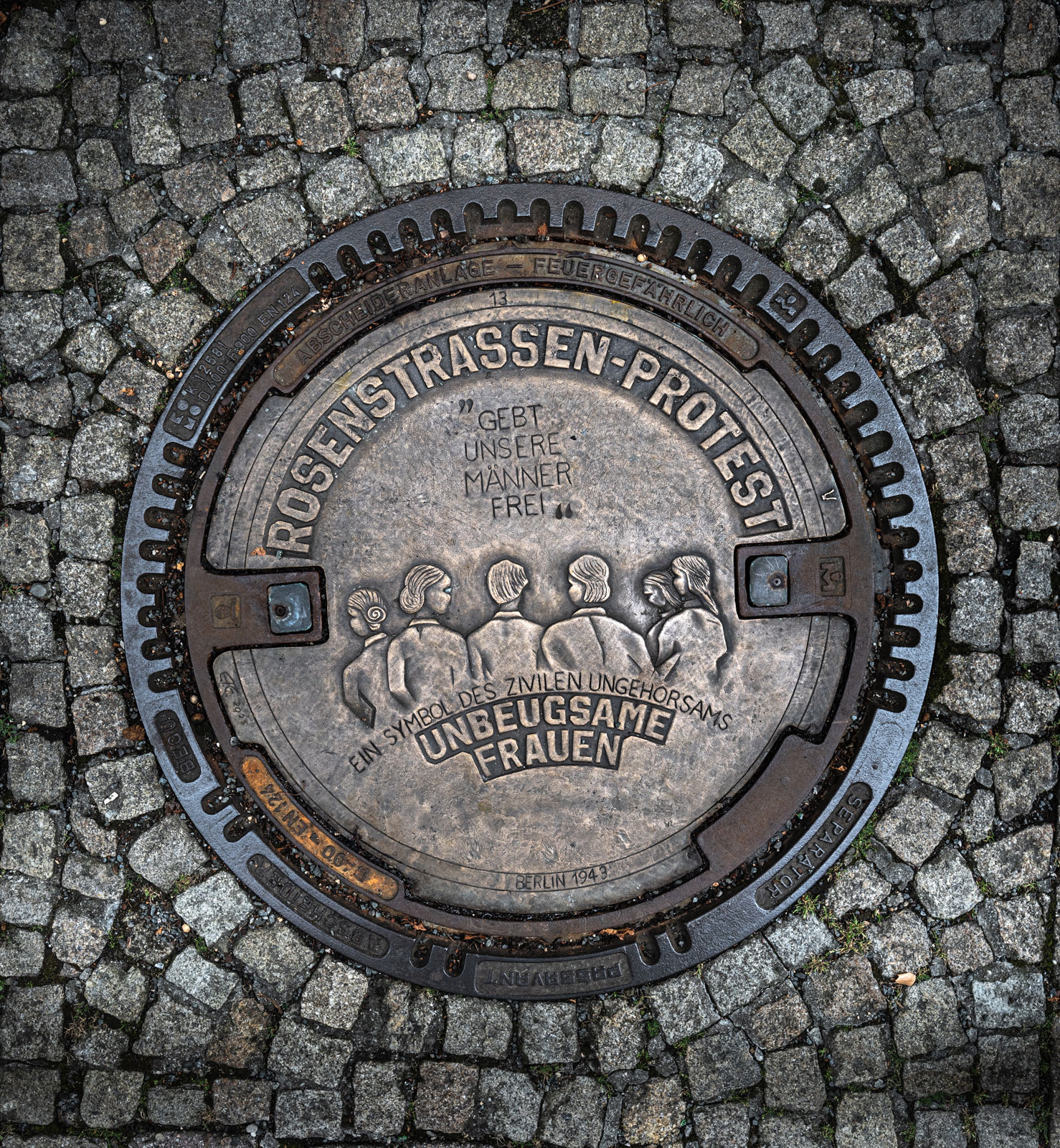
Ground relief
- Navigate to the location
Free our men!
People:
Demonstrant Gisela Mießner
On February 27/28, 1943, as part of the „Factory Action,“ approximately 11,000 Jewish women and men employed in the armament industry were forcibly arrested. One building in Rosenstraße served as one of several collection camps during this action. The Jewish women and men were to be deported to the Auschwitz-Birkenau concentration and extermination camp and the Theresienstadt ghetto.
More than 1,700 Jews are imprisoned in the former welfare office of the Berlin Jewish community in Rosenstraße 2–4. Most of those held there are married to non-Jewish women.
The news of the imprisonment of the Jewish men in Rosenstraße spreads quickly among the relatives. Several hundred women gather in front of the building and protest for the release of their relatives. Most of the men are released by mid-March 1943. However, they must continue to perform forced labor under extremely harsh conditions.
The women involved in the protest will not be punished.
© Memorial to the German Resistance. Catalogue for exhibition Women in Resistance to National Socialism, p. 81.
- Two monuments commemorate the protest in Berlin's Rosenstraße: In 1989, at the beginning of the street
(House numbers 1–2) a memorial tablet initiated by a project group was erected. In 1995, the multi-part sculpture followed at Rosenstraße 2–4. „The “Women’s Block” by Ingeborg Hunzinger. - On September 9, 1998, a memorial plaque was unveiled at Haus Rosenstraße 2 – initiated by hotel owner Wolfgang Loock (Alexander Plaza Berlin). At the ceremony, among others, Bundestag President Rita Süssmuth, Ignatz Bubis, the then chairman of the Central Council of Jews, and District Mayor Joachim Zeller were present.
- Nina Schröder: Hitler's unyielding opponents. Munich 1997.
- Nathan Stoltzfus: Resistance of the Heart. The Rebellion of the Berlin Women in Rosenstraße in 1943. Munich 1999.
- Gernot JochheimWomen's protest in Rosenstraße Berlin 1943. Reports, documents, background information.
Berlin 2002. - Wolf GrunerResistance in Rosenstraße. The factory action and the persecution of „mixed marriages“ in 1943.
Frankfurt am Main 2005. - Antonia Leugers Berlin: Rosenstraße 2–4. Protest in der NS-Diktatur. Neue Forschungen zum Frauenprotest in der Rosenstraße 1943. Annweiler 2005.
- Rosenstraße. German feature film. Directed by Margarethe von Trotta. Germany 2003.
- Protest in Rosenstraße. Eyewitness report by Gad Beck, who was imprisoned there. Yad Vashem, YouTube, March 2, 2011.
A mixed marriage in Rosenstraße. WDR Radio Mediathek 2025.
Eyewitness report
Charlotte Freudenthal’s eyewitness account of the Rosenstraße protests in 1943 is an impressive testimony to an extraordinary act of civil resistance. Here is an excerpt from her speech on June 3, 1990 at an event organized by the Volks-Universität on the topic „Women in the Resistance against German Fascism“:
„(…) On February 27, 1943, my Jewish husband went to the police to apply for a permit to work. Instead, he was arrested and taken to the assembly camp in Rosenstraße – it was the day of the „factory action“ that Goebbels wanted to make Berlin „Judenfrei“ with.
When my husband didn’t come home, I searched for him and soon found myself in front of the building on Rosenstraße – along with many other women who were desperately calling for their loved ones. Despite the SS guards, we did not back down, but came back day after day and shouted loudly: „We want our men back!“ Our cries echoed through the streets, getting louder and more desperate. Eventually, the SS put up machine guns and threatened to fire. Some fled, but most stayed. I was pushed forward, right in front of one of the guns. At that moment, all I thought was: Now I can't save my husband anymore; everything is over now. It was terrible how loud it was, how loud we were screaming. But suddenly the SS took down their weapons – and it was quiet.
On March 7th, I received the news that my husband would be released. And indeed, he returned. Traumatized but alive. We survived the 12 years (of the Nazi era). They were terrible years. I admit that. But I would never have left my husband, never.“
Charlotte Freudenthal – Lecture from June 3, 1990 at an event of the Volks-Universität on the topic „Women in the Resistance against German Fascism“. Source: Jochheim, Gernot: Women’s Protest in Rosenstraße Berlin 1943. Reports – Documents – Backgrounds. P. 64-65. Berlin 2002.
Diary entry from March 7, 1943 by Ruth Andreas-Friedrich (Resistance group Onkel Emil) regarding the Rosenstraße protest:
“(...) The Jewish partners in racially mixed marriages. Separated from the others, they were transported to a collective camp last Sunday. For examination and final decision. On the same day, the wives of those men set out to search for their arrested spouses. Six thousand non-Jewish women crowded into Rosenstraße, in front of the gates of the building where the „Arischversippten“ were being held captive. Six thousand women called out to their husbands. Shouted after them. Stood like a wall. Hour by hour, night and day. (…).“
Ruth Andreas-Friedrich The Shadow Man. Diary Records 1938–1948. Berlin 2000.
On February 27, 1943, the „Factory Action“ took place in the German Reich, in which thousands of Jewish forced laborers were arrested at their workplaces and subsequently deported to Auschwitz.

Ardi Goldman Kunst-
und Kulturstiftung gGmbH
Uniongelände
Hanauer Landstraße 188, 60314 Frankfurt am Main