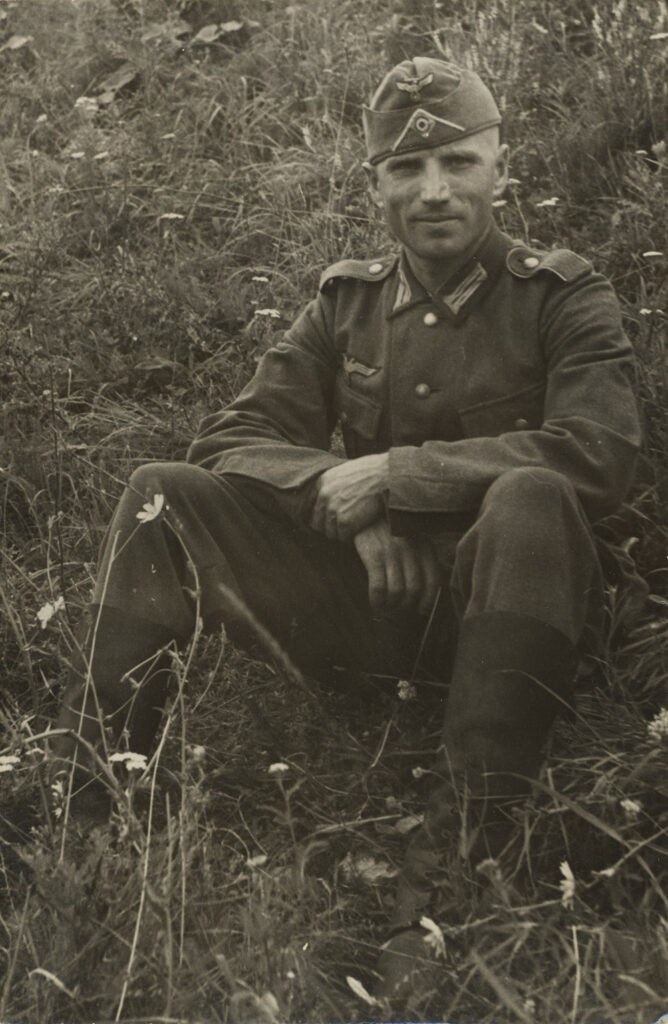
After completing an apprenticeship as a woodcarver, he studied Kurt Schumacher at the Berlin United State Schools of Free and Applied Arts. There he met Elisabeth Hohenemser, whom he married in 1934. The soon-to-be acclaimed master student became Harro Schulze-Boysen associated with the magazine „gegner“. The medallions received at the Berlin Lock Bridge are among his first commissioned works as a freelance sculptor. Political discussions in Schulze-Boysen’s circle of friends strengthened the emerging resistance network. Contacts with Heinrich Scheel and Eugen Neutert Hans Coppi expanded the circle of supporters. In May 1941, he Kurt Schumacher agreed to maintain communications with the Soviet Union as a radio operator in the event of war. However, in early June 1941, he was drafted into the Wehrmacht. In early August 1942, he took in Albert Hößler, a parachute agent from Moscow, and guided him in his work. Hans Coppi Upon the arrest of Schumacher on September 12, 1942, the Kurt Schumacher Gestapo devastated his studio and destroyed numerous works. On December 19, 1942, he was sentenced to death by the Reich War Tribunal and murdered three days later in Berlin-Plötzensee.
© Memorial to the German Resistance
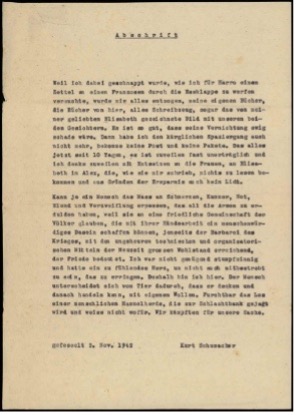
Copy of the last cashier's book from Kurt Schumacher November 2, 1942
Because I was caught trying to throw a note to a Frenchman through the trash can for Harro, everything was taken from me: my own books, the books from here, all my writing materials, even the picture my beloved Elisabeth gave me with our two faces. It’s so good that my destruction would be a terrible loss forever. Then I don’t even have the meager walk anymore; I don’t get any mail or packages. All this has been going on for 10 days now, it’s almost unbearable at times…
No single person can measure the extent of the pain, sorrow, distress, misery, and despair that all the poor have to endure because they belong to a peaceful community of nations.
People believe that by their manual labor they can create a dignified existence beyond the barbarity of war, achieving great prosperity with the immense technical and organizational means of modern times, and that peace means that. I was not foolish enough and had a heart to feel that I should not also strive to achieve that. That is why I am here. Man differs from the animal in that he can think and act according to his own will. Horrible the fate of a human herd of sheep that is hunted to the slaughter and does not know what it is for. We fought for our cause.
tied up 2nd Nov 1942 Kurt Schumacher
© Memorial to the German Resistance