Trollmann Johann
Hopefuls
PORTRAIT
- Navigate to the location
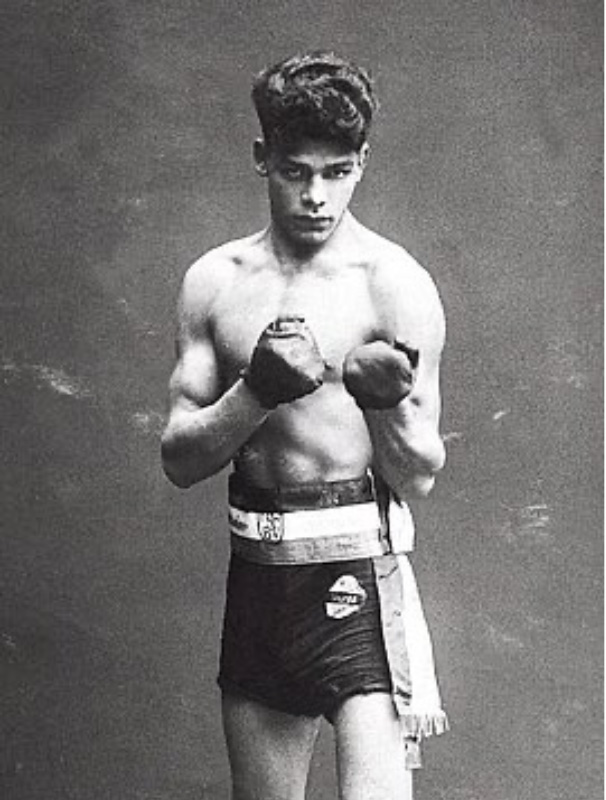
The German boxing champion. He danced in the ring.
27th December 1907 – 1944
Wilsche ∙ Neuengamme Außenlager Wittenberge
„I was ashamed that I was a Sinti woman. But today it makes me proud. I am the daughter of this
a great man.“Rita Vowe-Trollmann
Johann Wilhelm Trollmann grew up with eight siblings in poor conditions in the Old Town of Hanover. At the age of eight, he first entered the boxing ring. He won the regional championship four times in his early years and participated in the German Amateur Boxing Championship. When he was not selected for the Olympic Games in Amsterdam in 1928, he decided to become a professional boxer. His success grew rapidly. In 1930 alone, he competed in 13 fights, including international ones. After the Nazi regime came to power, the boxing clubs were „realigned”; „non-Aryan” members, such as the Sinto, were Johann Trollmann excluded. In June 1933, eight days after his victory over Adolf Witt, Johann Trollmann the title as German boxing champion in the light heavyweight division was revoked. In July 1933, he appeared in a boxing match with blond hair and white powdered skin to demonstrate against the racial hatred of the Nazi regime.
He had to give up his professional career and went on to make a name for himself as a boxer in the following years. In 1938, he was held captive for several months in the Hannover-Ahlem labor camp. After being released, he briefly went underground to avoid further arrests. In 1939, Trollmann was drafted into the Wehrmacht, was wounded on the Eastern Front in 1941, and was excluded from the Wehrmacht in 1942 for „racial reasons”.
In June 1942 he was arrested in Hanover, severely mistreated, and a few weeks later transferred to the Neuengamme concentration camp. In 1944 he was murdered Johann Trollmann in the outside camp of Wittenberge.
© Memorial to the German Resistance
- Johann „Rukeli“ Trollmann Today, it is publicly honored in many places. In the Kreuzkirchen district of the Old Town of Hanover, a footpath was renamed Johann-Trollmann-Weg in 2004. A plaque was also placed there in 2008 in front of his former residence.
- In Hamburg too, a plaque in the Schanzenviertel district, in front of the Roten Flora, has been commemorating Trollmann since 2009; he had fought several professional fights there – most recently in November 1933.
- In 2003, Trollmann received his master's title in the light heavyweight division from the Bund Deutscher Berufsboxer e. V. (BDB).
- Another stumbling block was placed in front of the former Bockbrauerei in Fidicinstraße in Berlin-Kreuzberg in 2010 – one of its historical boxing venues, on which a memorial plaque is now also attached. On January 28, 2011, the sports hall of the former Rosegger elementary school in Berlin-Kreuzberg was named Johann-Trollmann Boxcamp.
- Since 2023, a path in Gifhorn-Wilsche bears his name. The artist collective Bewegung Nurr is setting a special mark with the project „9841 – Temporary Monument to Johann Rukeli Trollmann“. The walkable sculpture in the shape of a slanted boxing ring, named after his inmate number, was temporarily displayed in Berlin in 2010 and in Hanover in 2011 and has been permanently displayed in the outdoor area of the Hellerau Festival Theatre in Dresden since October 2012.
Hans Firzlaff: Knock-out. The life of the German Sinti boxer Rukeli Trollmann from the Old Town of Hanover.
2nd edition, Hannover 1997.
Gibsy – The story of the Hanoverian boxer Johann Rukeli Trollmann. Documentary drama/biopic. Book, direction and production: Eike Besuden. Germany 2012.
Jennifer Stange: Nazi victims Johann Trollmann – The dancing „Gypsy“. Deutschlandfunk Archive, 27.06.2020.
„I was ashamed that I was a Sinti woman. But today it makes me proud. I am the daughter of this
a great man.“
Ardi Goldman Kunst-
und Kulturstiftung gGmbH
Uniongelände
Hanauer Landstraße 188, 60314 Frankfurt am Main