Wijsmuller-Meijer Geertruida
Hopefuls
–
PORTRAIT
- Navigate to the location
Goodbye, Mom! Goodbye, Dad! See you soon, my child!
„Wherever you can help, you must help.“
Geertruida Wijsmuller-Meijer
Geertruida „Truus“ Wijsmuller-Meijer, born on April 21, 1896 in Alkmaar, had been helping Jewish children escape from Nazi Germany since 1933. From 1938 onwards, „Auntie Truus“, as the children called her, saved thousands of them from persecution by the Nazi regime.
Truus was a Dutch woman, not Jewish, who had a vast network – and was brave enough to negotiate with Adolf Eichmann. In December 1938, she traveled to Vienna to talk with him about the deportation of 600 Jewish children to England. Eichmann agreed – on the condition that all the children leave Austria within five days. He was convinced that this was impossible in such a short time. But Truus used her connections and did not hesitate: In the same week, the children traveled.
From then on, she could no longer stay put. In Germany and Austria, Truus searched for children whose parents were desperately trying to bring them to safety. She traveled to Frankfurt, Berlin, Hamburg, Vienna, Breslau, Danzig, Königsberg, and Prague. Supported by children’s rescue committees and with the help of her contacts in the authorities, she organized weekly transports. Approximately 500 children regularly left the Dutch port of Hoek van Holland for England. The last transport departed on May 14, 1940 – the day of the Dutch surrender. On board: five buses with children from Amsterdam orphanages, personally sent on the journey by Truus.
Even after the last children’s transport, she continued her commitment. Now she helped especially adult Jewish refugees escape to foreign countries and provided urgently needed food and medicine to internees in camps and prisons. In 1944, she prevented the deportation of about 50 orphaned children from the Westerbork camp to Auschwitz. She did not hesitate for a single second – and told the authorities that the children were „of Aryan origin“. Instead of going to Auschwitz, they were transported via Bergen-Belsen to Theresienstadt and survived. In May 1945, the first train with survivors from Theresienstadt arrived in Maastricht. Truus stood at the train platform and personally welcomed the children.
Sources: Yad Vashem; Christa Matenaar: Geertruida Wijsmuller–Meijer – Biography. FemBio – Women. Biographical research, online.
- Geertruida Wijsmuller-Meijer received numerous honors, including the 1948 Medal of Recognition and the St. George's Medal in 1959.
- In 1966 she was recognized by Yad Vashem as a Righteous Among the Nations.
- In addition, she was an officer in the Order of Orange-Nassau and an honorary citizen of Amsterdam; many Dutch towns and places bear her name.
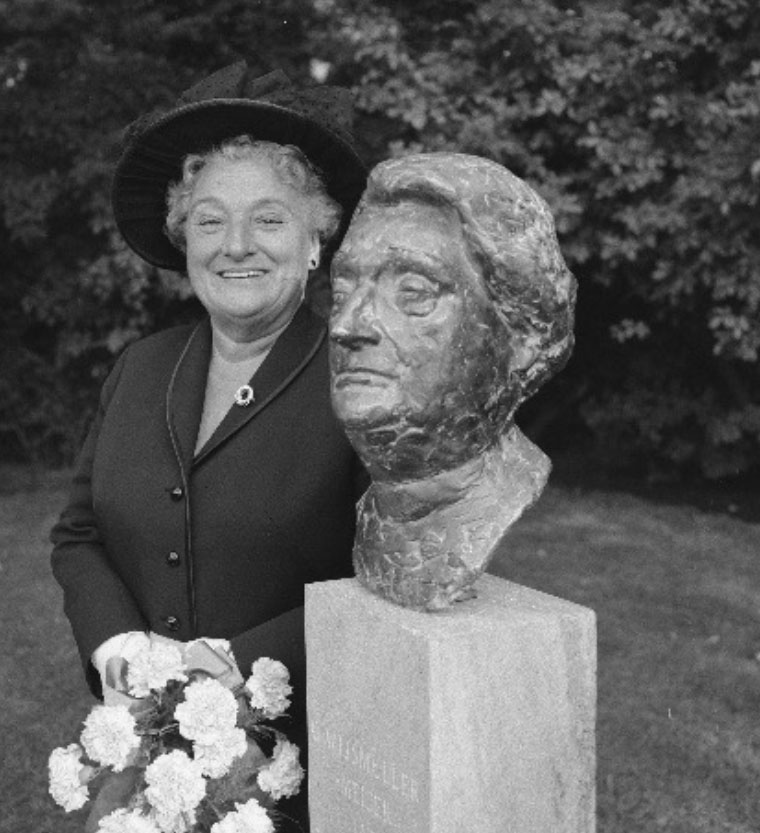
- In 1978 a bronze bust was erected on Bachplein in Amsterdam, and in 1980 a foundation for mentally disabled children and young people was established in Almere in their memory.
- In 2011 an asteroid was named after her (15296 Tantetruus) And in 2020, a monument in her hometown was dedicated in her honor.
Miriam Keesing: The children of Aunt Truus. Foundation Deutsche Kriegskinder in den Niederlanden (DOKIN) 2010, online.
European Holocaust Research Infrastructure – Podcast: The Lost Letter: It tells the story of Tommy Benford Jr., born in Paris in 1939 and Truus Wijsmuller-Meijer rescued. The basis is the letter from his father with the heartfelt request to save his son. EHRI Project Podcast Episode. The Lost Letter. Tommy Benford Jr. 14.11.2024, in English.
- Truus Children. Documentary film. Book and direction: Pamela Sturhoofd, Jessica van Tijn. Netherlands 2020. DVD. OmU.
- Truus Wijsmuller-Meijer Short film for schools. Solingen/Wuppertal 2024. On YouTube.
- No time for tears – Aunt Truus’s children’s transports: Exhibited at the Center for Persecuted Arts in Solingen in 2024; since 2025, it is available for loan as a traveling exhibition. For information and inquiries, visit tantetruus.de.
„Wherever you can help, you must help.“
Ardi Goldman Kunst-
und Kulturstiftung gGmbH
Uniongelände
Hanauer Landstraße 188, 60314 Frankfurt am Main