Child transport
Hopefuls
Ground relief
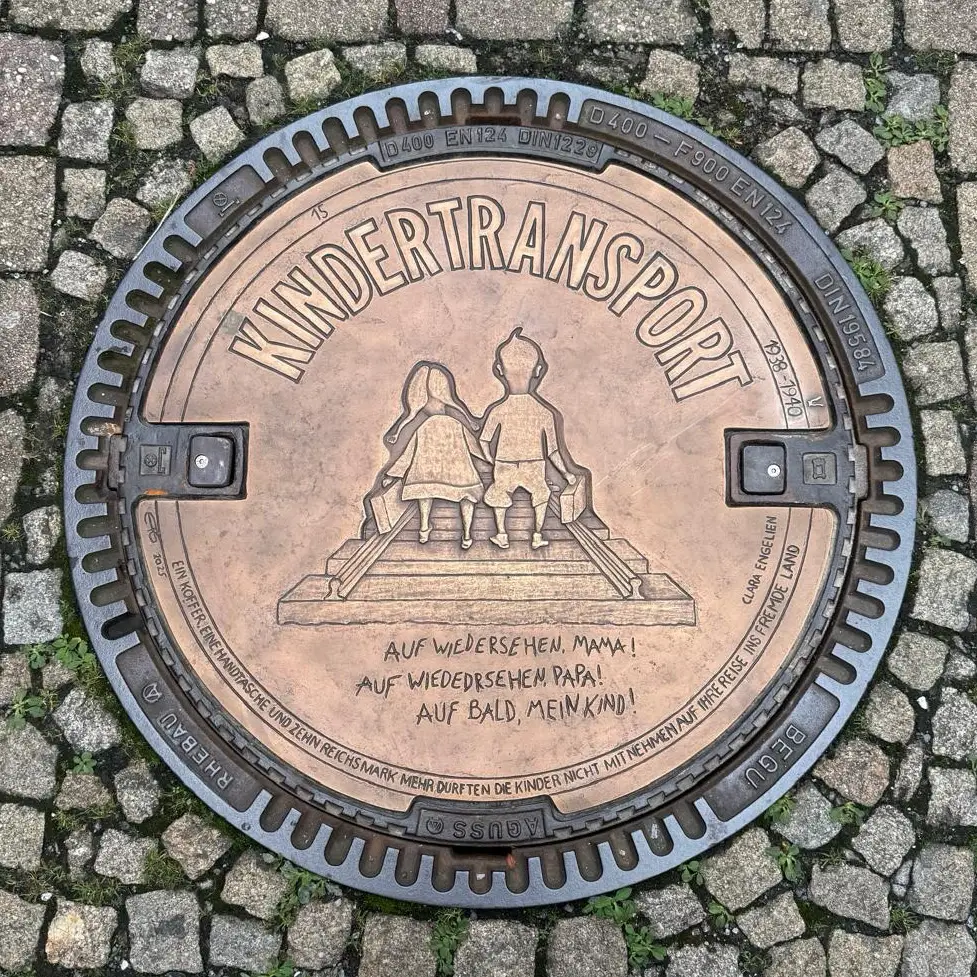
- Navigate to the location
Goodbye, Mom! Goodbye, Dad! See you soon, my child!
At the end of 1938, after the November pogroms, a dramatic journey begins for thousands of Jewish children: between December 1938 and September 1939, around 20,000 children and young people from Germany, Austria, parts of Czechoslovakia and Poland leave their homes – alone, without their families, often still full of hope for a quick reunion.
First and foremost, Great Britain is taking in around 10,000 children. The prerequisite for their entry is that private sponsors or aid organizations guarantee accommodation, care, and education. Other countries such as the Netherlands, Belgium, France, Sweden, Switzerland, and the USA are also opening their borders to these young refugees.
In Germany, Jewish welfare organizations in particular organize the transports – in Frankfurt under the leadership of Martha Wertheimer. From there, as from Berlin, Vienna or Prague, the children set off with a suitcase, a handbag and ten Reichsmarks – nothing more is allowed. Valuables are prohibited. Toys that could provide comfort are left behind.
Farewell to the unknown
The farewells at the train stations are marked by a painful silence. Parents try to maintain composure, knowing that this could be their last contact with their children. For many, the child transport was the only way to save at least their children’s lives – a desperate act of care.
After long train and ship journeys, the children reach a foreign country: a new language, unfamiliar rules, unknown people. Many are frightened and unsure, and have to quickly adapt – yet they live with the constant worry about their abandoned families.
Few ever see their parents again.
Traces of child transport
The Kindertransport has shaped generations: separation, loss, and the abrupt transition to adulthood are experiences that many of the rescued children could never forget – yet they often found their way. Many later became involved themselves in helping refugees or, as witnesses, told of their experiences so that this story would not be forgotten.
- Helga Krohn: Rescued from the Nazis. A relief effort for children in Frankfurt in 1939/40. Frankfurt am Main 1995.
- Helga Krohn, „Get them out before it’s too late!“ Relief efforts to rescue Jewish children between 1938 and 1940, in: Monica Kingreen (ed.), „After Kristallnacht“. Jewish Life and Anti-Jewish Politics in Frankfurt am Main 1938–1945. (Series of publications by the Fritz Bauer Institute, Volume 17). Frankfurt am Main 1999.
- Angelika Rieber/Till Lieberz-Gross (ed.): At least save the children. Child transports from Frankfurt am Main – Life paths of rescued children. Frankfurt 2018.
- Sylvia Asmus/Jessica Beebone (ed.): Children's emigration from Frankfurt am Main. Stories of rescue, loss, and memory. Göttingen 2021.
- The Jewish Museum in Berlin displays a collection of letters, postcards, and memorabilia related to the Kindertransport.
- „Child transport„Documentary film. Screenplay and direction: Mark Jonathan Harris. USA 2000.
- Heike Janssen, Benjamin Braden, Jonathan Miske: Witnesses of the child transports in 1938: „I have never gotten over it“ Spiegel story video, 14.11.2021. With Peggy Parnasse.
- In September 2021, the monument was unveiled in the Frankfurt train station district. „Orphans Carousel“ It was dedicated to the Israeli artist Yael Bartana. It recalls the children’s transports from 1938/39, shows the gap that the children left behind, and bears the farewell words „See you soon, child,“ „Goodbye, Mother,“ and „Goodbye, Father.“ The carousel, which is difficult to rotate, makes the parents’ difficult decision to have their children taken into an uncertain future palpable.
- The Junge Schauspiel Frankfurt presented the youth theater project on January 28, 2022. „See you“ The premiere features an ensemble that connects the stories of six children from the Frankfurt Kindertransport with today's experiences of unaccompanied minors.
- With the play „Child transport“ that brings Theatre in Frankfurt am Main in October 2023, a moving piece specially created for school classes.
Gabi Biesinger: 85 years of child transport to Great Britain – A rescue with its dark sides. SWR2 Wissen, 15.12.2023.
The story of Heinz Lichtwitz – representing thousands of rescued children
Heinz Lichtwitz was born in Berlin in 1932. After the death of his mother in 1937, he grew up with his father and grandmother. In late 1938, his father sent him on a children’s transport to England. On February 1, 1939, at the age of six, he boarded the train – it was the last time he saw his father. In Wales, he found a new home with Morris and Winnie Foner, took the name Henry Foner, and soon almost completely forgot his mother tongue. His father’s postcards were kept by his host mother in an album that Henry handed over to Yad Vashem in 2002.
© Yad Vashem
Berlin 03.02.39
Dear Heini.
I received the telegram from London and am glad that you have arrived safely at Aunt Winnie's. How was the trip? Many greetings from Omi, Nüppi, Uncle Lulu, Aunt Jordan and 1000 kisses from your dad.
Berlin, February 28, 1939
Dear little Heini.
I was very happy to receive your two letters and the pictures from the garden. I suppose you have already received your suitcase with your toys? Is everything arrived safely? How are Toddi and Joko? What does Tim say? How do you like the cards I always send you? I am very glad that you are learning English so quickly and that the teacher is happy with you.
Greetings to Uncle and Auntie.
Many greetings and kisses from
Dad
The postcards reflect the longing and love of a father who had to send his son away out of concern. Their cheerful motifs stand in stark contrast to the cruel reality. In November 1941, Max Lichtwitz wrote a farewell letter to a friend: „Please tell (Heinz) later that I only gave him up out of deep love and concern for his future; that I missed him on the other side the most on a daily basis and that my life has lost its meaning if there is no chance to see him again.“
Henry survived the war in England and later studied chemistry. In 1968 he emigrated to Israel. His father Max was killed on December 9, 1942, in Auschwitz deported and murdered a week later.
© Yad Vashem
Ardi Goldman Kunst-
und Kulturstiftung gGmbH
Uniongelände
Hanauer Landstraße 188, 60314 Frankfurt am Main