Prior Piäta, 1996
The Art Walk
Piäta, 1996
186 x 285 x 156 cm | 850 x 1400 x 28 cm
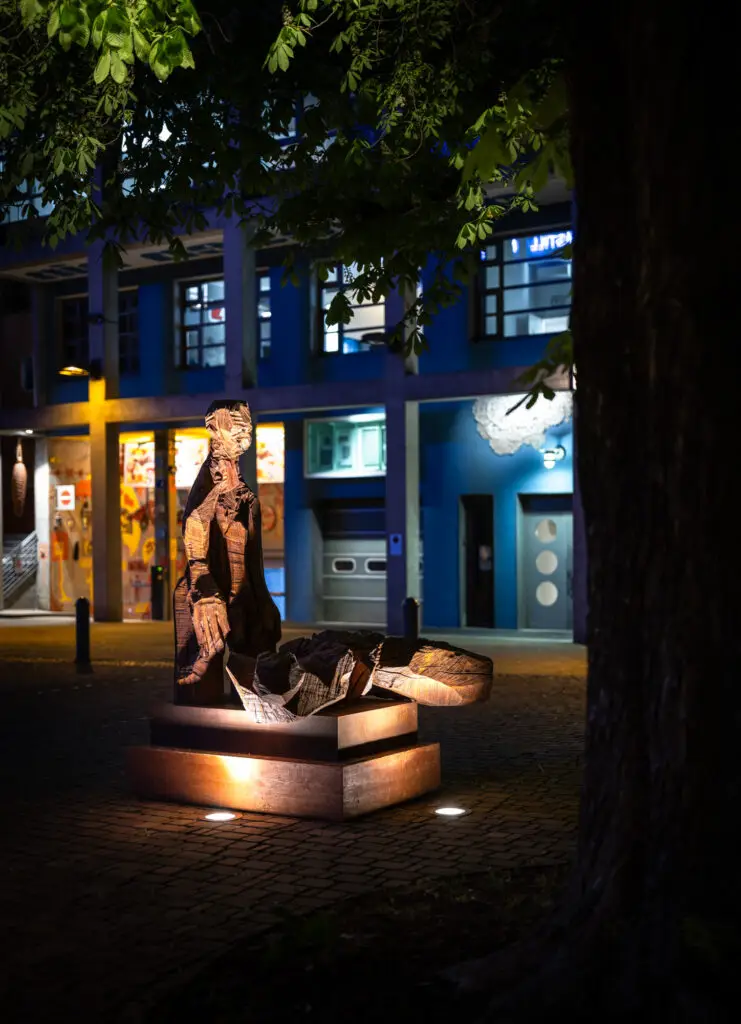
Every material is a challenge, whether it is a six-metre-tall tree trunk or a piece of paper.
EDUCATION
- Navigate to the location


A Closer Look at the Work
The Prior's art is open. However, the Prior has given the sculpture made of wood in 1995 a title: „Pietà“.
A few years later he made an iron cast of it.
The work does not show us the Jesus Mother bowing in penitence over the dead God-son; it also does not show us how, like Käthe Kollwitz, the grieving mother holds the fallen son in her lap. Prior has reversed the motif. A naked man stands „with his head bowed“ in front of a similarly naked woman, a mutilated body.
Prior spoke, as he rarely does, about the historical events that led him to create the work. We are writing in the 1990s. In Yugoslavia, in Rwanda, in Darfur, people are being slaughtered. Women are the preferred victims of sexualized violence.
Oriented by the title „Pietà“, we can assume that the man is not the perpetrator. He may be the grieving husband, the father, the brother who looks at the victim with hanging arms full of Gram. We therefore see the woman as the victim, the man as the grieving figure.
Prior’s ingenious reversal of motives is, of course, underlying. In front of the naked victim stands a naked man. He could be the family member torn apart by pain, but also the one who violates the woman who has become a victim because she has tarnished the family’s honor. Not infrequently, in reports about victims of rape, we read that the women have been excluded from the family. As victims of sexualized violence, they are said to have brought shame on the family. In the naked man, however, we can also see the perpetrator, who looks with cold indifference at his disgraced victim. As we always want to understand the work: the woman, not the Godly Son sacrificed for the good of humanity, not the soldier fallen for the benefit of the nation, is the victim. If Prior created this ensemble of characters in the light of the events of the time, then he is admonishing each and every one of us to self-awareness. Are we prepared, regardless of our national affiliation, to admit the crimes that may have been committed by those who are not our own? Are we willing to clear up and punish the atrocities, even if they were committed by our own countrymen? After 1945, when the Germans were confronted with the shameful realization that the murderers lived unmolested and probably suffered greatly under their rule, it is now evident worldwide that impunity and not justice and fairness still prevail. Many would have to go to The Hague, but unfortunately the road there is long and arduous.
About the Artist
Klaus Prior’s artistic work takes shape without preparatory sketches or models. Depending on their size, his sculptures and works on canvas and paper are often completed in a single, concentrated session. Spontaneity and condensation define the process. Through a form of psychic automatism, Prior gives visual expression to his state of mind at that moment. The works reflect raw, intuitive sensations and immediate emotional states.
Using spontaneously chosen colours, impulsive gestures and swiftly applied brushstrokes, the artist develops the silhouettes of his motifs out of an inner necessity. Crossing the boundaries of form, deliberately exaggerating heads, faces, limbs and gestures, and leaving the traces of the working process visible are central stylistic devices. They embody the expression of the moment and give the works their compelling presence.
As a sculptor, Prior works primarily with wood, one of the oldest artistic materials. His iron sculptures also originate in wooden works. He consistently avoids narrative contexts, attributes and representational references that might place his figures within particular stories. The figures stand on their own: existential, vulnerable and isolated.
Prior’s art is deeply shaped by his childhood and youth in post-war Germany, by his awareness of the human condition and its fragility, and by the lived realities of an industrial working-class culture shaped by many nationalities. His paintings and sculptures explore pain, injury and isolation as recurring conditions of human existence.
As a member of the generation born after the perpetrators, Prior rejected their repression of the past and refusal to acknowledge guilt. He avoided conscription in West Germany during the economic miracle by emigrating to Switzerland. From there, he followed the Auschwitz trial in Frankfurt am Main closely and, although he bore no personal guilt, engaged deeply with Germany’s crimes against humanity.
This historical awareness and his engagement with philosophy after Auschwitz underpin his thinking and creative work. Prior’s oeuvre expresses an existential struggle with memory, responsibility and the fragile dignity of human beings.
Photos: © Stefan Gröpper Photography / Daniel Woeller
Ardi Goldman Kunst-
und Kulturstiftung gGmbH
Uniongelände
Hanauer Landstraße 188, 60314 Frankfurt am Main