Kraus, a miracle
The Art of unionität
Hannelore Kraus
Ein Wunder
For those who don't let themselves be distracted.
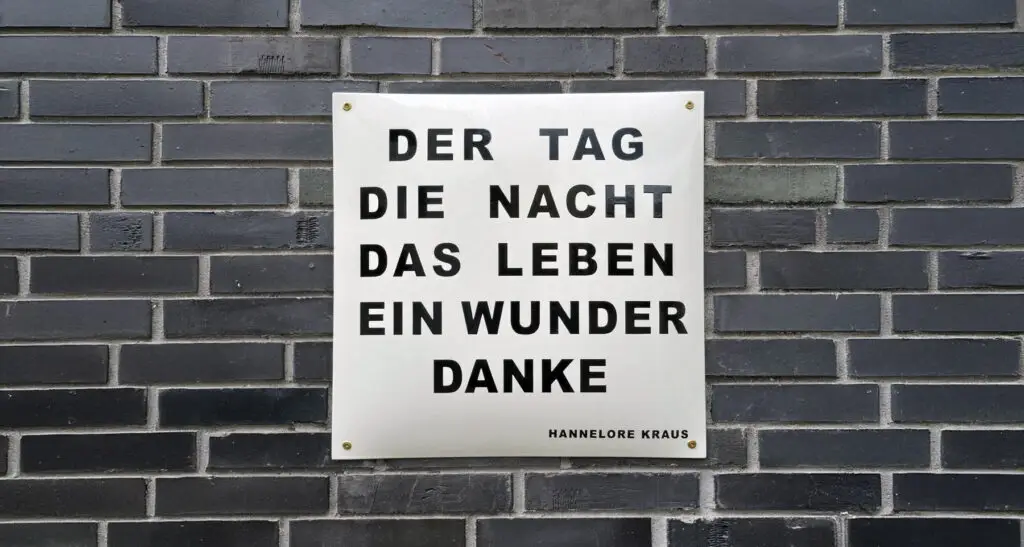
„The day. The night. Life. A miracle. Thank you."
Simple words on an enamel plate. No explanation. Just a look at the whole thing: the day, the night, life – as a miracle. And a thank you.
They come from Hannelore Kraus, a political scientist, host, and resistance activist. For over four decades, she ran a small guesthouse in the Frankfurt train station district. A house with ten rooms – and an open mind. Artists, publishers, intellectuals, nomads, free spirits – anyone who knocked on her door was welcome, as long as they came with respect. The Pension Aller was more than just a place to stay. It was a stage, a safe space, a place to think. A world in miniature where great conversations could unfold.
At the end of the 1980s, she became a symbol: When the tallest office tower in Europe was to be built right next to her retirement home – the so-called Campanile –, she resisted it. Not because she feared for her home. But for the neighborhood. For the social structures, the neighborhood, the diversity. She recognized early on what would later be called gentrification: that architecture shapes society. And that luxury apartments, yield-generating projects, and urbanistic symbols not only bring concrete but also displacement.
She said no – in court, against money, against pressure. Not out of principle, but out of responsibility. For a place that was more than just a property.
They come from Hannelore Kraus, a political scientist, host, and resistance activist. For over four decades, she ran a small guesthouse in the Frankfurt train station district. A house with ten rooms – and an open mind. Artists, publishers, intellectuals, nomads, free spirits – anyone who knocked on her door was welcome, as long as they came with respect. The Pension Aller was more than just a place to stay. It was a stage, a safe space, a place to think. A world in miniature where great conversations could unfold.
At the end of the 1980s, she became a symbol: When the tallest office tower in Europe was to be built right next to her retirement home – the so-called Campanile –, she resisted it. Not because she feared for her home. But for the neighborhood. For the social structures, the neighborhood, the diversity. She recognized early on what would later be called gentrification: that architecture shapes society. And that luxury apartments, yield-generating projects, and urbanistic symbols not only bring concrete but also displacement.
She said no – in court, against money, against pressure. Not out of principle, but out of responsibility. For a place that was more than just a property.
A Closer Look at the Work
Today, their words hang on the wall Union-Gelände. It’s about the city again – but in a different way. It’s about an idea of the city that not only allows for diversity but also protects it. It doesn’t exclude but creates spaces. For art. For community. For a different form of living together. Seen in this way, Hannelore Kraus a silent ally: it has fought for a Frankfurt that not only shines but also breathes.
Her words remain – quiet, clear, unbluessing: The day. The night. Life. A miracle.
Photos: © Stefan Gröpper
Ardi Goldman Kunst-
und Kulturstiftung gGmbH
Uniongelände
Hanauer Landstraße 188, 60314 Frankfurt am Main