Baumann Crown of Horns, 2024
The Art Walk
Crown of Horns, 2024
I have always been looking for something I can’t do. I want to surprise myself and let the material guide me. That’s why I’ve been experimenting with new materials every five to seven years: from plywood to plaster to concrete, ceramics, porcelain and plastic.
EDUCATION
Grants, awards, recognition
2024 1st Prize Art in Construction Competition Family Center / Kindergarten, Bingen
- Navigate to the location
A Closer Look at the Work
Anselm Baumann – CROWN OF HORNS
The artist Anselm Baumann acts like a researcher. His working method is an intensive experimentation with colors, materials, and production techniques, with his works often emerging in an ongoing development process lasting months and always revolving around a central theme: space. Space understood as architectural, as a color and idea space that unfolds between construction and representation. Essential to this process is the unpredictability, which is accepted as a disruption and consciously integrated into the work process as a creative potential. This openness allows the work to evolve beyond its original intentions. As a trained sculptor, Baumann came into contact with a wide variety of materials and processing techniques early on. Since then, he has consistently expanded his range, which is particularly evident in his plaster reliefs. Abstract collages within architectural elements, where scale and purpose are deliberately kept in balance. Models for buildings or just facades, final works or intermediate stages of a larger idea are, in their intended ambiguity, part of the artistic concept that, through the model-like imperfection, activates the imagination of the viewers and leaves room for the question: What would a building of this type look like, where would it be located, how would it function?
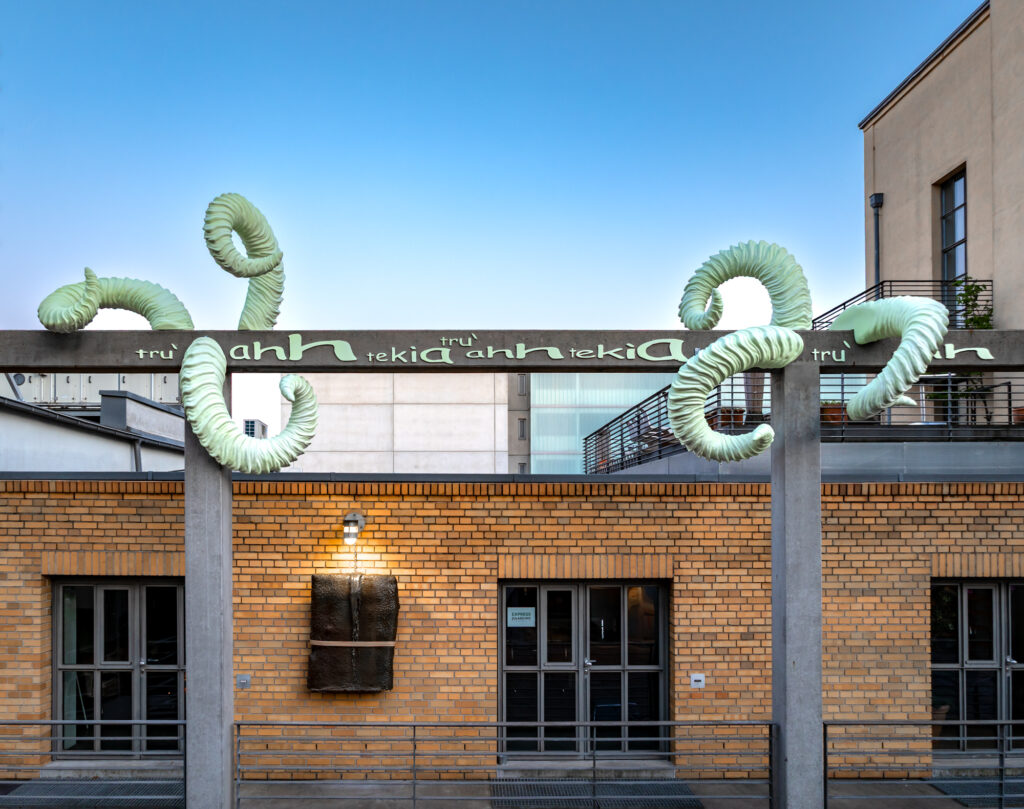
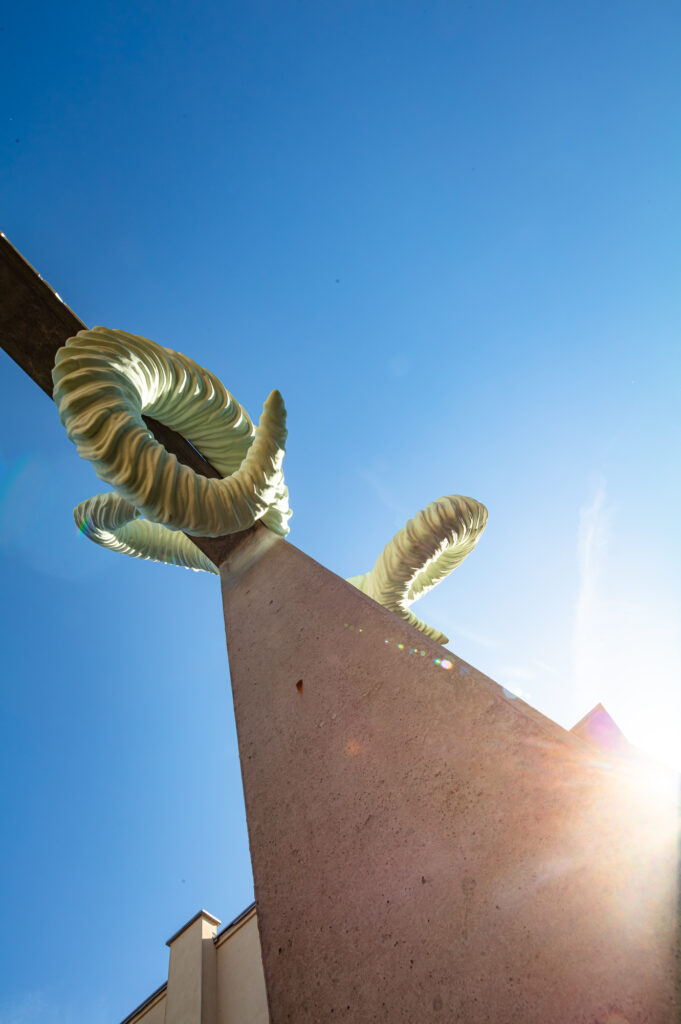
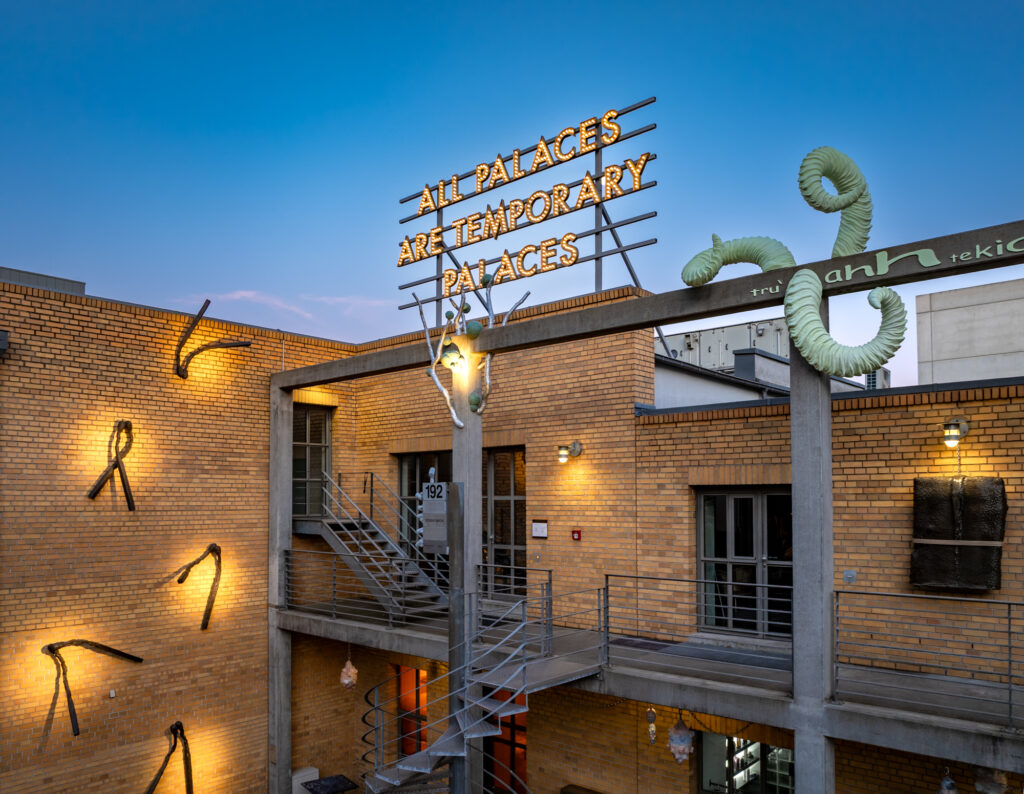
In the Union area, this mindset manifests itself in two nest-like plastic forms. Like stylized capitals, they evoke tree crowns and serve as sculptural elements at the intersections of the post-barracks structure. With their powerful presence, they draw the eye upward, while at the same time they bypass the rational pragmatism of the structural structure and, through their organoid form language, enter into a dialogue with the constructive clarity. Thus begins a game in which plastic elements and collaged surface structures constantly unleash new perceptions and, through movement along the spiral staircase, turn the viewers themselves into actors who, through their perspective, create changes by repeatedly experiencing the nest-like tree crown configuration. They arise from the interaction with natural nest forms and comparable organic structures, with the aluminum-cast branches, with their filigree elegance, representing a continuation and enhancement of the respective spiral staircases and entering into a dialogue with the roofs. In this narrative weave, which weaves architecture, sculpture, and symbolism together, the two tree sculptures, together with the stylized ram horns, refer to the biblical narrative of the sacrifice of Isaac.
An accompanying inscription visualizes the tradition of blowing the shofar, that archaic horn that has deep spiritual significance in Judaism. On Rosh Hashanah, the Jewish New Year, the shofar is traditionally blown to evoke an inner call to repentance. This call stands for renewal, freedom, and redemption. Its notes – Tekia, Tru’ah, and Schewarim – form a symbolic sound architecture that oscillates between permanence, dissolution, and interruption, with the Schewarim, interpreted in the Jewish context as „fragments,“ standing for the state of being shaken and at the same time of renewal, thus serving as a metaphorical bridge between being broken and the beginning of something new. The lettering that incorporates this sound symbolism plays with the idea of sound painting; size, color, and the possible execution as cut-outs are part of the design concept that opens up a dialogue between sculpture, text, sound, and spiritual meaning, and ultimately also raises the question of the effectiveness of art in space: as disruption, as resistance, as a catalyst for change.
About the Artist
The artist and sculptor Anselm Baumann (*1958 in Freiburg im Breisgau) has lived in Frankfurt am Main since 1989 and has been a lecturer in „New Possibilities“ at the HfG (School of Design) in Offenbach since 2006. He runs a highly professional-equipped studio that specializes in various techniques, and has collaborated with renowned artists such as Tobias Rehberger, Anne Imhof, Michael Sailstorfer, Michael Beutler, among others, and produced works by them. He has won numerous competitions and has distinguished himself with art-in-architecture and public space projects.
Photos: © Stefan Gröpper Photography
Ardi Goldman Kunst-
und Kulturstiftung gGmbH
Uniongelände
Hanauer Landstraße 188, 60314 Frankfurt am Main