Armann Hugo
Hopefuls
–
PORTRAIT
- Navigate to the location
If many had done a little, much could have been achieved.
–
·
„…Everyone had seen that their Jewish neighbors had to wear the yellow star and were driven to the train stations. Everyone knew that the Jews were not being transported to paradise.“
Hugo Armann
Hugo Armann He grew up in a traditionally Protestant family in the small Thuringian village of Rauenstein. Before the war, he studied to become a teacher and later became headmaster of a primary school.
In the spring of 1942, Armann was transferred to Baranowicze (now Baranowitschi in Belarus) as a Hauptfeldwebel. There, he led a unit that organized the return of front soldiers on home leave. In this capacity, he had access to important resources: coveted „seat badges“ for trains to Germany, contacts with military and police authorities – and insight into the Jewish workshops under the control of the Security Service (SD).
Armann did not use his position for power or privileges, but to protect persecuted people. He specifically employed Jewish workers and thus provided them with temporary security. One of them was the 19-year-old Sarah Czazkes-Manishevitz, who worked in his household. When Armann learned of an impending deportation on September 20, 1942, he did not let Sarah return to the ghetto. Instead, he hid her in his house for a week.
After the final liquidation of the ghetto on December 17, 1942, Armann knew that he could no longer protect his Jewish workers. But instead of leaving them to their fate, he provided them with weapons and ammunition – and helped them escape to the partisans in the forests.
Two of the survivors, Sarah Czazkes-Manishevitz and her brother-in-law, Dr. A. Sternfeld, remained Hugo Armann in contact even after the war.
On September 5, Hugo Armann 1985, Yad Vashem honored him as a „Righteous Among the Nations.“.
© Yad Vashem
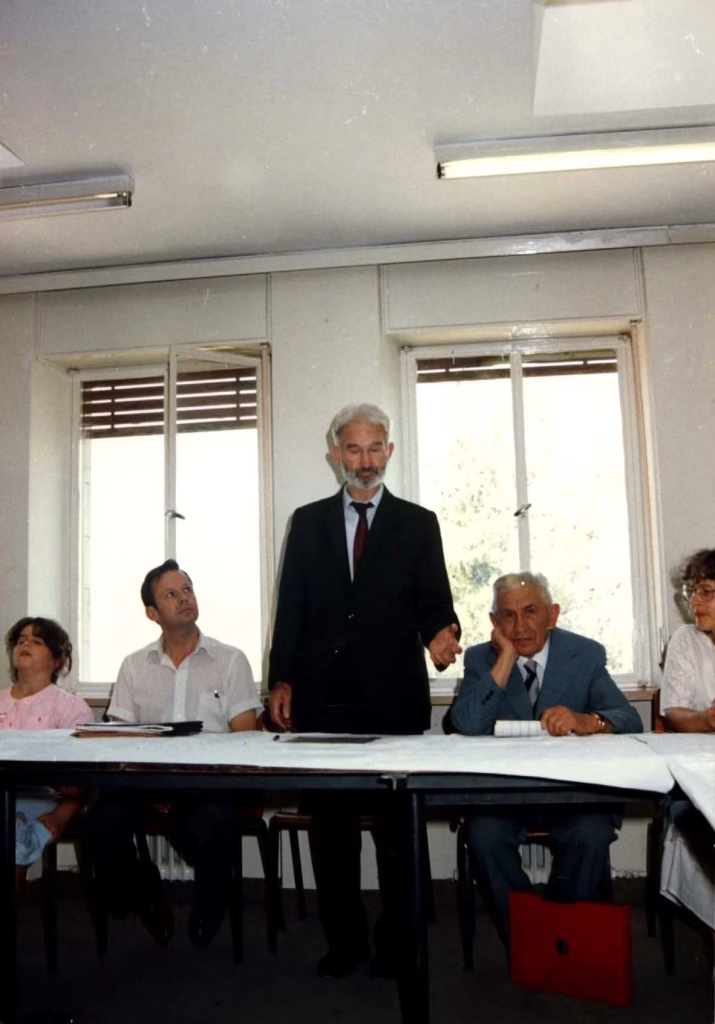
On September 5, 1985 Hugo Armann, Yad Vashem recognized him as a „Righteous Among the Nations.“ The then nearly 70-year-old planted his tree at Yad Vashem himself and met many of his friends from that time.
Wolfram Wette, Detlef Bald (Ed.): Olaf Meuther: The rescue operations of the Feldwebel Hugo Armann. In: Zivilcourage. Embittered, helpers and rescuers from the Wehrmacht, police and SS. Frankfurt am Main 2003, pp. 114–127.
„…Everyone had seen that their Jewish neighbors had to wear the yellow star and were driven to the train stations. Everyone knew that the Jews were not being transported to paradise.“

Ardi Goldman Kunst-
und Kulturstiftung gGmbH
Uniongelände
Hanauer Landstraße 188, 60314 Frankfurt am Main