The Burned Poets
Hopefuls
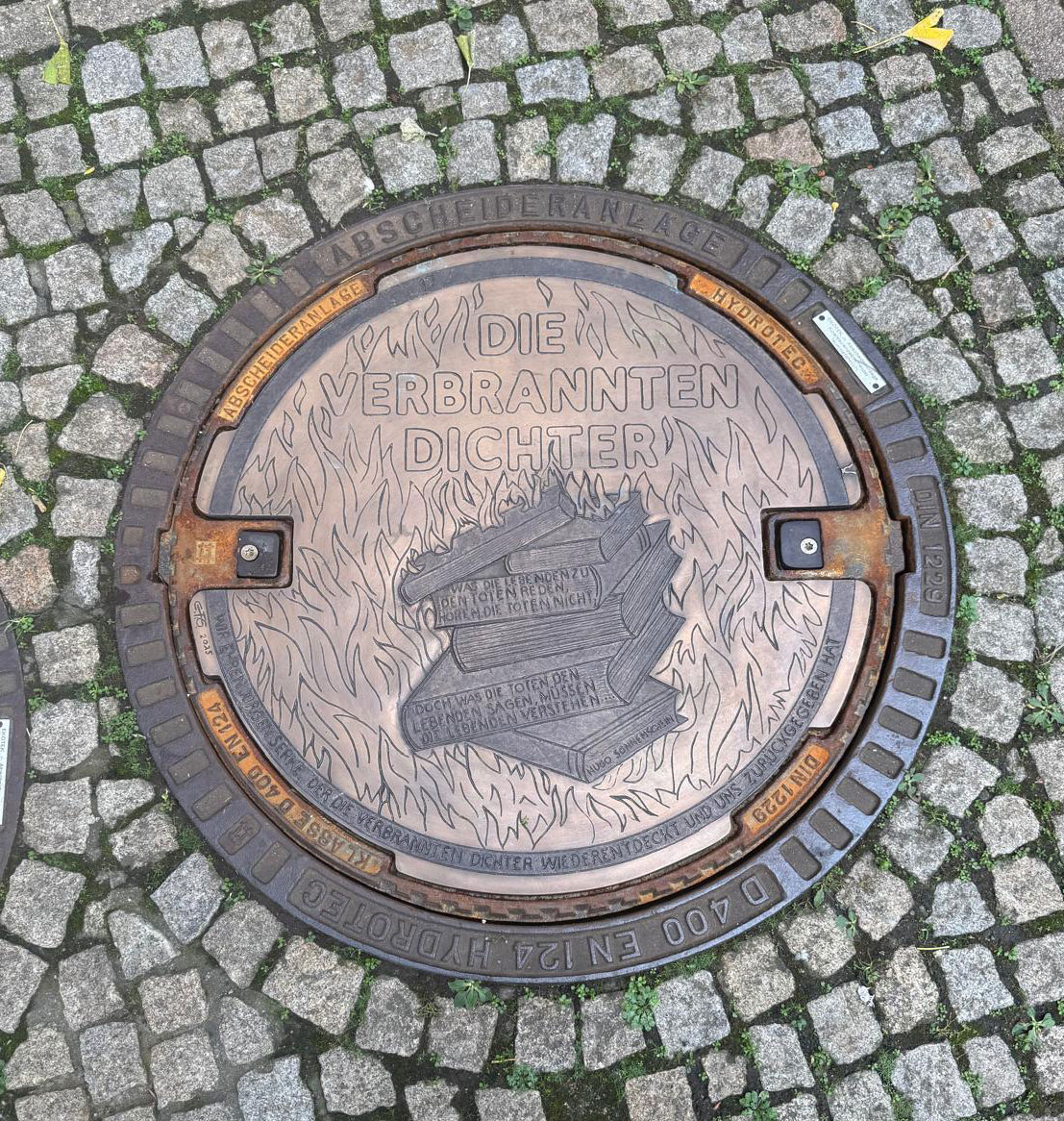
Ground relief
- Navigate to the location
What the living say about the dead, the dead do not hear. But what the dead say to the living, the living must understand.
People:
Writer Erich Mühsam
It has become dark everywhere in Europe. That is why it is all the more important to point out the resistance of such people who have risked much in their lives and even everything when one wants to enforce humanity in a society.
On the occasion of the reissue of his book Die verbrannten Dichter (The Burned-Up Poets), Jürgen Serke was asked why he thinks it is important to constantly remember the extermination of writers?
That Hugo Sonnenschein, the poet called Sonka, whose quote adorns the bronze plaque – an anarchist who survived Auschwitz and died in a Czech prison in 1953 – was rediscovered, we owe to the journalist Jürgen Serke.
May 10, 1933 was the culmination of the „against the undemocratic spirit“ campaign. In 19 German university cities, the ashes of the martyrs were burned. From public and private libraries, the books of Jewish and oppositionist authors were confiscated and publicly burned under the glare of torches and flames. It was students, professors, men in uniform, and ordinary citizens who threw them into the fire. They burned the books, but they meant the people. „Holocaust of Books,“ called it the American magazine „Newsweek.“.
Everyone knows Kurt Tucholsky, Heinrich Mann, his nephew Klaus, Franz Kafka, Bertolt Brecht, Anna Seghers, to name just a few, whose books were burned. Perhaps everyone also Erich Kästnerknows his story, how he witnessed his novel Fabian being burned in Berlin in the Opera Square. But what about Armin T. Wegner, the poet who defied Hitler? The writer Claire Goll, the lyricist Albert Ehrenstein or Else Lasker-Schüler? Who knew them anymore, who still read their works?
Did Hitler manage to exterminate an entire generation of poets? No!
In the autumn of 1976, Jürgen Serkes series „The Burned Poets“ appeared in the magazine Stern. Portraits of poets and writers whose works were burned by the National Socialists in 1933 and who were themselves persecuted, expelled, or murdered. Serke had researched their stories, tracked them down if they were still alive, and interviewed them; Wilfried Bauer had photographed them. It was a „journey of discovery into German history,“ as Serke called it. The response from the readers, their concern about what had been taken from them in literature, was enormous. A year later, the series was expanded to include 20 more portraits and published as a book. It was supposed to have consequences: the works of Franz Jung and Walter Mehring were reissued. Also, Irmgard Keun, who had become one of us overnight and became a shooting star of the Weimar Republic and who the Nazis had sued and turned their backs on Germany, was rediscovered. Although she could no longer link her achievements before the war, her books were reprinted and she was honored.
Ardi Goldman He was present when, on May 9, 2023, 90 years after the book burnings of 1933 and shortly after Jürgen Serke’s 85th birthday, The Burned Poets were presented in the German National Library in the new edition of the Wallstein Verlag. He had a request: he Ardi Goldman wanted Jürgen Serke, whose reports about The Burned Poets had deeply touched him, to win the Topography of Hope.
What could have all come to be, but life had a different plan. Shortly before his 86th birthday, Jürgen Serke „rushed into the sky on a cloud“.
What remains? His signature: „Jürgen Serke for – Ardi Goldman Frankfurt – May 9, 2023”
A wistful charm and the need to say thank you.
WE HONOR JÜRGEN SERKE, WHO DEEPLY RE-DISCOVERED THE LOST AND GAVE IT BACK TO US.
Jürgen Serkes’s collection of books, paintings and documents was taken over by the Else-Lasker-Schüler Foundation in 2008. It is part of the „Citizens“ Foundation for Persecuted Arts – Else Lasker-Schüler Center – Art Collection Gerhard Schneider”.
Jürgen Serkes The Burned Poets: Life Stories and Documents appeared on April 25, 2023 in the Göttinger Wallstein Verlag.
It has become dark everywhere in Europe. That is why it is all the more important to point out the resistance of such people who have risked much in their lives and even everything when one wants to enforce humanity in a society.
Ardi Goldman Kunst-
und Kulturstiftung gGmbH
Uniongelände
Hanauer Landstraße 188, 60314 Frankfurt am Main