Ringelblum Archive
Hopefuls
Ground relief
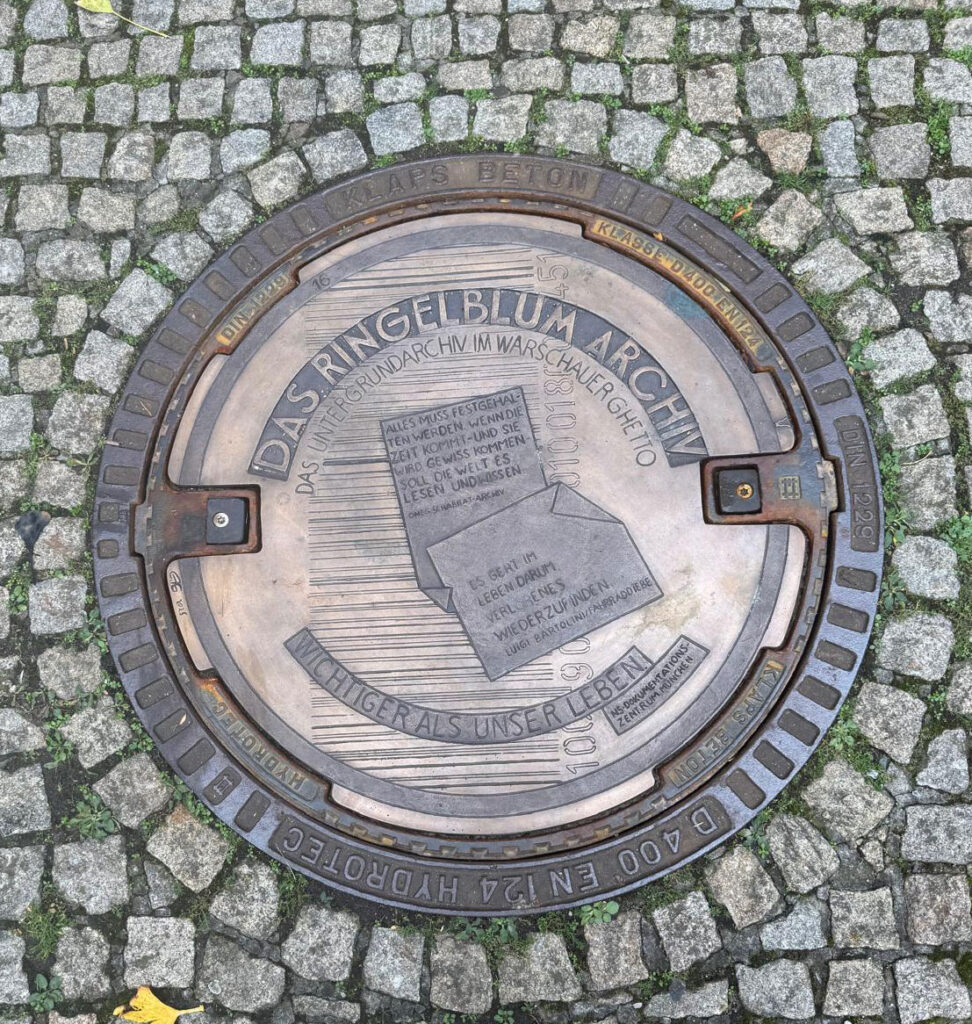
- Navigate to the location
The underground archive in the Warsaw Ghetto
People:
Historian Dr. Emanuel Ringelblum
„We have to hurry because we don’t know how much time we have left. … We weren’t afraid to take a risk. We were aware that we were making history. And that was more important than our lives.“
David Graber, 19 years old
Until 1939, Warsaw was one of the most important cultural, religious, and political centers of European Jewry. With the German occupation, everything changed. In 1940, part of the city was turned into a ghetto, where the Jewish population was forced to live under catastrophic conditions. Overcrowded streets, hunger, and disease characterized everyday life; despair spread. Emanuel Ringelblum In the midst of this chaos, the historian founded a secret archive in November 1940. Under his leadership, a group of about 60 people began collecting testimonies of suffering, resilience, and resistance in the Warsaw ghetto. Their code name was Oneg Shabbat – „Joy in the Sabbath“. But their meetings on Saturdays were not meant for celebration, but for documenting the ghetto. Their activities are still considered exemplary for civil resistance against the German occupation in Poland.
The group included educators, students, writers, intellectuals, a rabbi, and politically and socially engaged men and women. They collected everything that reflected life in the ghetto: posters, newspaper reports, documents, statistics, food rations, etc. But personal testimonies also found their place – diaries, school essays, poems, family photos, letters, and postcards. Alongside the horrors, they also documented the daily life of theater performances, corruption, and the collaboration of individuals with the German occupiers.
If the group’s work had been discovered, it would have meant its immediate death. But they continued, and the archive grew into a chronicle of the Warsaw Ghetto and occupied Poland. From 1942 onwards, they also documented the systematic extermination of the Jewish population and smuggled reports of the mass murders to the Polish exile government in London – a desperate attempt to move the world to action. On July 22, 1942, deportations also began in the Warsaw Ghetto. Within two months, around 280,000 men, women, and children were transported to Treblinka and murdered there. It was high time to save the archive. The members of „Oneg Schabbat“ hid their previous records in metal boxes and milk cans, buried them in various places in the Ghetto – in the hope that someone would find them one day.
In 1946, miraculously, parts of the archive were discovered under the ruins of the destroyed ghetto. Almost 30,000 pages survived the destruction. With the „Oneg Schabbat“ archive Emanuel Ringelblum, their co-organizers left a unique and invaluable testimony about life and resistance in the Warsaw Ghetto. The collection not only preserves the memory of the Jewish community, but also shows that the people in the ghetto were not only victims – they resisted, documented their fate, supported each other, and despite inhumane conditions, maintained their culture and identity. The voices of the ghetto residents have not been silenced. They continue to resonate, preserved in the Ringelblum Archive.
Sources: Yad Vashem, online.
Sonja Ernst: The Ringelblum Archive. Federal Central Agency for Political Education, 08.05.2013, online.
- Samuel D. Kassow, Karl Heinz Siber: Ringelblum’s legacy: The secret archive of the Warsaw Ghetto. Hamburg 2010.
- Georges Didi Hubermann: Ruined: A journey into the Ringelblum Archive of the Warsaw Ghetto.
Constance 2022. - Ulla-Britta Vollhardt, Mirjam Zadoff (ed.): More Important Than Our Lives. The Underground Archive of the Warsaw Ghetto. Göttingen 2023. The volume was published to coincide with the eponymous exhibition at the NS Documentation Center Munich, in cooperation with the Jewish Historical Institute in Warsaw.
- Secret matter: Ghetto film. Directed by Yael Hersonski, 2013. Federal Central Agency for Political Education – Mediathek. German version 2015.
- The secret archive in the Warsaw Ghetto. (. Original title: Who Will Write Our History, USA/Poland/Germany 2019). Directed by Roberta Grossman. The film tells the story of the Ringelblum Archive in the Warsaw Ghetto and is available for streaming on YouTube.
From the Ringelblum Archive
Poem
„Phone“
about the last working phone in his house:
With a broken and sick heart, I think: Let me call someone on the other end… and suddenly it dawns on me: Oh my God, there’s actually no one I could call…
The management is free to decide – but where should I call? To Brussels? To Paris? To Vienna? To Prague? Maybe to Lemberg? Or Warsaw? No – that’s the Warsaw Ghetto…
The numbers have been erased, gone missing; empty windows; destroyed cities; streets filled with weeping people – and no voices at the other end anymore.
Only the humming remains, that faint sound, an echo from the past, and the hope that someone will remember when no one else is there to call upon…
Wladyslaw Szlengel
Letter
Hunger was omnipresent in the ghetto and a central theme in the documents. Leyb Goldin wrote about it:
„It’s about you and your stomach. It’s about your stomach and you. It’s 90 percent about your stomach and a little bit about you… Every day, the profiles of our children and our women are filled with the sorrowful expressions of foxes, dingoes, kangaroos. Our crying is like the screams of chameleons… The world is upside down. A planet is melting in tears. And I – I am hungry, hungry. I am hungry.“
Leyb Goldin, August 1941.
Legacy
„I am not asking for thanks, for a memorial, or for praise. I only want people to remember me so that my brother and sister on the other side of the sea will someday know where my mortal remains are kept.
I want people to remember my wife, Gela Seksztajn, the painter (…).
I want people to remember my little daughter. Margolis is 20 months old today. She speaks flawless Yiddish.“
Source: Israel Lichtenstein, Mein Vermächtnis, Warsaw, July 31, 1942. More important than our lives.
The underground archive of the Warsaw Ghetto. p. 124, 128.
Diary entry
David Graber, a 19-year-old student and member of the underground archive, buried the first part of the archive materials with his teacher Israel Lichtensztejn in a cellar of the ghetto on August 3, 1942. Under the entry „My Last Will and Testament,“ he wrote in his diary on August 3, 1942:
„What we couldn’t shout out into the world and scream out have we buried in the ground. … „I would very much like to experience the moment when the great treasure is unearthed and the truth screams into the world’s face. May this treasure fall into good hands, may it survive into better times, may it alarm the world and draw attention to what happened in the 20th century.“
David Graber could no longer experience that moment.
„We have to hurry because we don’t know how much time we have left. … We weren’t afraid to take a risk. We were aware that we were making history. And that was more important than our lives.“
Ardi Goldman Kunst-
und Kulturstiftung gGmbH
Uniongelände
Hanauer Landstraße 188, 60314 Frankfurt am Main