Ringelblum Emanuel
Hopefuls
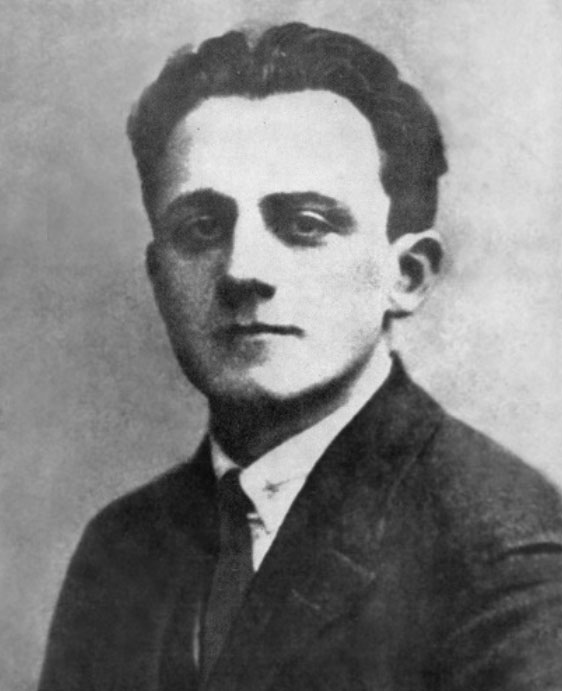
PORTRAIT
- Navigate to the location
Everything must be recorded. When the time comes – and it will surely come – the world should read and know it.
„He was a silent, tireless organizer, a cool historian, a passionate archivist, an amazingly disciplined and goal-oriented man.“
Marcel Reich-Ranicki who worked in the archive about Ringelblum
Emanuel Ringelblum He was born in 1900 in Buczacz, a Polish town that is now part of Ukraine. In the 1920s he studied in Warsaw and received his doctorate in history in 1927. After that, he worked as a high school teacher and conducted research at the Jewish Scientific Institute in Vilnius.
With the German invasion of Poland in September 1939, everything changed. In 1940, all the Jewish residents of Warsaw, including Emanuel Ringelblum his wife Judyta and their little son Uri, were forced into the ghetto. From one day to the next, their daily lives became a battle for survival. Ringelblum opened soup kitchens and founded house committees to curb hunger and disease. Together with a friend, he founded the Society for the Promotion of Jewish Culture – an attempt to preserve a piece of identity and dignity for people amidst distress and misery. But the situation continued to worsen. Running water, electricity, medical care, and above all food became increasingly scarce. Every day, people were dying, and there was no way to bury them.
Ringelblum began to document everything. He knew that what happened here could not be lost. Secretly, he founded the archive Oneg Shabbat – „Sabbat joy.“ A desperate attempt to leave a record. The members of his group met on the Sabbath, wrote down what they saw, heard, experienced. All this under the greatest danger to their lives. The records were hidden and buried in milk jugs and tin containers – a last resort to preserve the truth.
In March 1943, Ringelblum and his family fled the ghetto. A year later, they were betrayed. All 38 people who had taken refuge there, including their Polish helpers, were shot. But his legacy remained. After the war, large parts of the Oneg Shabbat–Archive preserved – one of the most important sources on life in the Warsaw Ghetto and the destruction of Polish Jewry. Today it is kept in the Jewish Historical Institute in Warsaw, which bears its name.
Emanuel Ringelblum He did not witness the end of the war. But through his work, the voices of those who survived remain audible to this day. The world has learned what happened. The history and the people of the Warsaw Ghetto have not disappeared without a trace – they continue to live on in every document of the Ringelblum Archive and remain unforgettable.
- Samuel D. Kassow, Karl Heinz Siber: The legacy of Ringelblum: The secret archive of the Warsaw Ghetto.
Hamburg, 2010. - Georges Didi Hubermann: Ruined: A journey into the Ringelblum Archive of the Warsaw Ghetto.
Konstanz, 2022. - Ulla-Britta Vollhardt, Mirjam Zadoff (ed.): More Important Than Our Lives. The Underground Archive of the Warsaw Ghetto. Göttingen 2023. The volume was published to coincide with the exhibition of the same name, at the NS Documentation Center Munich, in cooperation with the Jewish Historical Institute in Warsaw.
The secret archive in the Warsaw Ghetto.
(Original title: Who Will Write Our History, USA/Poland/Germany 2019).
Directed by Roberta Grossman. The film tells the story of the Ringelblum Archive in the Warsaw Ghetto and is available for streaming on YouTube.
Emanuel Ringelblum, Letter, March 1944
„Dear ones,
Is it now finally settled that the collection will be preserved? I would like to notify Rafael [Mahler] about the address of our collection. If none of us survives the war, we must now name Rafael and Aunt YIVO as the heirs. Then at least what remains of us will be preserved.
Perhaps that sounds sad, and it is unpleasant to harbor such gloomy thoughts. But what can one do; it is better to plan ahead than for everything to be lost without a trace…“
Emanuel Ringelblum Letter from the hiding place, March 1944 – his legacy for the archive. Source: Emanuel Ringelblum, Last request, in: Yad Vashem Studies, Vol. XXXI (Jerusalem 2003), pp. 7–14. Available online: YAD VASHEM PDF.
„He was a silent, tireless organizer, a cool historian, a passionate archivist, an amazingly disciplined and goal-oriented man.“
Ardi Goldman Kunst-
und Kulturstiftung gGmbH
Uniongelände
Hanauer Landstraße 188, 60314 Frankfurt am Main